Looking for classes? Ksquare Career Institute, Bengaluru →

Biology
Human Reproduction
116 questions, each with its answer.
-
Match List I with List II related to embryonic development at various months of pregnancy:
Pick the matching item from Column II for each row.
Column I
- i. The foetus movement starts and hair appears on the head
- ii. The foetus develops limbs and digits
- iii. The foetus develops external genital organs
- iv. The foetus body is covered with fine hair
Column II
- a. 24 weeks of pregnancy
- b. 20 weeks of pregnancy
- c. 8 weeks of pregnancy
- d. 12 weeks of pregnancy
Correct answer: i → b, ii → c, iii → d, iv → a
-
Spermatogonia undergo a series of cell divisions to produce sperms. Select the correct statements from the following: I. Spermatogonia always undergo meiotic cell division. II. Primary spermatocytes divide mitotically to produce secondary spermatocytes. III. Secondary spermatocytes, through their second meiotic division, produce haploid spermatids. IV. Spermatids produce spermatozoa through mitosis. V. Spermatids transform into spermatozoa by spermiogenesis. Choose the CORRECT answer from the options given below:
-
Arrange the following cell layers/structures around the female gamete, from outer to inner side: I. Zona pellucida II. Perivitelline space III. Corona radiata IV. Plasma membrane of ovum Choose the CORRECT answer from the options given below:
-
Which of the following structure is not a part of the male reproductive system?Reference: NCERT Class XII, page 29.
-
Given below are two statements: Statement I: Ovulation is caused by LH surge leading to rupture of Graafian follicles. Statement II: Graafian follicle remaining after ovulation transform into corpus luteum and secretes large amount of estrogen. In the light of the above statements, choose the most appropriate answer from the options given below:Reference: NCERT Class XII, page 35.
-
Which of the following hormone is not secreted by human placenta?Reference: NCERT Class XII, page 37.
-
The covering of ovum at ovulation is _________.Reference: NCERT Class XII, page 33.
-
Match List-I with List-II.
Pick the matching item from Column II for each row.
Column I
- A. Head
- B. Middle piece
- C. Acrosome
- D. Tail
Column II
- I. Enzymes
- II. Sperm motility
- III. Energy
- IV. Genetic material
Correct answer: A → IV, B → III, C → I, D → II
A-IV, B-III, C-I, D-II.
The sperm head houses the haploid genetic nucleus (IV). The middle piece contains mitochondria producing ATP energy (III). The acrosome contains hydrolytic enzymes for fertilization (I). The tail provides flagellar motility (II). -
Find the correct statements:
A. In human pregnancy, the major organ systems are formed at the end of 12 weeks.
B. In human pregnancy the major organ systems are formed at the end of 8 weeks.
C. In human pregnancy heart is formed after one month of gestation.
D. In human pregnancy, limbs and digits develop by the end of second month.
E. In human pregnancy the appearance of hair usually observed in the fifth month.
Choose the correct answer from the options given below:Statements A, C, D, and E are correct embryological milestones from NCERT.
During human gestation: Heart is formed after 1 month (C); limbs and digits develop by end of 2nd month (D); major organ systems and external genitalia are formed by end of 12 weeks/first trimester (A); first movements and hair on head appear during the 5th month (E). Thus, A, C, D, and E are correct. -
Consider the following:
A. The reductive division for the human female gametogenesis starts earlier than that of the male gametogenesis.
B. The gap between the first meiotic division and the second meiotic division is much shorter for males compared to females.
C. The first polar body is associated with the formation of the primary oocyte.
D. Luteinizing Hormone (LH) surge leads to disintegration of the endometrium and onset of menstrual bleeding.
Choose the correct answer from the options given below:A and B are true: female meiosis starts in fetal life; gap between meiosis I and II spans years in females vs hours/days in males.
Oogenesis initiates embryonic life before birth, whereas spermatogenesis starts only at puberty (A is true). In females, meiosis I arrests in prophase I until ovulation decades later, so the interphase gap between meiosis I and II is dramatically prolonged compared to males (B is true). First polar body forms during secondary oocyte formation, and LH surge triggers ovulation, not endometrial breakdown. -
The first menstruation is called:
The onset of menstruation at puberty in human females is menarche.
The initiation of the first menstrual cycle at puberty in human females is termed menarche. Permanent cessation around age 50 is known as menopause. -
Twins are born to a family that lives next door to you. The twins are a boy and a girl. Which of the following must be true?
Opposite-sex twins must arise from two separate ova and sperm, making them fraternal (dizygotic) twins.
Monozygotic (identical) twins develop from a single zygote and must have the same sex and karyotype (both male or both female). A boy and a girl twin set must arise from two distinct fertilizations (dizygotic/fraternal twins). -
Given below are two statements: Statement I: The presence or absence of hymen is not a reliable indicator of virginity. Statement II: The hymen is torn during the first coitus only. In the light of the above statements, choose the correct answer from the options given below:Statement I is true: the presence or absence of the hymen is not a reliable indicator of virginity or sexual experience. Statement II is false: the hymen is often torn during the first coitus, but it can also be broken by a sudden fall or jolt, insertion of a tampon, or active sports such as horse-riding and cycling; in some women it persists even after coitus. So Statement I is true but Statement II is false.
-
Assertion A: FSH acts upon ovarian follicles in female and Leydig cells in male.Reason: Reason R: Growing ovarian follicles secrete estrogen in female while interstitial cells secrete androgen in male human being.Assertion: In males, FSH acts on the Sertoli cells (not Leydig cells) and stimulates secretion of factors that help in spermiogenesis; LH acts on the Leydig cells. So the Assertion is false. Reason: Growing ovarian follicles secrete estrogen in females, while interstitial (Leydig) cells secrete androgens in males – true. So A is false but R is true.
-
Assertion A: Breast-feeding during initial period of infant growth is recommended by doctors for bringing a healthy babyReason: Reason R: Colostrum contains several antibodies absolutely essential to develop resistance for the new born baby.Breast-feeding during the initial period of infant growth is recommended by doctors for bringing up a healthy baby – Assertion is true. Colostrum, the yellowish fluid secreted during the initial days of lactation, contains abundant antibodies (IgA) essential to develop resistance in the new-born baby – Reason is true and correctly explains the Assertion. So both A and R are correct and R is the correct explanation of A.
-
Which of the following is not a component of Fallopian tube?The fallopian tube (oviduct) consists of the infundibulum (part closer to the ovary), ampulla (wider part) and isthmus (last narrow part that links to the uterus). The uterine fundus is the upper dome-shaped part of the uterus, above the openings of the fallopian tubes, so it is not a part of the fallopian tube.
-
Identify the correct option (A), (B), (C), (D) with respect to spermatogenesis.
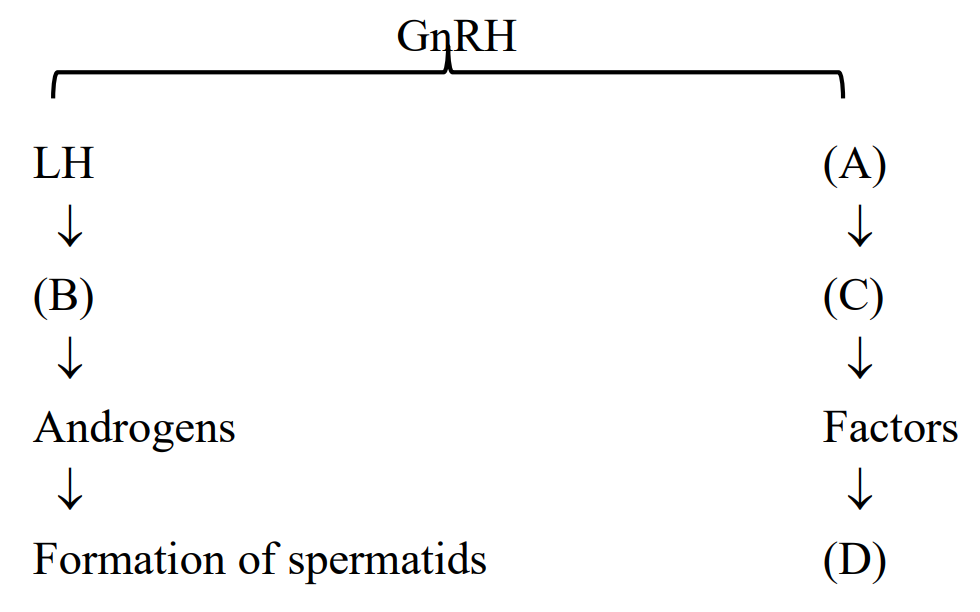 GnRH from the hypothalamus acts on the anterior pituitary to release LH and FSH, so (A) = FSH.
LH acts on the Leydig cells and stimulates synthesis and secretion of androgens, so (B) = Leydig cells.
FSH acts on the Sertoli cells and stimulates secretion of factors that help in spermiogenesis, so (C) = Sertoli cells and (D) = spermiogenesis.
So the correct option is FSH, Leydig cells, Sertoli cells, spermiogenesis. -
During menstrual cycle, the ovulation takes place approximately on 14th day.Reason: Rapid secretion of LH in the middle of menstrual cycle induces rupture of Graafian follicle and thereby the release of ovum.During a 28-day menstrual cycle, rapid secretion of LH reaching its maximum (LH surge) at mid-cycle induces the rupture of the Graafian follicle, causing ovulation on approximately the 14th day. Both Assertion and Reason are true, and the Reason correctly explains the Assertion.
-
Arrange the following parts in human Mammary gland, traversing the route of milk ejection. A. Mammary duct B. Lactiferous duct C. Mammary alveolus D. Ampulla E. Mammary tubule. Choose the correct answer from the options given below:Milk is produced in the mammary alveoli (C), flows into the mammary tubules (E), then into the mammary ducts (A), which converge and dilate to form ampullae (D), which are connected to the lactiferous ducts (B) opening at the nipple. So the correct route is C → E → A → D → B.
-
Match List-I (Structures) with List-II (Features) relating to human female external genitalia and choose the correct answer from the options given below:
Pick the matching item from Column II for each row.
Column I
- A. Mons pubis
- B. Clitoris
- C. Hymen
- D. Labia majora
Column II
- I. A fleshy fold of tissue surrounding the vaginal opening
- II. Fatty cushion of cells covered by skin and hair
- III. Tiny finger-like structure above labia minora
- IV. A thin membrane-like structure covering vaginal opening
Correct answer: A → II, B → III, C → IV, D → I
Mons pubis is a fatty cushion of cells covered by skin and hair (A-II); Clitoris is a tiny finger-like structure above the labia minora (B-III); Hymen is a thin membrane-like structure covering the vaginal opening (C-IV); Labia majora are fleshy folds of tissue surrounding the vaginal opening (D-I). -
Match List-I with List-II and choose the correct answer from the option given below:
Pick the matching item from Column II for each row.
Column I
- A. Parturition
- B. Placenta
- C. Colostrum
- D. Fimbriae
Column II
- I. Several antibodies for new-born babies
- II. Collection of ovum after ovulation
- III. Foetal ejection reflex
- IV. Secretion of the hormone hCG
Correct answer: A → III, B → IV, C → I, D → II
Parturition is associated with the foetal ejection reflex (A-III); Placenta secretes the hormone hCG (B-IV); Colostrum contains several antibodies for the new-born baby (C-I); Fimbriae are involved in the collection of ovum after ovulation (D-II). -
Given below are two statements: Statement I: Vas deferens receives a duct from seminal vesicle and opens into urethra as the ejaculatory duct. Statement II: The cavity of the cervix is called cervical canal which along with vagina forms birth canal. In the light of the above statements, choose the correct answer from the options given below:
The ejaculatory duct forms from the vas deferens and seminal vesicle duct; the cervical canal and vagina form the birth canal.
Each ejaculatory duct is formed by the union of the duct from the seminal vesicle and the vas deferens. They open into the prostatic urethra. Cervical canal (interior of the cervix) along with vagina forms the birth canal. -
Endometrium is necessary for implantation of blastocyst.Reason: In the absence of fertilization, the corpus luteum degenerates that causes disintegration of endometrium.
Both are true, but the corpus luteum degeneration does not explain why the endometrium is needed for implantation.
Both assertion and reason are correct but reason is not the correct explanation why endometrium is necessary for implantation of blastocyst. The attachment of a blastocyst to the endometrium is called the implantation. It occurs about 6 days after fertilisation. The endometrium is necessary for implantation as it serves as a key place not only for supporting foetal growth through supplementation of oxygen and nutrients but also for protecting the embryo and later the foetus from microbial invasion during pregnancy. If fertilisation does not occur, the levels of progesterone and estrogens decline due to degeneration of the corpus luteum. Withdrawal of progesterone and estrogens causes disintegration of the endometrium leading to menstruation. -
Which of the following statements are correct regarding female reproductive cycle? A. In non-primate mammals cyclical changes during reproduction are called oestrus cycle. B. First menstrual cycle begins at puberty and is called menopause. C. Lack of menstruation may be indicative of pregnancy. D. Cyclic menstruation extends between menarche and menopause. Choose the most appropriate answer from the options given below:
The first menstrual cycle at puberty is menarche, not menopause, so statement B is wrong.
All statements are correct except B. The first menstrual cycle begins at puberty and is called menarche, not menopause. -
Arrange the sequence of different hormones for their role during gametogenesis. (A) Gonadotropin LH stimulates synthesis and secretion of Androgen (B) Gonadotropin releasing hormone from hypothalamus (C) Androgen stimulates spermatogenesis (D) Gonadotropin FSH helps in the process of spermiogenesis (E) Gonadotropins from anterior pituitary gland. Choose the correct answer from the options given below:Correct sequence: Gonadotropin releasing hormone (GnRH) is released from the hypothalamus (B) → this stimulates the anterior pituitary to release Gonadotropins (LH and FSH) (E) → LH stimulates synthesis and secretion of Androgen (A) → Androgen stimulates spermatogenesis (C) → FSH helps in the process of spermiogenesis (D). Order: B, E, A, C, D.
Want a score?
Answers here are not saved. Practise as a test to be marked and see your progress.
Practise as a test