Looking for classes? Ksquare Career Institute, Bengaluru →

Biology
Principles of Inheritance and Variation
198 questions, each with its answer.
-
Which one of the following disorders is caused by the substitution of Glutamic acid (Glu) by Valine (Val) at the sixth position of the beta globin chain of the haemoglobin molecule?
-
Match List I with List II:
Pick the matching item from Column II for each row.
Column I
- i. Incomplete dominance
- ii. Co-dominance
- iii. Pleiotropy
- iv. Polygenic inheritance
Column II
- a. Human skin colour
- b. Inheritance of flower colour in $Antirrhinum$ sp.
- c. Phenylketonuria disease in humans
- d. ABO blood groups
Correct answer: i → b, ii → d, iii → c, iv → a
-
Which of the following statements are true with reference to the sex-determination in honeybees? I. An offspring formed from the union of a sperm and an egg, develops as a female (queen or worker). II. An unfertilized egg develops as a male by parthenogenesis. III. A male has half the number of chromosomes than that of a female. IV. Males produce sperms by meiosis. V. Honeybees have a haplodiploid sex-determination system. Choose the CORRECT answer from the options given below:
-
The sixth mutant codon of beta globin gene causing polymerization of Haemoglobin and change in RBC shape is _______.
-
What is the probability of having children with 'O' blood group, where both mother and father are heterozygous for 'A' and 'B' blood group, respectively?
-
In a population of a grasshopper species, the chromosome number of some members is 23 and some other members possess 24 chromosomes. The 23 and 24 chromosome-bearing members in this species are _______.
-
In which animal do haploid cells divide mitotically to produce gametes?
-
Given below are two statements: Statement I: Down's syndrome is caused by the absence of one of the X-chromosomes. Statement II: Turner's syndrome is caused by the presence of an additional copy of the chromosomes. In the light of the above statements, choose the correct answer from the options given below:Reference: NCERT Class XII, page 76.
-
For a person with blood group 'O', which of the following is not a possible combination of parents' blood group genotypes?Reference: NCERT Class XII, page 61.
-
In an experiment, Mendel observed that the F1 progeny plants are all tall and none are dwarf.Reason: Stem height is a contrasting trait, with tall being dominant and dwarf being recessive.Reference: NCERT Class XII, page 54.
-
What is the pattern of inheritance for polygenic trait?
Polygenic inheritance shows continuous phenotypic variation and follows a non-Mendelian inheritance pattern.
Polygenic traits are controlled by three or more genes with cumulative additive effects showing continuous bell-shaped phenotypic variation (e.g. human skin colour, height), deviating from typical Mendelian monogenic ratios, hence following a non-Mendelian inheritance pattern. -
Genes R and Y follow independent assortment. If RRYY produce round yellow seeds and rryy produce wrinkled green seeds, what will be the phenotypic ratio of the F2 generation?
A standard Mendelian dihybrid cross with independent assortment yields a 9:3:3:1 phenotypic ratio in F2.
Crossing homozygous parents $RRYY \times rryy$ gives dihybrid $RrYy$ in $F_1$. Self-fertilization of $F_1$ yields 16 combinations in $F_2$ with the classic 9:3:3:1 ratio (9 Round Yellow, 3 Round Green, 3 Wrinkled Yellow, 1 Wrinkled Green). -
With the help of given pedigree, find out the probability for the birth of a child having no disease and being a carrier (has the disease mutation in one allele of the gene) in $F_{3}$ generation.
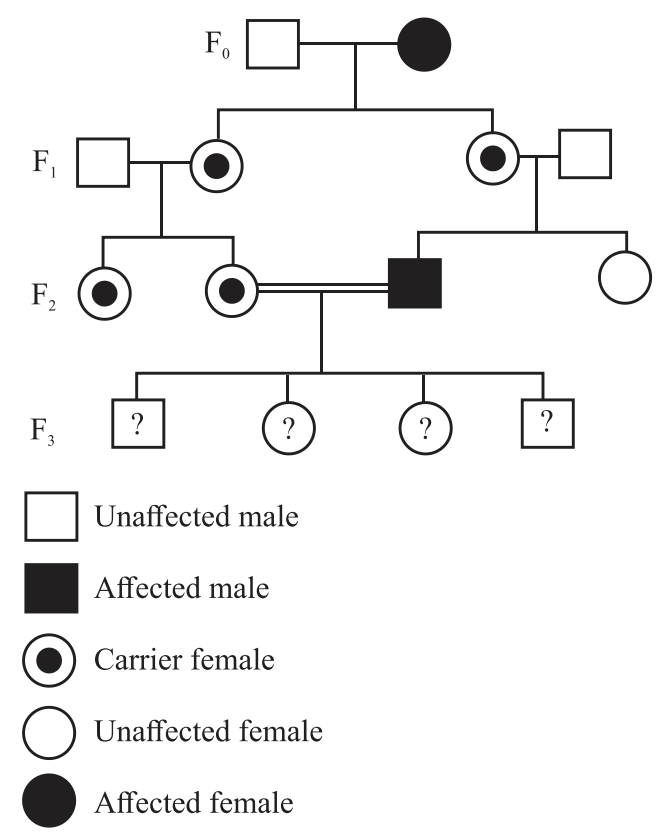
Probability of a carrier female child ($X^C X$) from a carrier mother ($X^C X$) and normal father ($XY$) is 1/4.
The pedigree shows X-linked recessive inheritance. In $F_2$, the mother is a carrier female ($X^C X$) and the father is unaffected ($XY$). The offspring genotypes are: $X^C X$ (carrier female, 1/4), $XX$ (normal female, 1/4), $X^C Y$ (affected male, 1/4), $XY$ (normal male, 1/4). The probability of an unaffected child being a carrier is 1/4. -
In a plant, black seed color (BB/Bb) is dominant over white seed color (bb). In order to find out the genotype of the black seed plant, with which of the following genotype will you cross it?To find whether a black-seeded plant is BB or Bb, a test cross is performed with the homozygous recessive (bb) plant. If all offspring are black, the plant is BB; if half are black and half white, it is Bb.
-
A pink flowered Snapdragon plant was crossed with a red flowered Snapdragon plant. What type of phenotype/s is/are expected in the progeny?Flower colour in snapdragon shows incomplete dominance: RR = red, Rr = pink, rr = white. Pink (Rr) × Red (RR) gives RR (red) and Rr (pink) in a 1 : 1 ratio. So both red flowered and pink flowered plants are expected.
-
Match List I with List II regarding genetics terminology.
Pick the matching item from Column II for each row.
Column I
- A. Two or more alternative forms of a gene
- B. Cross of F1 progeny with homozygous recessive parent
- C. Cross of F1 progeny with any of the parents
- D. Number of chromosome sets in plant
Column II
- I. Back cross
- II. Ploidy
- III. Allele
- IV. Test cross
Correct answer: A → III, B → IV, C → I, D → II
Two or more alternative forms of a gene – allele Cross of $F_1$ progeny with homozygous recessive parent – test cross Cross of $F_1$ progeny with any of the parents – back cross Number of chromosome sets in a plant – ploidy Correct match: A-III, B-IV, C-I, D-II. -
Which one of the following can be explained on the basis of Mendel's Law of Dominance? A. Out of one pair of factors one is dominant and the other is recessive. B. Alleles do not show any expression and both the characters appear as such in F2 generation. C. Factors occur in pair in normal diploid plants. D. The discrete unit controlling a particular character is called factor. E. The expression of only one of the parental characters is found in a monohybrid cross. Choose the correct answer from the options given below:The Law of Dominance explains that characters are controlled by discrete units called factors (D), that factors occur in pairs in normal diploid plants (C), that of a pair of dissimilar factors one is dominant and the other recessive (A), and that only one of the parental characters is expressed in a monohybrid cross (E). Statement B is not explained by the law of dominance. So A, C, D and E only are correct.
-
Match List-I with List-II regarding genetic disorders and the chromosome involved.
Pick the matching item from Column II for each row.
Column I
- A. Down's syndrome
- B. $\alpha$-Thalassemia
- C. $\beta$-Thalassemia
- D. Klinefelter's
Column II
- I. 11th chromosome
- II. 'X' chromosome
- III. 21st chromosome
- IV. 16th chromosome
Correct answer: A → III, B → IV, C → I, D → II
Down's syndrome – additional copy of chromosome 21 (trisomy 21) $\alpha$-Thalassemia – controlled by two closely linked genes HBA1 and HBA2 on chromosome 16 $\beta$-Thalassemia – controlled by a single gene HBB on chromosome 11 Klinefelter's syndrome – additional copy of the X chromosome (47, XXY) Correct match: A-III, B-IV, C-I, D-II. -
As per ABO blood grouping system, the blood group of fathers is $B^+$, mother is $A^+$ and child is $O^+$. Their respective genotype can be A. $I^Bi/I^Ai/ii$ B. $I^BI^B/I^AI^A/ii$ C. $I^AI^B/iI^A/I^Bi$ D. $I^Ai/I^Bi/I^Ai$ E. $iI^B/iI^A/I^AI^B$ Choose the most appropriate answer from the options given below:For an $O^+$ child (genotype ii), each parent must carry the recessive allele i. Father with blood group $B^+$ must be $I^Bi$, and mother with blood group $A^+$ must be $I^Ai$; child is ii. So only combination A ($I^Bi / I^Ai / ii$) is possible.
-
Given below are two statements: Statement I: When many alleles of a single gene govern a character, it is called polygenic inheritance. Statement II: In Polygenic inheritance, the effect of each allele is additive. In the light of the above statements, choose the correct answer from the options given below.Statement I incorrectly describes multiple alleles (many alleles of a single gene); polygenic inheritance actually refers to a character governed by more than one gene (multiple genes), so Statement I is false. In polygenic inheritance, the contribution of each gene/allele is additive, producing a continuous range of phenotypes, so Statement II is true.
-
Match List-I (Type of Inheritance) with List-II (Example) and choose the correct answer from the options given below:
Pick the matching item from Column II for each row.
Column I
- A. Incomplete dominance
- B. Co-dominance
- C. Pleiotropy
- D. Polygenic inheritance
Column II
- I. Blood groups in human
- II. Flower colour in Antirrhinum
- III. Skin colour in human
- IV. Phenylketonuria
Correct answer: A → II, B → I, C → IV, D → III
Incomplete dominance is exemplified by flower colour in Antirrhinum (A-II); Co-dominance is exemplified by blood groups in humans (B-I); Pleiotropy is exemplified by phenylketonuria (C-IV); Polygenic inheritance is exemplified by skin colour in humans (D-III). -
Given below are two statements: Statement I: Failure of segregation of chromatids during cell cycle resulting in the gain or loss of whole set of chromosome in an organism is known as aneuploidy. Statement II: Failure of cytokinesis after anaphase stage of cell division results in the gain or loss of a chromosome is called polyploidy. In the light of the above statements, choose the correct answer from the options given below:Statement I is incorrect: failure of segregation of chromatids resulting in the gain or loss of a whole set of chromosomes describes polyploidy, not aneuploidy (aneuploidy involves the gain or loss of one or a few chromosomes, not the whole set). Statement II is also incorrect: failure of cytokinesis after the anaphase stage causes doubling of the whole chromosome set (polyploidy), not simply the gain or loss of a single chromosome.
-
When a tall pea plant with round seeds was selfed, it produced the progeny of: (a) Tall plants with round seeds and (b) Tall plants with wrinkled seeds. Identify the genotype of the parent plant.Since all progeny are tall (no short plants appear), the parent must be homozygous tall, TT. Since the progeny show both round and wrinkled seed phenotypes (segregation), the parent must be heterozygous for seed shape, Rr. Hence the parent genotype is TTRr.
-
Aneuploidy is a chromosomal disorder where chromosome number is not the exact copy of its haploid set of chromosomes, due to: A. Substitution B. Addition C. Deletion D. Translocation E. Inversion. Choose the most appropriate answer from the options given below:Aneuploidy (gain or loss of one or more individual chromosomes from the normal set) arises due to failure of segregation of chromatids, resulting in addition or deletion of one or more chromosomes.
-
The mother has $A^+$ blood group the father has $B^+$ and the child is $A^+$. What can be the possibility of genotypes of all three, respectively?Since the child is $A^+$ and the father is $B^+$, the child must have received the $I^Bi$ allele combination from the father contributing $i$, meaning the father's genotype must include $i$ (i.e. $I^Bi$). The mother, being $A^+$, can be $I^AI^A$ or $I^Ai$. Consistent possibilities for (mother, father, child) genotypes are: $I^AI^A\,|\,I^Bi\,|\,I^Ai$ (option B) and $I^Ai\,|\,I^Bi\,|\,I^Ai$ (option E) — so the answer is B and E.
Want a score?
Answers here are not saved. Practise as a test to be marked and see your progress.
Practise as a test