Looking for classes? Ksquare Career Institute, Bengaluru →

Chemistry
Chemical Bonding and Molecular Structure
108 questions, each with its answer.
-
Identify the correct statement about $ClF_3$, from the following options:In $ClF_3$, Cl has 3 bond pairs and 2 lone pairs, so hybridisation is $sp^3d$. The two lone pairs occupy equatorial positions, giving a T-shaped geometry. So $ClF_3$ is T-shaped with two lone pairs on the central Cl atom.
-
Match List I with List II
Pick the matching item from Column II for each row.
Column I
- i. $C_2H_4$
- ii. $C_2H_2$
- iii. $CH_4$
- iv. $NH_3$
Column II
- a. 3 $\sigma$ bonds, 2 $\pi$ bonds
- b. 3 $\sigma$ bonds, one lone pair
- c. 4 $\sigma$ bonds
- d. 5 $\sigma$ bonds, 1 $\pi$ bond
Correct answer: i → d, ii → a, iii → c, iv → b
$C_2H_4$ ($H_2C=CH_2$): 5 $\sigma$ bonds, 1 $\pi$ bond $C_2H_2$ ($H-C \equiv C-H$): 3 $\sigma$ bonds, 2 $\pi$ bonds $CH_4$: 4 $\sigma$ bonds $NH_3$: 3 $\sigma$ bonds, 1 lone pair Correct match: i-d, ii-a, iii-c, iv-b. -
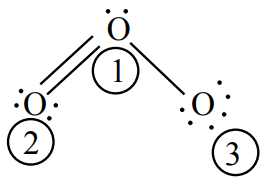 The correct formal charges on oxygen atoms numbered 2, 1 and 3 respectively are:F.C. = (valence electrons in free atom) $-$ (non-bonding electrons) $- \frac{1}{2}$(bonding electrons) O-2: $6 - 4 - \frac{1}{2}(4) = 0$ O-1: $6 - 2 - \frac{1}{2}(6) = +1$ O-3: $6 - 6 - \frac{1}{2}(2) = -1$ So formal charges on O-2, O-1 and O-3 are 0, +1, $-1$.
-
Match the species in List-I with their geometry in List-II.
Pick the matching item from Column II for each row.
Column I
- A. $PCl_5$
- B. $BrF_5$
- C. $BF_4^-$
- D. $[Ni(CN)_4]^{2-}$
Column II
- I. Tetrahedral
- II. Square Planar
- III. Trigonal bipyramidal
- IV. Square pyramidal
Correct answer: A → III, B → IV, C → I, D → II
(A) $PCl_5$: $sp^3d$, trigonal bipyramidal. (B) $BrF_5$: $sp^3d^2$ with 1 lone pair, square pyramidal. (C) $BF_4^-$: $sp^3$, tetrahedral. (D) $[Ni(CN)_4]^{2-}$: $dsp^2$, square planar. -
The highest occupied molecular orbital for $Ne_2$ is$Ne_2$ has 20 electrons: $\sigma1s^2\,\sigma^*1s^2\,\sigma2s^2\,\sigma^*2s^2\,\sigma2p_z^2\,\pi2p_x^2=\pi2p_y^2\,\pi^*2p_x^2=\pi^*2p_y^2\,\sigma^*2p_z^2$. The highest occupied molecular orbital (HOMO) is $\sigma^*2p_z$.
-
Given below are two statements:
Statement I: A hypothetical diatomic molecule with bond order zero is quite stable.
Statement II: As bond order increases, the bond length increases.
In the light of the above statements, choose the most appropriate answer from the options given below:Both statements are false: bond order zero implies no chemical bond (molecule does not exist), and bond length is inversely proportional to bond order.
In Molecular Orbital Theory, a bond order of zero indicates that bonding electrons equal antibonding electrons, meaning no net attractive bonding exists and the molecule is completely unstable/does not exist (Statement I is false). As bond order increases, atoms are pulled closer by stronger shared electron density, so bond length decreases (Statement II is false). Hence, both statements are false. -
Identify the correct orders against the property mentioned:
A. $\text{H}_2\text{O} > \text{NH}_3 > \text{CHCl}_3$ - dipole moment
B. $\text{XeF}_4 > \text{XeO}_3 > \text{XeF}_2$ – number of lone pairs on central atom
C. $\text{O}-\text{H} > \text{C}-\text{H} > \text{N}-\text{O}$ – bond length
D. $\text{N}_2 > \text{O}_2 > \text{H}_2$ – bond enthalpy
Choose the correct answer from the options given below:Dipole moments: $\text{H}_2\text{O} (1.85\text{ D}) > \text{NH}_3 (1.47\text{ D}) > \text{CHCl}_3 (1.04\text{ D})$ (A is true). Bond enthalpies: $\text{N}_2 (946\text{ kJ/mol}) > \text{O}_2 (498\text{ kJ/mol}) > \text{H}_2 (436\text{ kJ/mol})$ (D is true).
Analyzing each statement: A. Dipole moment: $\text{H}_2\text{O} (1.85\text{ D}) > \text{NH}_3 (1.47\text{ D}) > \text{CHCl}_3 (1.04\text{ D})$. True. B. Lone pairs on xenon: $\text{XeF}_2$ has 3 lone pairs, $\text{XeF}_4$ has 2, $\text{XeO}_3$ has 1. Correct order is $\text{XeF}_2 > \text{XeF}_4 > \text{XeO}_3$, so B is false. C. Single bond lengths: $\text{N}-\text{O} (\approx 136\text{ pm}) > \text{C}-\text{H} (109\text{ pm}) > \text{O}-\text{H} (96\text{ pm})$, so C is false. D. Bond dissociation enthalpy: $\text{N}\equiv\text{N} (946\text{ kJ/mol}) > \text{O}=\text{O} (498\text{ kJ/mol}) > \text{H}-\text{H} (436\text{ kJ/mol})$. True. Thus, only A and D are correct. -
Intramolecular hydrogen bonding is present inIntramolecular hydrogen bonding takes place within the same molecule and occurs only when the two functional groups are close to each other in the molecule.
In HF, only intermolecular hydrogen bonding is possible.
In m-nitrophenol and p-nitrophenol, the $-NO_2$ and $-OH$ groups are far apart, so intramolecular hydrogen bonding is not possible.
In o-nitrophenol, the $-NO_2$ and $-OH$ groups are on adjacent carbon atoms, so they form intramolecular hydrogen bonding.
So intramolecular hydrogen bonding is present in o-nitrophenol (2-nitrophenol).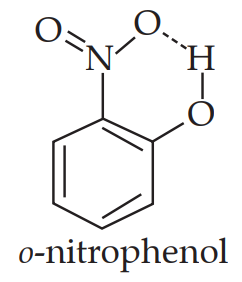
-
Match List-I with List-II regarding the shape/geometry of the given compounds.
Pick the matching item from Column II for each row.
Column I
- A. $NH_3$
- B. $BrF_5$
- C. $XeF_4$
- D. $SF_6$
Column II
- I. Trigonal Pyramidal
- II. Square Planar
- III. Octahedral
- IV. Square Pyramidal
Correct answer: A → I, B → IV, C → II, D → III
$NH_3$: 3 bond pairs + 1 lone pair ($sp^3$) – trigonal pyramidal $BrF_5$: 5 bond pairs + 1 lone pair ($sp^3d^2$) – square pyramidal $XeF_4$: 4 bond pairs + 2 lone pairs ($sp^3d^2$) – square planar $SF_6$: 6 bond pairs ($sp^3d^2$) – octahedral Correct match: A-I, B-IV, C-II, D-III. -
Match List-I with List-II regarding the number and types of bonds between two carbon atoms in the given molecules.
Pick the matching item from Column II for each row.
Column I
- A. ethane
- B. ethene
- C. carbon molecule, $C_2$
- D. ethyne
Column II
- I. one $\sigma$-bond and two $\pi$-bonds
- II. two $\pi$-bonds
- III. one $\sigma$-bond
- IV. one $\sigma$-bond and one $\pi$-bond
Correct answer: A → III, B → IV, C → II, D → I
Ethane ($CH_3-CH_3$): one $\sigma$-bond Ethene ($CH_2=CH_2$): one $\sigma$-bond and one $\pi$-bond Carbon molecule $C_2$: two $\pi$-bonds Ethyne ($HC \equiv CH$): one $\sigma$-bond and two $\pi$-bonds Correct match: A-III, B-IV, C-II, D-I. -
Identify the correct answer.Dipole moment of $NF_3$ is less than that of $NH_3$ (in $NF_3$ the lone-pair moment opposes the N–F bond moments) – incorrect. Three equivalent canonical forms can be drawn for $CO_3^{2-}$ – correct. Only two resonance structures can be drawn for ozone, not three – incorrect. $BF_3$ is trigonal planar and symmetrical, so its dipole moment is zero – incorrect. So the correct answer is: three canonical forms can be drawn for $CO_3^{2-}$ ion.
-
Which of the following molecules has "NON ZERO" dipole moment value?$CCl_4$, $CO_2$ and $BF_3$ are all symmetric molecules with zero net dipole moment due to cancellation of bond dipoles. HI is a polar diatomic molecule with a non-zero dipole moment ($\mu=0.38$ D) due to the electronegativity difference between H and I.
-
Identify the incorrect statement about $PCl_5$.$PCl_5$ has trigonal bipyramidal geometry with $sp^3d$ hybridisation, five P–Cl sigma bonds, and two distinct bond angles ($90^\circ$ axial-equatorial and $120^\circ$ equatorial-equatorial). The three equatorial bonds are shorter than the two axial bonds, so all five P–Cl bonds are NOT identical in length — this statement is incorrect.
-
Amongst the following, the total number of species NOT having eight electrons around central atom in its outer most shell, is: $NH_3$, $AlCl_3$, $BeCl_2$, $CCl_4$, $PCl_5$
$AlCl_3$, $BeCl_2$ and $PCl_5$ do not obey the octet rule.
$AlCl_3$, $BeCl_2$ and $PCl_5$ do not obey the octet rule. $AlCl_3$ and $BeCl_2$ are electron-deficient species (fewer than eight electrons in the valence shell of the central atom), whereas $PCl_5$ has ten electrons in the valence shell of phosphorus. The structures are: [add image] -
The correct order of energies of molecular orbitals of $N_2$ molecule is:
For $N_2$ (fewer than 15 electrons) the $\pi2p$ orbitals lie below $\sigma2p_z$.
$\sigma1s<\sigma^*1s<\sigma2s<\sigma^*2s<(\pi2p_x=\pi2p_y)<\sigma2p_z<(\pi^*2p_x=\pi^*2p_y)<\sigma^*2p_z$ is the correct order of energy of MO for homo nuclear diatomic species $N_2$. -
Intermolecular forces are forces of attraction and repulsion between interacting particles that will include: A. dipole-dipole forces. B. dipole - induced dipole forces, C. hydrogen bonding. D. covalent bonding. E. dispersion forces. Choose the most appropriate answer from the options given below:
Covalent bonding is not an intermolecular force.
Covalent bonding is NOT an intermolecular force while rest all are considered as intermolecular forces. -
The correct order of dipole moments for molecules $NH_3$, $H_2S$, $CH_4$ and HF, is:The correct order of dipole moments is $HF>NH_3>H_2S>CH_4$, where $CH_4$, being a perfectly symmetric (non-polar) tetrahedral molecule, has a dipole moment of zero.
-
Which one of the following statements is incorrect related to Molecular Orbital Theory?Molecular orbitals formed from $2P_x$ and $2P_y$ orbitals (perpendicular to the bond axis, typically taken as the z-axis) are actually unsymmetrical (not symmetrical) around the bond axis — they form $\pi$ molecular orbitals with electron density above and below the axis, not symmetric around it. So this statement is incorrect.
-
Amongst the following which one will have maximum 'lone pair-lone pair' electron repulsions?$XeF_2$ has 2 bond pairs and 3 lone pairs on Xe ($sp^3d$, linear); the three lone pairs are in equatorial positions.
So $XeF_2$ has the maximum (3) lone pair–lone pair repulsions among the given molecules. -
Which amongst the following is incorrect statement$O_2^+$ has 15 electrons, so it contains one unpaired electron. Hence it is paramagnetic, not diamagnetic – so this statement is incorrect. (Bond orders of $O_2^+$, $O_2$, $O_2^-$, $O_2^{2-}$ are 2.5, 2, 1.5, 1; $C_2$ has 4 electrons in two degenerate $\pi$ MOs; $H_2^+$ has one electron – all correct.)
-
Match List - I (molecules) with List - II (shape). Choose the correct answer.
Pick the matching item from Column II for each row.
Column I
- A. $NH_3$
- B. $ClF_3$
- C. $PCl_5$
- D. $BrF_5$
Column II
- I. square pyramidal
- II. trigonal bipyramidal
- III. trigonal pyramidal
- IV. T-shape
Correct answer: A → III, B → IV, C → II, D → I
$NH_3\rightarrow$ trigonal pyramidal; $ClF_3\rightarrow$ T-shape; $PCl_5\rightarrow$ trigonal bipyramidal; $BrF_5\rightarrow$ square pyramidal. -
The correct order of bond angles in the following compounds/species is:$CO_2$: $180^\circ$; $NH_4^+$: $109.5^\circ$; $NH_3$: $107^\circ$ (one lone pair on N); $H_2O$: $104.5^\circ$ (two lone pairs on O). Lone pair-lone pair repulsion decreases the angle in water the most.
-
$BF_3$ is planar and electron deficient compound. Hybridization and number of electrons around the central atom, respectively are:In $BF_3$, B forms three B–F bonds with no lone pair: $sp^2$ hybridised, trigonal planar. Number of electrons around B = 3 × 2 = 6 (electron deficient).
-
Match List-I with List-II.
Pick the matching item from Column II for each row.
Column I
- A. $PCl_5$
- B. $SF_6$
- C. $BrF_5$
- D. $BF_3$
Column II
- I. Square pyramidal
- II. Trigonal planar
- III. Octahedral
- IV. Trigonal bipyramidal
Correct answer: A → IV, B → III, C → I, D → II
$PCl_5$: $sp^3d$ – trigonal bipyramidal $SF_6$: $sp^3d^2$ – octahedral $BrF_5$: $sp^3d^2$ with one lone pair – square pyramidal $BF_3$: $sp^2$ – trigonal planar Correct match: A-IV, B-III, C-I, D-II. -
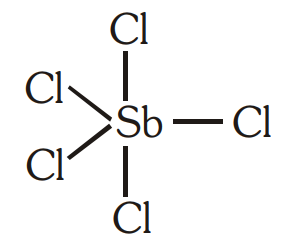
Which of the following molecules is non-polar in nature?$SbCl_5$: $sp^3d$, trigonal bipyramidal and symmetrical, so the bond dipoles cancel: dipole moment = 0 (non-polar).
Want a score?
Answers here are not saved. Practise as a test to be marked and see your progress.
Practise as a test