Looking for classes? Ksquare Career Institute, Bengaluru →

Physics
Ray Optics and Optical Instruments
89 questions, each with its answer.
-
In a concave lens, a ray of light emanating from the object parallel to the principal axis of the lens, after refraction:
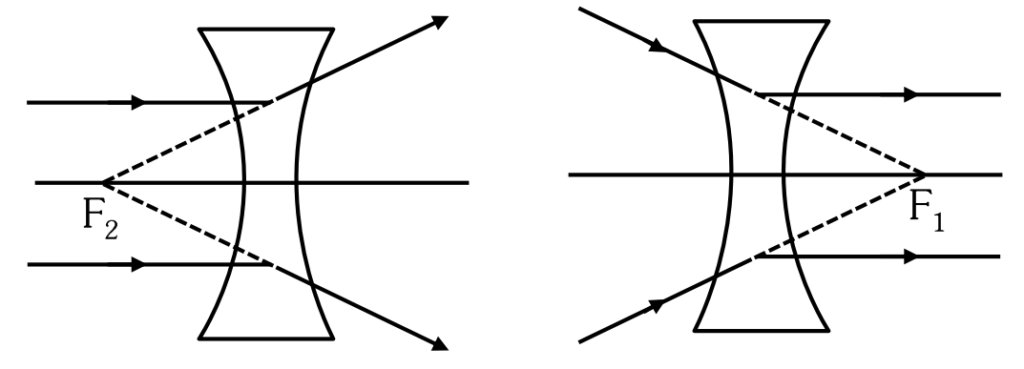
A concave (diverging) lens makes a ray parallel to the principal axis diverge after refraction, so that it appears to come from the focus on the same side as the object. By NCERT's convention, the focus on the side of the source of light is called the first focal point ($F_1$), and the other is the second focal point ($F_2$). On this basis the answer is: the ray appears to diverge from the first principal focus. Note: ALLEN marks this answer as per NCERT but states that conceptually the question should be treated as bonus, because by the standard definition of foci the diverging ray appears to come from the second principal focus. -
A ray of monochromatic light is passing through an equilateral prism (ABC) as shown in the figure. The refracted ray (QR) is parallel to its base (BC) and the angle of incidence (i) is $50^\circ$. Then the angle of deviation ($\delta$) is:
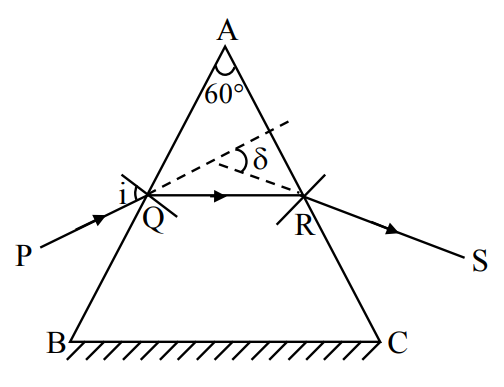 For an equilateral prism, $A = 60^\circ$. Since the refracted ray is parallel to the base, this is the condition of minimum deviation: $r = \frac{A}{2} = \frac{60^\circ}{2} = 30^\circ$ and $i = e = 50^\circ$ $\delta = i + e - A = 50^\circ + 50^\circ - 60^\circ$ $= 40^\circ$
-
Which of the following measurements require 'index correction'?Index correction (also known as bench correction) is applied in the optical bench experiment, which is used to find the focal length of lenses.
-
Consider three media P, Q and R with refractive indices 1, 1.25 and 1.5 respectively. The medium Q having a thickness of 5 cm is placed between extended media P and R as shown in the figure. An object O is placed at the centre of medium Q. If viewed from medium P near the normal direction, the apparent depth of O is $h_1$. For similar observation from medium R, the apparent depth is $h_2$. The value of $|h_1-h_2|$, in cm, is:
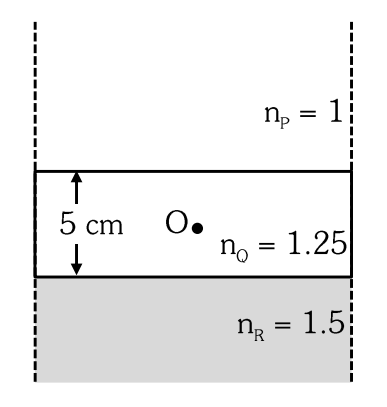 The object is 2.5 cm from each face of Q. Observer I (in P): $\frac{d'}{d}=\frac{\mu_P}{\mu_Q} \Rightarrow d'=2.5\times\frac{1}{1.25}=2$ cm $=h_1$. Observer II (in R): $d'=2.5\times\frac{1.5}{1.25}=3$ cm $=h_2$. $|h_1-h_2|=1$ cm.
-
The lens combination as shown in the figure, consists of two lenses, $L_1$ and $L_2$, of the focal lengths +10 cm and -10 cm, respectively. The position of the image formed is:
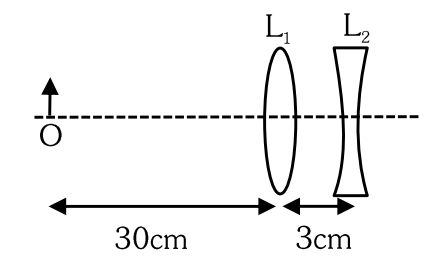 First lens: u = -30 cm, f = +10 cm, so $v=\frac{uf}{u+f}=\frac{-30\times10}{-30+10}=15$ cm. This image lies 12 cm beyond the concave lens (placed 3 cm away) and acts as a virtual object for it. Second lens: u = +12 cm, f = -10 cm, so $v=\frac{12\times(-10)}{12-10}=-60$ cm (virtual image). The negative sign means the image is 60 cm to the left of the concave lens.
-
A microscope has an objective of focal length $2\text{ cm}$, eyepiece of focal length $4\text{ cm}$ and the tube length of $40\text{ cm}$. If the distance of distinct vision of eye is $25\text{ cm}$, the magnification in the microscope is:
Magnification is $m = \frac{L}{f_o} \times \frac{D}{f_e} = \frac{40}{2} \times \frac{25}{4} = 125$.
The magnifying power of a compound microscope is given by $m = m_o \times m_e = \left(\frac{L}{f_o}\right) \left(\frac{D}{f_e}\right)$. Substituting the given values: $m = \left(\frac{40}{2}\right) \times \left(\frac{25}{4}\right) = 20 \times 6.25 = 125$. -
In a certain camera, a combination of four similar thin convex lenses are arranged axially in contact. Then the power of the combination and the total magnification in comparison to the power ($p$) and magnification ($m$) for each lens will be, respectively:
Powers in contact add algebraically ($P = 4p$), while successive magnifications multiply ($M = m^4$).
When thin lenses are placed in contact, their focal powers add algebraically: $P = p_1 + p_2 + p_3 + p_4 = 4p$. For successive lenses, the total linear magnification is the product of individual magnifications: $M = m_1 \times m_2 \times m_3 \times m_4 = m^4$. -
A light ray enters through a right angled prism at point $P$ with the angle of incidence $30^\circ$ as shown in figure. It travels through the prism parallel to its base $BC$ and emerges along the face $AC$. The refractive index of the prism is:
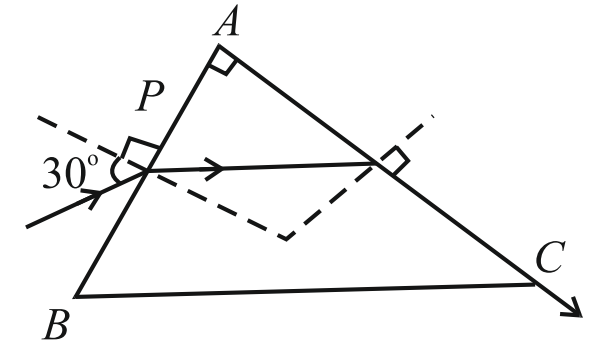 [add image: right-angled prism with the ray entering at P and travelling parallel to BC] Let $\theta$ be the angle of incidence at face AC. The ray just emerges along AC (critical condition): $\mu \sin\theta = 1 \Rightarrow \sin\theta = \frac{1}{\mu}$, so $\cos\theta = \frac{\sqrt{\mu^2 - 1}}{\mu}$ From the geometry, the angle of refraction at face AB is $(90^\circ - \theta)$. Snell's law at AB: $\sin 30^\circ = \mu \sin(90^\circ - \theta) = \mu\cos\theta$ $\frac{1}{2} = \mu \times \frac{\sqrt{\mu^2 - 1}}{\mu} = \sqrt{\mu^2 - 1}$ $\mu^2 = \frac{5}{4} \Rightarrow \mu = \frac{\sqrt{5}}{2}$
-
A small telescope has an objective of focal length 140 cm and an eye piece of focal length 5.0 cm. The magnifying power of telescope for viewing a distant object is:Magnifying power of a telescope (normal adjustment) $m = \frac{f_o}{f_e}$ $m = \frac{140}{5} = 28$
-
Given below are two statements: Statement I: Image formation needs regular reflection and/or refraction. Statement II: The variety in colour of objects we see around us is due to the constituent colours of the light incident on them. In the light of the above statements, choose the most appropriate answer from the options given below:Regular reflection and/or refraction is needed to form an image, which is why we see our image in a mirror but not on a rough wall. The variety of colours we see in objects is due to the constituent colours of the incident light that get selectively reflected. Hence both statements are correct.
-
Light travels a distance $x$ in time $t_1$ in air and $10x$ in time $t_2$ in another denser medium. What is the critical angle for this medium?
$\mu=\frac{t_2}{10t_1}$ and $\sin C=\frac{1}{\mu}=\frac{10t_1}{t_2}$.
Speed of light in air: $C=\frac{x}{t_1}$ Speed of light in the denser medium: $C_2=\frac{10x}{t_2}$ $\Rightarrow\mu=\frac{C}{C_2}=\frac{x}{t_1}\times\frac{t_2}{10x}=\frac{t_2}{10t_1}$ For total internal reflection $\sin C=\frac{1}{\mu}\Rightarrow\sin C=\frac{10t_1}{t_2}$ $C=\sin^{-1}\left(\frac{10t_1}{t_2}\right)$ -
In the figure shown here, what is the equivalent focal length of the combination of lenses (Assume that all layers are thin)?
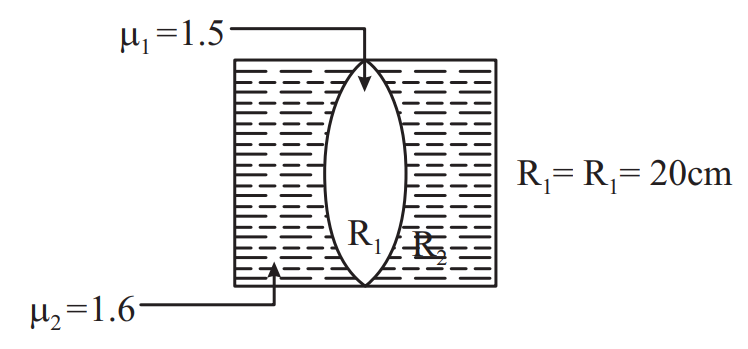
Using $\frac{1}{f}=(\mu-1)\left(\frac{1}{R_1}-\frac{1}{R_2}\right)$ for each layer and adding: $f_{net}=-100\ cm$.
$\frac{1}{f_1}=(1.6-1)\left(\frac{1}{\infty}-\frac{1}{20}\right)=-\frac{3}{100}$ $\frac{1}{f_2}=(1.5-1)\left(\frac{1}{20}-\frac{1}{-20}\right)=\frac{1}{20}$ $\frac{1}{f_3}=\frac{1}{f_1}=-\frac{3}{100}$ $\frac{1}{f_{net}}=\frac{1}{f_1}+\frac{1}{f_2}+\frac{1}{f_3}=-\frac{3}{50}+\frac{1}{20}$ $\Rightarrow f_{net}=-100\ cm$ -
Two thin lenses are of same focal lengths ($f$), but one is convex and the other one is concave. When they are placed in contact with each other, the equivalent focal length of the combination will be:
$\frac{1}{f_{comb}}=\frac{1}{f}-\frac{1}{f}=0$, so $f_{comb}=\infty$.
$F_{convex}=f$, $F_{concave}=-f$ $\frac{1}{f_{comb}}=\frac{1}{F_{convex}}+\frac{1}{F_{concave}}=\frac{1}{f}-\frac{1}{f}$ $\Rightarrow f_{comb}=\infty$ -
A lens is made up of 3 different transparent media as shown in figure. A point object O is placed on its axis beyond 2f. How many real images will be obtained on the other side?
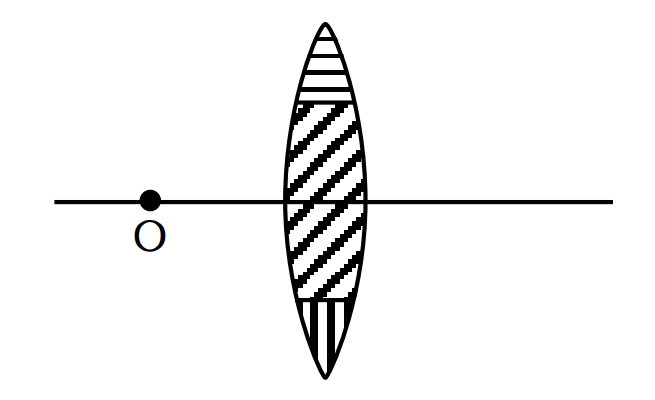 Since the lens is made of three different transparent materials, each material has its own distinct refractive index, resulting in three different effective focal lengths and hence three separate real images.
-
A horizontal ray of light is incident on the right angled prism with prism angle $6^\circ$. If the refractive index of the material of the prism is 1.5, then the angle of emergence will be:
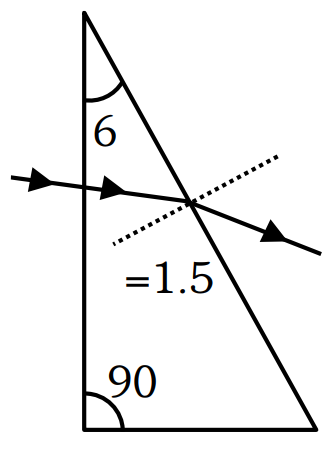 For the given geometry, $A=r_1+r_2=6^\circ$. Since the incident ray is horizontal (normal incidence at the first face for this configuration), $r_1\approx0$, so $r_2\approx6^\circ$. Using $\mu=\dfrac{\sin e}{\sin r_2}$: $1.5=\dfrac{\sin e}{\sin6^\circ}\Rightarrow\sin e=1.5\sin6^\circ\Rightarrow e\approx9^\circ$ (using the small-angle approximation).
-
Which set of colours will come out in air for a situation shown in figure?
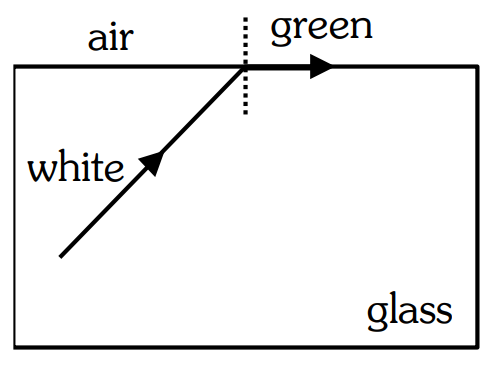 The critical angle $\sin i_c=\dfrac{1}{\mu}\propto\lambda$ (critical angle increases with wavelength, since $\mu$ decreases with increasing wavelength). At the given angle of incidence inside the glass, only colours with a sufficiently large critical angle (i.e., longer wavelengths — yellow, orange and red) can emerge into air without undergoing total internal reflection.
-
An object is mounted on a wall. Its image of equal size is to be obtained on a parallel wall with the help of a convex lens placed between these walls. The lens is kept at distance x in front of the second wall. The required focal length of the lens will be:For an equal-size real image, the object and image distances from the lens are equal ($u=v=x$), corresponding to magnification $-1$ (i.e., object at the centre of curvature, $u=2f$). So $x=2f\Rightarrow f=\dfrac{x}{2}$.
-
A biconvex lens has radii of curvature, 20 cm each. If the refractive index of the material of the lens is 1.5, the power of the lens is :$R_1 = +20$ cm, $R_2 = -20$ cm, $\mu = \frac{3}{2}$ $P = \frac{1}{f} = (\mu - 1)\left(\frac{1}{R_1} - \frac{1}{R_2}\right)$ $P = \left(\frac{3}{2} - 1\right)\left(\frac{1}{0.2} + \frac{1}{0.2}\right) = \frac{1}{2}\left(\frac{2}{0.2}\right) = +5$ D
-
A light ray falls on a glass surface of refractive index $\sqrt{3}$, at an angle $60^\circ$. The angle between the refracted and reflected rays would be :By Snell's law: $1 \times \sin 60^\circ = \sqrt{3}\sin r \Rightarrow \frac{\sqrt{3}}{2} = \sqrt{3}\sin r \Rightarrow \sin r = \frac{1}{2}$, so $r = 30^\circ$ Angle of reflection = $60^\circ$, so the angle between the reflected and refracted rays $= 180^\circ - 60^\circ - 30^\circ = 90^\circ$ (Alternatively, $\tan i_p = \mu = \sqrt{3} \Rightarrow i_p = 60^\circ$; the ray is incident at Brewster's angle, so the reflected and refracted rays are perpendicular.)
-
Two transparent media A and B are separated by a plane boundary. The speed of light in those media are $1.5\times10^8\ m/s$ and $2.0\times10^8\ m/s$, respectively. The critical angle for a ray of light for these two media is :$\mu = \frac{c}{v} \Rightarrow \mu \propto \frac{1}{v}$ A is the denser medium (lower speed). For critical angle (ray going from A to B): $\sin i_c = \frac{\mu_B}{\mu_A} = \frac{v_A}{v_B} = \frac{1.5}{2.0} = \frac{3}{4}$ $i_c = \sin^{-1}(0.750)$
-
During a cloudy day, a primary and a secondary rainbow may be created, then the:The primary rainbow is formed after one total internal reflection inside the water droplet, while the secondary rainbow is formed after two internal reflections. The secondary rainbow appears above the primary rainbow.
-
An astronomical refracting telescope is being used by an observer to observe planets in normal adjustment. The focal lengths of the objective and eye piece used in the construction of the telescope are 20 m and 2 cm respectively. Consider the following statements about the telescope: (a) The distance between the objective and eyepiece is 20.02 m (b) The magnification of the telescope is (-) 1000 (c) The image of the planet is erect and diminished (d) The aperture of eye piece is smaller than that of objective The correct statements are:In normal adjustment the final image is at infinity and is inverted. $m=-\frac{f_o}{f_e}=-\frac{20}{2\times10^{-2}}=-1000$. Tube length $L=f_o+f_e=20+0.02=20.02$ m. The aperture of the eyepiece is smaller than that of the objective. So (a), (b) and (d) are correct; (c) is wrong since the image is inverted.
-
A lens of large focal length and large aperture is best suited as an objective of an astronomical telescope since:Magnifying power $MP = \frac{f_o}{f_e}$ – a large focal length of the objective gives higher magnification. Resolving power $RP = \frac{a}{1.22\lambda}$ – a large aperture gives better resolution and hence better quality of image. A large area of the objective also gathers more light, improving visibility. So all of the above reasons are correct.
-
A convex lens 'A' of focal length 20 cm and a concave lens 'B' of focal length 5 cm are kept along the same axis with a distance 'd' between them. If a parallel beam of light falling on 'A' leaves 'B' as a parallel beam, then the distance 'd' in cm will be:
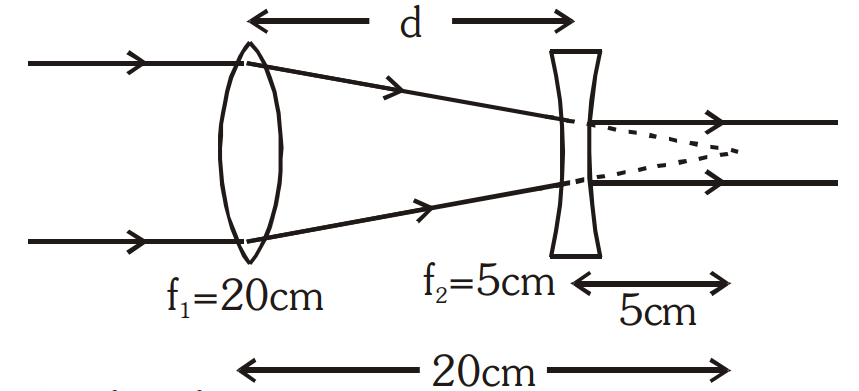
For a parallel beam to emerge parallel, the second focal point of A must coincide with the focal point of B (on the far side of B).
$d = f_1 - f_2 = 20 - 5 = 15$ cm -
Find the value of the angle of emergence from the prism. Refractive index of the glass is $\sqrt{3}$.
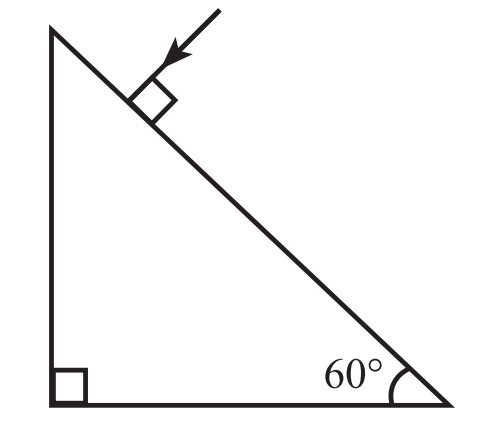 The ray enters normally, so $r_1 = 0^\circ$. Prism angle A = $30^\circ$, so $r_2 = A - r_1 = 30^\circ$.
Snell's law at the second face: $\sqrt{3}\sin 30^\circ = 1 \times \sin e$
$\sin e = \frac{\sqrt{3}}{2} \Rightarrow e = 60^\circ$
Want a score?
Answers here are not saved. Practise as a test to be marked and see your progress.
Practise as a test