Looking for classes? Ksquare Career Institute, Bengaluru →

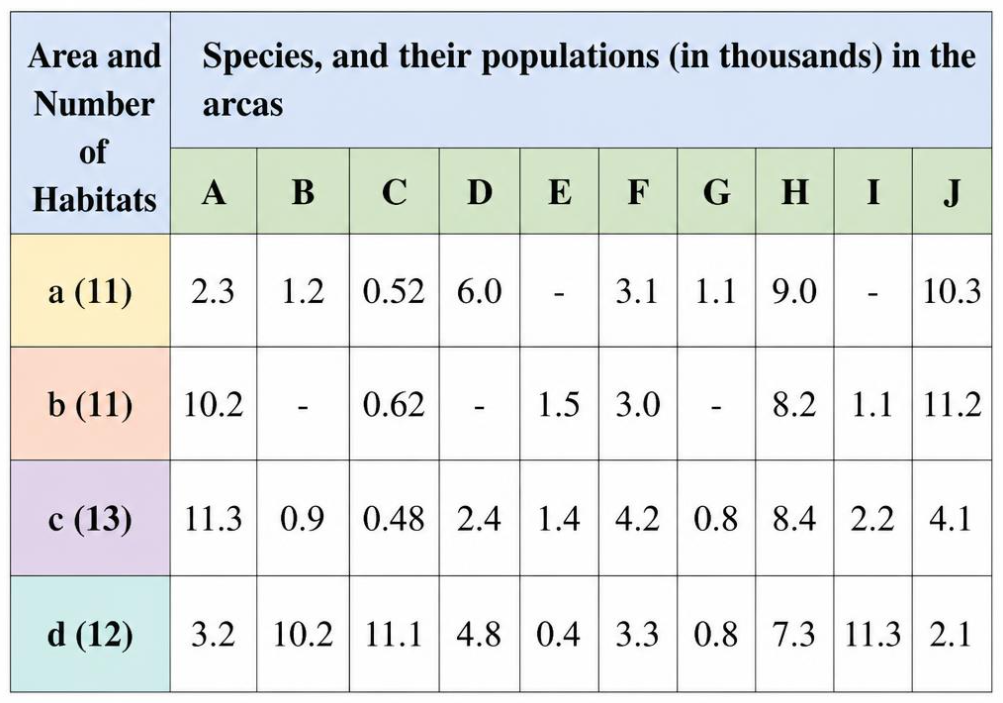
The table below gives the populations (in thousands) of ten species (A-J) in four areas (a-d) consisting of the number of habitats given within brackets against each. Study the table and answer the question which follows:
Which area out of a to d shows maximum species diversity?
Which area out of a to d shows maximum species diversity?
A
d
B
a
C
b
D
c
Detailed Solution
Species diversity depends on two things: species richness (the number of species present) and species evenness (how evenly the individuals are distributed among the species).
Area a has only 8 of the ten species (E and I are absent).
Area b has only 7 of the ten species (B, D and G are absent).
Areas c and d both have all 10 species, so they have the highest species richness.
Between c and d: in area c the populations are very unequal, with one species (A = 11.3) dominating and several species below 1.0.
In area d the total population is larger and it is shared more evenly, with several species (B = 10.2, C = 11.1, I = 11.3, H = 7.3) being abundant, and the ten species are packed into fewer habitats (12 against 13).
So area d, with all ten species and a more even distribution, shows the maximum species diversity, as given in the answer key.
Area a has only 8 of the ten species (E and I are absent).
Area b has only 7 of the ten species (B, D and G are absent).
Areas c and d both have all 10 species, so they have the highest species richness.
Between c and d: in area c the populations are very unequal, with one species (A = 11.3) dominating and several species below 1.0.
In area d the total population is larger and it is shared more evenly, with several species (B = 10.2, C = 11.1, I = 11.3, H = 7.3) being abundant, and the ten species are packed into fewer habitats (12 against 13).
So area d, with all ten species and a more even distribution, shows the maximum species diversity, as given in the answer key.