Looking for classes? Ksquare Career Institute, Bengaluru →

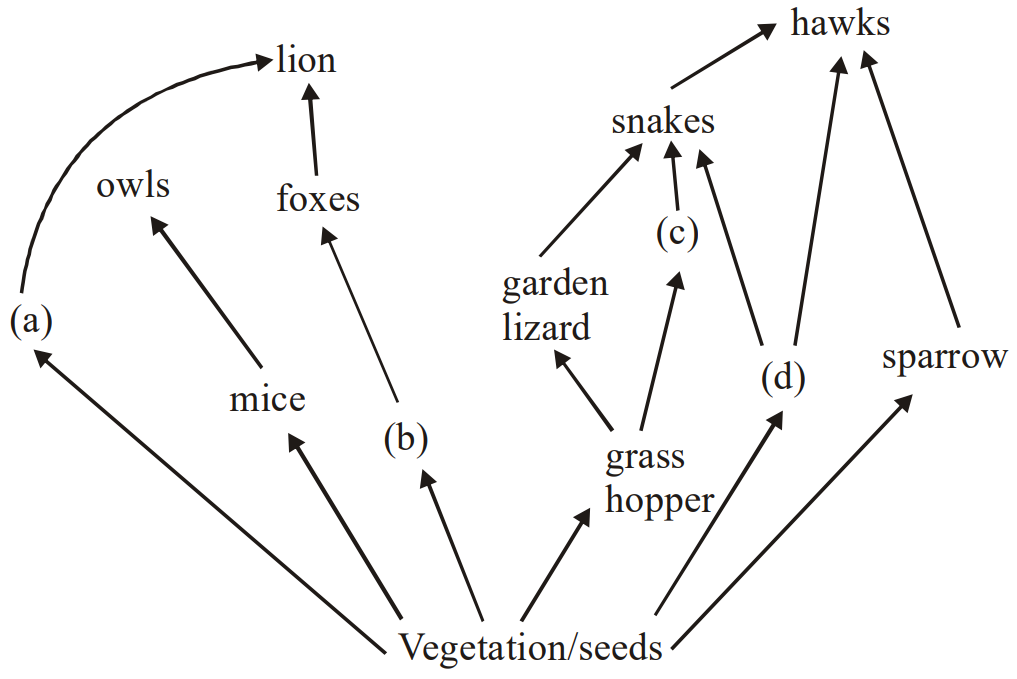
Identify the likely organisms (a), (b), (c) and (d) in the food web shown below.
A
(a) squirrel, (b) cat, (c) rat, (d) pigeon
B
(a) deer, (b) rabbit, (c) frog, (d) rat
C
(a) dog, (b) squirrel, (c) bat, (d) deer
D
(a) rat, (b) dog, (c) tortoise, (d) crow
Detailed Solution
In the food web, vegetation/seeds form the producer level and the arrows show who eats whom.
(a) feeds on vegetation and is eaten by the lion, so it must be a large herbivore: deer.
(b) feeds on vegetation and is eaten by foxes, so it is a small herbivore: rabbit.
(c) feeds on grasshoppers and is eaten by snakes, so it is an insect-eating carnivore: frog.
(d) feeds on vegetation/seeds and is eaten by hawks, snakes and owls, so it is a small seed-eating herbivore: rat.
A cat, dog, bat or tortoise does not fit these feeding positions.
So (a) is deer, (b) is rabbit, (c) is frog and (d) is rat.
(a) feeds on vegetation and is eaten by the lion, so it must be a large herbivore: deer.
(b) feeds on vegetation and is eaten by foxes, so it is a small herbivore: rabbit.
(c) feeds on grasshoppers and is eaten by snakes, so it is an insect-eating carnivore: frog.
(d) feeds on vegetation/seeds and is eaten by hawks, snakes and owls, so it is a small seed-eating herbivore: rat.
A cat, dog, bat or tortoise does not fit these feeding positions.
So (a) is deer, (b) is rabbit, (c) is frog and (d) is rat.