Looking for classes? Ksquare Career Institute, Bengaluru →

Biology
Evolution
143 questions from 37 papers, each with its answer.
- 143 questions
- 37 papers
- 4.06% of Biology
Population genetics terminology
-
Match List-I with List-II and choose the correct answer from the options given below:
Pick the matching item from Column II for each row.
Column I
- A. Gene pool
- B. Genetic drift
- C. Gene flow
- D. Gene frequency
Column II
- I. Stable within a generation
- II. Change in gene frequency by chance
- III. Transfer of genes into or out of population
- IV. Total number of genes and their alleles
Correct answer: A → IV, B → II, C → III, D → I
Gene pool is the total number of genes and their alleles in a population (A-IV); Genetic drift is a change in gene frequency by chance (B-II); Gene flow is the transfer of genes into or out of a population (C-III); Gene frequency is stable within a generation (D-I).
Adaptive radiation (Darwin's finches)
-
Which evolutionary phenomenon is depicted by the sketch given in figure?
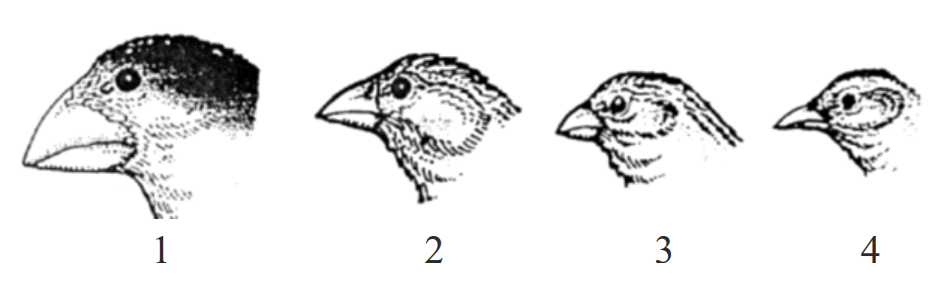 The sketch, showing a series of related species with differently adapted beaks arising from a common ancestor (as with Darwin's finches), depicts adaptive radiation — the evolution of different species from a common ancestor, each adapted to a different niche/habitat.
Convergent evolution - analogous marsupial and placental mammals
-
Match List-I with List-II with respect to convergent evolution and choose the correct answer from the options given below:
Pick the matching item from Column II for each row.
Column I
- A. Lemur
- B. Bobcat
- C. Anteater
- D. Flying squirrels
Column II
- I. Flying phalanger
- II. Numbat
- III. Spotted cuscus
- IV. Tasmanian tiger cat
Correct answer: A → III, B → IV, C → II, D → I
Lemur (placental) is analogous to the Spotted cuscus (marsupial) (A-III); Bobcat is analogous to the Tasmanian tiger cat (B-IV); Anteater is analogous to the Numbat (C-II); Flying squirrels are analogous to the Flying phalanger (D-I).
Evidence for evolution - living fossils, connecting links, vestigial organs, atavism
-
Match List-I with List-II and choose the correct answer from the options given below:
Pick the matching item from Column II for each row.
Column I
- A. Living Fossil
- B. Connecting Link
- C. Vestigial Organ
- D. Atavism
Column II
- I. Elongated canine teeth
- II. Vermiform appendix
- III. Echidna
- IV. Latimeria
Correct answer: A → IV, B → III, C → II, D → I
Living Fossil is exemplified by Latimeria (A-IV); Connecting Link is exemplified by Echidna (B-III); Vestigial Organ is exemplified by the Vermiform appendix (C-II); Atavism is exemplified by elongated canine teeth (D-I).
Geological time scale - Paleozoic era
-
What is the correct order (old to recent) of periods in Paleozoic era?The correct chronological order (old to recent) of these periods in the Paleozoic era is: Silurian, Devonian, Carboniferous, Permian.
That is every question in Evolution for this filter.
Want a score?
Answers here are not saved. Practise as a test to be marked and see your progress.
Practise as a test