Looking for classes? Ksquare Career Institute, Bengaluru →

Chemistry
Alcohols, Phenols and Ethers
65 questions from 33 papers, each with its answer.
- 65 questions
- 33 papers
- 3.69% of Chemistry
Oxidation of primary alcohols to carboxylic acids
-
Reagents which can be used to convert alcohols to carboxylic acids, are
(A) $CrO_3-H_2SO_4$
(B) $K_2Cr_2O_7+H_2SO_4$
(C) $KMnO_4+KOH/H_3O^+$
(D) $Cu, 573 K$
(E) $CrO_3, (CH_3CO)_2O$. Choose the most appropriate answer from the options given below:Strong oxidising agents such as $CrO_3-H_2SO_4$ (A), $K_2Cr_2O_7-H_2SO_4$ (B), and $KMnO_4+KOH/H_3O^+$ (C) can oxidise a primary alcohol all the way to a carboxylic acid. (D) Cu at 573 K only dehydrogenates the alcohol to an aldehyde, and (E) $CrO_3$ with acetic anhydride (Collins-type reagent, Sarrett's reagent variant) typically stops oxidation at the aldehyde stage.
Selective reduction with NaBH4 followed by acid-catalysed dehydration
-
The major product formed in the following conversion is _____.
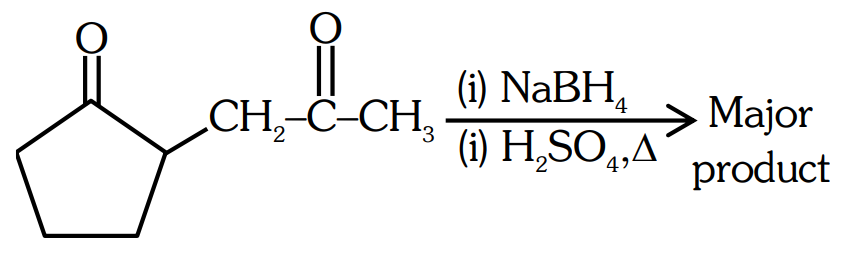 $NaBH_4$ selectively reduces the more reactive ketone in the side chain to a secondary alcohol without touching the ring, giving a diol-like intermediate with $-CH_2-CH(OH)-CH_3$ on the side chain and the ring ketone reduced too, giving $-OH$ on the ring as well. On treatment with $H_2SO_4/\Delta$, acid-catalysed dehydration (E1) occurs at both positions, ultimately giving the major product with a cyclopentene ring conjugated to a $-CH=CH-CH_3$ side chain (the more substituted, conjugated/stable alkene being favoured, per Zaitsev's rule).
That is every question in Alcohols, Phenols and Ethers for this filter.
Show all 65 questions Next: Aldehydes, Ketones and Carboxylic Acids
Want a score?
Answers here are not saved. Practise as a test to be marked and see your progress.
Practise as a test