Looking for classes? Ksquare Career Institute, Bengaluru →

Chemistry
Aldehydes, Ketones and Carboxylic Acids
91 questions from 38 papers, each with its answer.
- 91 questions
- 38 papers
- 5.17% of Chemistry
Acidity of Carboxylic Acids
-
The correct order of decreasing acid strength of trichloroacetic acid (A), trifluoroacetic acid (B), acetic acid (C) and formic acid (D) is:Electron-withdrawing groups (–I effect) stabilise the carboxylate ion and increase acid strength; electron-releasing groups (+I) decrease it.
F is more electronegative than Cl, so $CF_3COOH > CCl_3COOH$.
The $CH_3$ group in acetic acid has a +I effect, so HCOOH > $CH_3COOH$.
Order: $CF_3COOH$ (B) > $CCl_3COOH$ (A) > HCOOH (D) > $CH_3COOH$ (C)
Tests for carbonyl compounds
-
$CH_3CHO$ and $C_6H_5CH_2CHO$ can be distinguished chemically byBoth compounds are aldehydes, so both respond to Fehling's, Benedict's and Tollens' tests. These tests cannot tell them apart.
The iodoform test is given only by aldehydes and ketones that have the $CH_3-CO-$ group.
$CH_3CHO$ has this group: $CH_3CHO + 3I_2 + 4NaOH \rightarrow CHI_3 + HCOONa + 3NaI + 3H_2O$, giving a yellow precipitate of iodoform.
$C_6H_5CH_2CHO$ has no $CH_3-CO-$ group, so it gives no precipitate.
So the two are distinguished by the iodoform test.
Nucleophilic addition reactions
-
Acetone is treated with excess of ethanol in the presence of hydrochloric acid. The product obtained is:In the presence of dry HCl, one molecule of ethanol adds to the carbonyl group of acetone to give a hemiketal, $(CH_3)_2C(OH)(OC_2H_5)$.
With excess ethanol the hemiketal reacts with a second molecule of ethanol, losing water, to give the ketal.
$(CH_3)_2C=O + 2C_2H_5OH \xrightarrow{HCl} (CH_3)_2C(OC_2H_5)_2 + H_2O$
So the product is 2,2-diethoxypropane, $(CH_3)_2C(OC_2H_5)_2$.
Reactions of carboxylic acids
-
In the following sequence of reactions $CH_3-Br \xrightarrow{KCN} A \xrightarrow{H_3O^+} B \xrightarrow[ether]{LiAlH_4} C$, the end product (C) is$CH_3Br \xrightarrow{KCN} CH_3CN$ (A, methyl cyanide) by nucleophilic substitution
$CH_3CN \xrightarrow{H_3O^+} CH_3COOH$ (B, acetic acid) by hydrolysis
$CH_3COOH \xrightarrow[ether]{LiAlH_4} CH_3CH_2OH$ (C) by reduction
So C is ethyl alcohol.
Cannizzaro reaction
-
Predict the products in the given reaction:
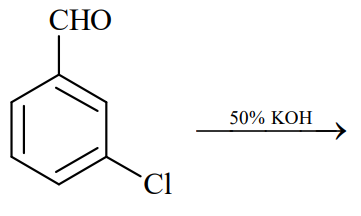
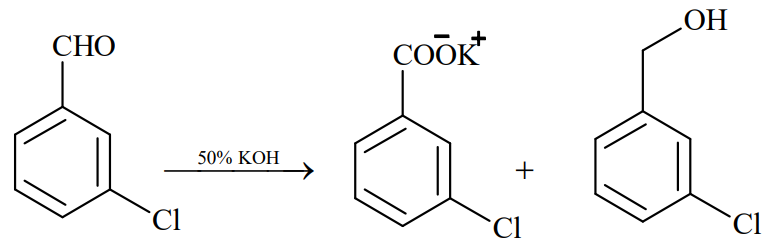
m-Chlorobenzaldehyde has no α-hydrogen, so with concentrated (50%) KOH it undergoes the Cannizzaro reaction.
One molecule is oxidised to the salt of the acid and another is reduced to the alcohol.
$2\,m\text{-}ClC_6H_4CHO \xrightarrow{50\%\ KOH} m\text{-}ClC_6H_4COO^-K^+ + m\text{-}ClC_6H_4CH_2OH$
The Cl on the ring is not replaced. The products are m-chlorobenzyl alcohol and the m-chlorobenzoate ion.
That is every question in Aldehydes, Ketones and Carboxylic Acids for this filter.
Want a score?
Answers here are not saved. Practise as a test to be marked and see your progress.
Practise as a test