Looking for classes? Ksquare Career Institute, Bengaluru →

Chemistry
Aldehydes, Ketones and Carboxylic Acids
91 questions from 38 papers, each with its answer.
- 91 questions
- 38 papers
- 5.17% of Chemistry
Preparation of Aldehydes
-
The incorrect method to synthesize benzaldehyde is:Benzonitrile with $CH_3MgBr$ followed by hydrolysis gives acetophenone ($C_6H_5COCH_3$), a ketone, not benzaldehyde. Benzoyl chloride with $H_2$/Pd-$BaSO_4$ (Rosenmund reduction), ethyl benzoate with DIBAL-H, and toluene with $CrO_2Cl_2$ (Etard reaction) all give benzaldehyde.
Nucleophilic Addition and Addition-Elimination Reactions
-
Which of the following reactions is not an example for nucleophilic addition - elimination reaction?In nucleophilic addition-elimination reactions a water molecule is eliminated along with the product (imines, oximes, hydrazones). The reaction of $CH_3CHO$ with $NaHSO_3$ is only an addition reaction (bisulphite adduct).
Cyanohydrin formation and decarboxylation
-
The below product formed from the following reaction sequence is:
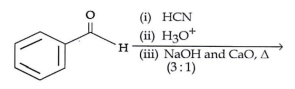 Benzaldehyde + HCN gives the cyanohydrin $C_6H_5CH(OH)CN$; acid hydrolysis gives $C_6H_5CH(OH)COOH$; heating with sodalime (NaOH + CaO, a decarboxylating reagent) removes $CO_2$ to give benzyl alcohol $C_6H_5CH_2OH$.
Grignard carboxylation and amide formation
-
The products A and B in the following reaction sequence are:
 Styrene + HBr (Markovnikov) gives 1-bromo-1-phenylethane; with Mg in dry ether it forms the Grignard reagent, which on reaction with $CO_2$ followed by $H_3O^+$ gives 2-phenylpropanoic acid (A). $SOCl_2$ converts A to the acid chloride, which with $CH_3NH_2$ gives N-methyl-2-phenylpropanamide (B).
That is every question in Aldehydes, Ketones and Carboxylic Acids for this filter.
Want a score?
Answers here are not saved. Practise as a test to be marked and see your progress.
Practise as a test