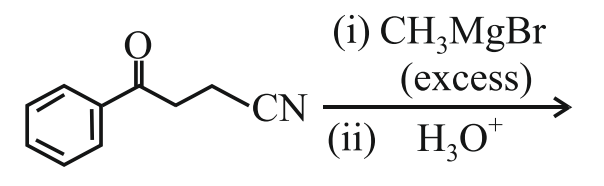
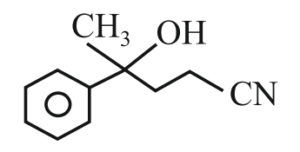
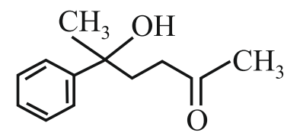
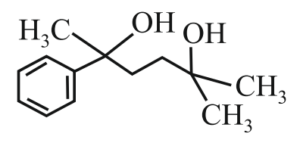
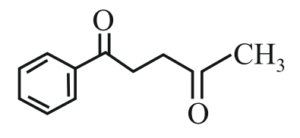
Excess $\text{CH}_3\text{MgBr}$ attacks both the ketone (forming a tertiary alcohol) and the nitrile (forming a methyl ketone after hydrolysis), yielding $\text{C}_6\text{H}_5-\text{C(OH)(CH}_3)-\text{CH}_2-\text{CH}_2-\text{COCH}_3$.
The starting compound contains two electrophilic functional groups: a ketone and a nitrile. Step 1: Grignard addition of $\text{CH}_3\text{MgBr}$ to the ketone gives a magnesium alkoxide: $\text{C}_6\text{H}_5-\text{C(O}^-\text{MgBr}^+)(\text{CH}_3)-\text{CH}_2-\text{CH}_2-\text{CN}$. Step 2: Another equivalent of $\text{CH}_3\text{MgBr}$ adds to the nitrile group to form an imine magnesium salt: $-\text{C}(=\text{N}^-\text{MgBr}^+)\text{CH}_3$. Step 3: Acidic aqueous workup ($\text{H}_3\text{O}^+$) protonates the alkoxide to a tertiary alcohol ($-\text{C(OH)(CH}_3)-$) and hydrolyzes the imine complex into a methyl ketone ($-\text{COCH}_3$). The major product is 5-hydroxy-5-phenylhexan-2-one (Option 2).
ConceptGrignard Addition to Ketones and Nitriles
Aldehydes, Ketones and Carboxylic Acids in past papers
91 questions from this chapter have appeared across 27 exam years.