Looking for classes? Ksquare Career Institute, Bengaluru →

Consider the following compounds.
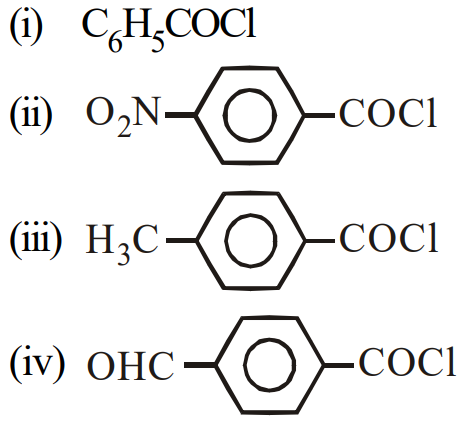
The correct decreasing order of their reactivity towards hydrolysis is
The correct decreasing order of their reactivity towards hydrolysis is
A
(i) > (ii) > (iii) > (iv)
B
(iv) > (ii) > (i) > (iii)
C
(ii) > (iv) > (i) > (iii)
D
(ii) > (iv) > (iii) > (i)
Detailed Solution
Hydrolysis of an acid chloride is a nucleophilic attack of water on the carbonyl carbon.
The ease of hydrolysis increases as the magnitude of the positive charge on the carbonyl carbon increases.
An electron withdrawing group on the ring increases this positive charge, while an electron releasing group decreases it.
Among the substituents, $-NO_2$ and $-CHO$ are electron withdrawing groups, and $-NO_2$ withdraws electrons more strongly than $-CHO$.
On the other hand, $-CH_3$ is an electron releasing group ($+I$ and hyperconjugation), so it lowers the reactivity below that of unsubstituted benzoyl chloride.
Therefore the order of reactivity towards hydrolysis is: $p\text{-}O_2N-C_6H_4COCl \gt p\text{-}OHC-C_6H_4COCl \gt C_6H_5COCl \gt p\text{-}H_3C-C_6H_4COCl$
That is, (ii) > (iv) > (i) > (iii).
The ease of hydrolysis increases as the magnitude of the positive charge on the carbonyl carbon increases.
An electron withdrawing group on the ring increases this positive charge, while an electron releasing group decreases it.
Among the substituents, $-NO_2$ and $-CHO$ are electron withdrawing groups, and $-NO_2$ withdraws electrons more strongly than $-CHO$.
On the other hand, $-CH_3$ is an electron releasing group ($+I$ and hyperconjugation), so it lowers the reactivity below that of unsubstituted benzoyl chloride.
Therefore the order of reactivity towards hydrolysis is: $p\text{-}O_2N-C_6H_4COCl \gt p\text{-}OHC-C_6H_4COCl \gt C_6H_5COCl \gt p\text{-}H_3C-C_6H_4COCl$
That is, (ii) > (iv) > (i) > (iii).