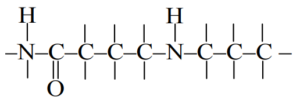
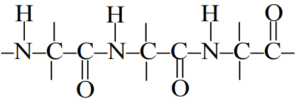
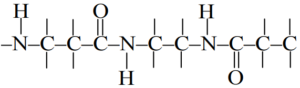
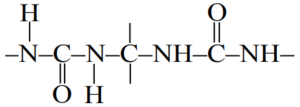
Which one of the following structures represents the peptide chain :-
A
-
B
-
C
-
D
-
The answer is B.
Solution
Proteins are polymers of $\alpha$-amino acids, $H_2N-CHR-COOH$. In an $\alpha$-amino acid, the amino group and the carboxyl group are attached to the same ($\alpha$) carbon. When amino acids join, the $-COOH$ of one combines with the $-NH_2$ of the next, eliminating water and forming a peptide bond $-CO-NH-$. So a peptide chain has the repeating unit $-NH-CHR-CO-$: nitrogen, then one $\alpha$ carbon, then a carbonyl carbon, then nitrogen again. The chain $-NH-C-CO-NH-C-CO-NH-C-CO-$ has exactly this repeating pattern, so it represents a peptide chain. The other chains have two or three carbons between the N and the C=O, or have $-NH-CO-NH-$ (urea-type) linkages, so they do not correspond to $\alpha$-amino acid units. So the peptide chain is $-NH-C-CO-NH-C-CO-NH-C-CO-$.
ConceptStructure of a polypeptide backbone
Proteins – peptide bond in past papers
3 questions from this chapter have appeared across 3 exam years.