Solution

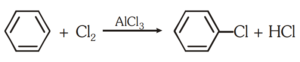
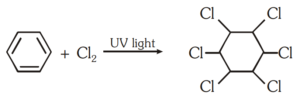
Chlorination of benzene with $Cl_2$ in presence of anhydrous $AlCl_3$ proceeds through electrophilic substitution: $C_6H_6+Cl_2\xrightarrow{AlCl_3}C_6H_5Cl+HCl$ Generation of electrophile: $Cl-Cl+AlCl_3\rightarrow Cl^++AlCl_4^-$ $Cl^+$ attacks the benzene ring to form the arenium ion (σ-complex), which loses $H^+$ to give chlorobenzene. (The Sandmeyer reaction is not an electrophilic substitution, $Cl_2$/UV light gives an addition product, and $C_6H_5CH_2OH$ + HCl is nucleophilic substitution.)

Concept identifying an electrophilic substitution reaction

Hydrocarbons in past papers

75 questions from this chapter have appeared across 26 exam years.