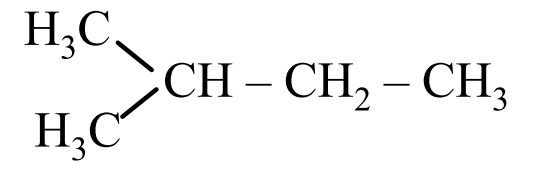
How many products (including stereoisomers) are expected from monochlorination of the following compound?
The answer is D.
Solution
Monochlorination yields 4 constitutional isomers: 1-chloro-2-methylbutane (2 stereoisomers: d, l), 2-chloro-2-methylbutane (1 achiral), 2-chloro-3-methylbutane (2 stereoisomers: d, l), and 1-chloro-3-methylbutane (1 achiral). Total $= 2 + 1 + 2 + 1 = 6$.
Monochlorination of 2-methylbutane produces substitution at 4 distinct carbon positions: 1. At C-1 (or C-1'): $\text{CH}_2\text{Cl}-\text{CH}(\text{CH}_3)-\text{CH}_2-\text{CH}_3$ (1-chloro-2-methylbutane, C-2 is chiral $\implies$ 2 enantiomers). 2. At C-2: $\text{CH}_3-\text{C(Cl)}(\text{CH}_3)-\text{CH}_2-\text{CH}_3$ (2-chloro-2-methylbutane, achiral $\implies$ 1 product). 3. At C-3: $\text{CH}_3-\text{CH}(\text{CH}_3)-\text{CH(Cl)}-\text{CH}_3$ (2-chloro-3-methylbutane, C-3 is chiral $\implies$ 2 enantiomers). 4. At C-4: $\text{CH}_3-\text{CH}(\text{CH}_3)-\text{CH}_2-\text{CH}_2\text{Cl}$ (1-chloro-3-methylbutane, achiral $\implies$ 1 product). Total products including stereoisomers $= 2 + 1 + 2 + 1 = 6$.
Concept
Stereoisomerism in Alkane Halogenation
Free Radical Halogenation of Alkanes in past papers
2 questions from this chapter have appeared across 2 exam years.