Looking for classes? Ksquare Career Institute, Bengaluru →

The stability of carbanions in the following :
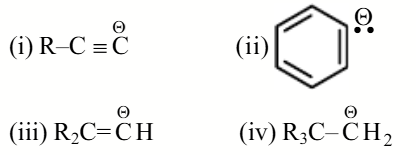
is in the order of :
is in the order of :
A
(iv) > (ii) > (iii) > (i)
B
(i) > (iii) > (ii) > (iv)
C
(i) > (ii) > (iii) > (iv)
D
(ii) > (iii) > (iv) > (i)
Detailed Solution
More the electronegativity of the hybrid atom carrying the negative charge, more is its tendency to retain the (-)ve charge, and more stable is the carbanion.
The electronegativity of hybrid orbitals depends on their s-character. It follows the order: $sp \gt sp^2 \gt sp^3$
(i) $R-C\equiv C^{\ominus}$: the negative charge is on an $sp$ carbon (50 percent s-character), so it is the most stable.
(ii) Phenyl carbanion: the negative charge is on an $sp^2$ carbon of the ring.
(iii) $R_2C=\overset{\ominus}{C}H$: the negative charge is on an $sp^2$ carbon, but the two electron releasing alkyl groups ($+I$ effect) on the adjacent carbon intensify the charge, so it is less stable than (ii).
(iv) $R_3C-\overset{\ominus}{C}H_2$: the negative charge is on an $sp^3$ carbon (25 percent s-character) and is further destabilised by the $+I$ effect of the alkyl groups, so it is the least stable.
Order of stability: (i) > (ii) > (iii) > (iv)
The electronegativity of hybrid orbitals depends on their s-character. It follows the order: $sp \gt sp^2 \gt sp^3$
(i) $R-C\equiv C^{\ominus}$: the negative charge is on an $sp$ carbon (50 percent s-character), so it is the most stable.
(ii) Phenyl carbanion: the negative charge is on an $sp^2$ carbon of the ring.
(iii) $R_2C=\overset{\ominus}{C}H$: the negative charge is on an $sp^2$ carbon, but the two electron releasing alkyl groups ($+I$ effect) on the adjacent carbon intensify the charge, so it is less stable than (ii).
(iv) $R_3C-\overset{\ominus}{C}H_2$: the negative charge is on an $sp^3$ carbon (25 percent s-character) and is further destabilised by the $+I$ effect of the alkyl groups, so it is the least stable.
Order of stability: (i) > (ii) > (iii) > (iv)