Looking for classes? Ksquare Career Institute, Bengaluru →

From the following bond energies:
H–H bond energy: 431.37 kJ $mol^{-1}$
C=C bond energy: 606.10 kJ $mol^{-1}$
C–C bond energy: 336.49 kJ $mol^{-1}$
C–H bond energy: 410.50 kJ $mol^{-1}$
Enthalpy for the reaction,
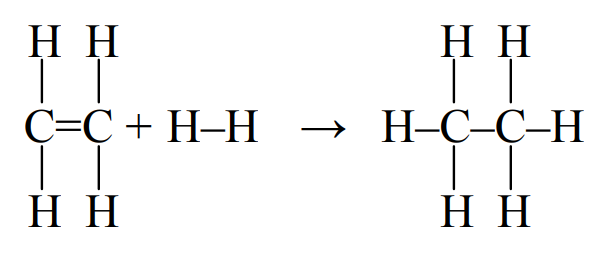 will be
H–H bond energy: 431.37 kJ $mol^{-1}$
C=C bond energy: 606.10 kJ $mol^{-1}$
C–C bond energy: 336.49 kJ $mol^{-1}$
C–H bond energy: 410.50 kJ $mol^{-1}$
Enthalpy for the reaction,
will be
A
553.0 kJ $mol^{-1}$
B
1523.6 kJ $mol^{-1}$
C
–243.6 kJ $mol^{-1}$
D
–120.0 kJ $mol^{-1}$
Detailed Solution
$\Delta H$ = (sum of bond energies of bonds broken) − (sum of bond energies of bonds formed)
Bonds broken (reactants): 1 C=C + 4 C–H + 1 H–H = $606.10 + 4(410.50) + 431.37 = 2679.47$ kJ
Bonds formed (product, ethane): 1 C–C + 6 C–H = $336.49 + 6(410.50) = 2799.49$ kJ
$\Delta H = 2679.47 - 2799.49$
$\Delta H = -120.02 \approx -120.0$ kJ $mol^{-1}$
Bonds broken (reactants): 1 C=C + 4 C–H + 1 H–H = $606.10 + 4(410.50) + 431.37 = 2679.47$ kJ
Bonds formed (product, ethane): 1 C–C + 6 C–H = $336.49 + 6(410.50) = 2799.49$ kJ
$\Delta H = 2679.47 - 2799.49$
$\Delta H = -120.02 \approx -120.0$ kJ $mol^{-1}$