Looking for classes? Ksquare Career Institute, Bengaluru →

Consider the reversible processes for 1.0 mol of an ideal gas as shown in the figure.
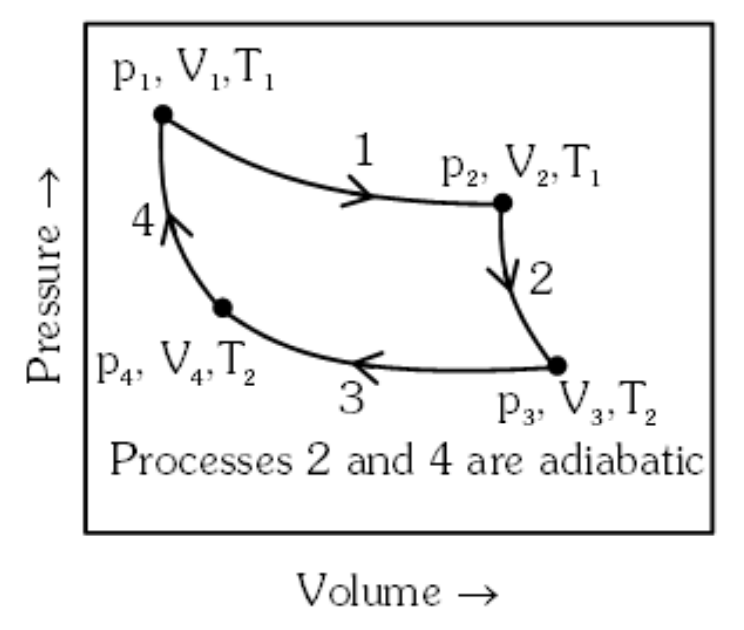 $w_1$, $w_2$, $w_3$ and $w_4$ represent work done (in calories) in the processes 1, 2, 3 and 4, respectively; $\Delta U_2$ and $\Delta U_4$ are changes in the internal energy for the processes 2 and 4, respectively. [use R = 2 cal K$^{-1}$ mol$^{-1}$] The correct option is
$w_1$, $w_2$, $w_3$ and $w_4$ represent work done (in calories) in the processes 1, 2, 3 and 4, respectively; $\Delta U_2$ and $\Delta U_4$ are changes in the internal energy for the processes 2 and 4, respectively. [use R = 2 cal K$^{-1}$ mol$^{-1}$] The correct option isDetailed Solution
Process 1 (isothermal, reversible): $w_1=-nRT_1\ln\frac{V_2}{V_1}=-2T_1\ln\frac{V_2}{V_1}$. Process 3 (isothermal, reversible): $w_3=-2T_2\ln\frac{V_4}{V_3}$. So $w_1+w_3=-2T_1\ln\frac{V_2}{V_1}-2T_2\ln\frac{V_4}{V_3}$. Process 2 (adiabatic expansion): $w_2=\Delta U_2=C_V(T_2-T_1)$. Process 4 (adiabatic compression): $w_4=\Delta U_4=C_V(T_1-T_2)$, so $w_2+w_4=\Delta U_2+\Delta U_4=0$.