2018 Dual Nature of Radiation and Matterde Broglie wavelength of accelerated electron Medium Question 29 of 82 in Dual Nature of Radiation and Matter

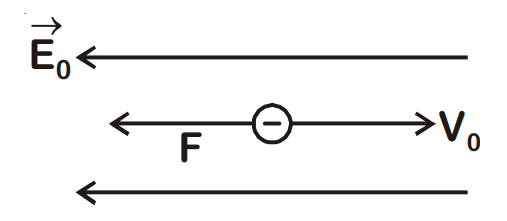
An electron of mass m with an initial velocity $\vec{V} = V_0\hat{i}\ (V_0 > 0)$ enters an electric field $\vec{E} = -E_0\hat{i}$ ($E_0$ = constant > 0) at t = 0. If $\lambda_0$ is its de-Broglie wavelength initially, then its de-Broglie wavelength at time t is

A $\lambda_0 t$
B $\lambda_0\left(1 + \frac{eE_0}{mV_0}t\right)$
C $\frac{\lambda_0}{\left(1 + \frac{eE_0}{mV_0}t\right)}$
D $\lambda_0$

The answer is C.
Solution

The electron speeds up, so $\lambda = h/mV$ decreases as $\lambda_0/(1 + eE_0t/mV_0)$.

Initial de-Broglie wavelength $\lambda_0 = \frac{h}{mV_0}$ ...(i)

Acceleration of electron $a = \frac{eE_0}{m}$ (along +x, since the field is along –x)
Velocity after time t: $V = V_0 + \frac{eE_0}{m}t$
So, $\lambda = \frac{h}{mV} = \frac{h}{m\left(V_0 + \frac{eE_0}{m}t\right)} = \frac{h}{mV_0\left[1 + \frac{eE_0}{mV_0}t\right]}$ ...(ii)
Divide (ii) by (i): $\lambda = \frac{\lambda_0}{\left[1 + \frac{eE_0}{mV_0}t\right]}$

Concept de-broglie-wavelength-electric-field

Dual Nature of Radiation and Matter in past papers

82 questions from this chapter have appeared across 27 exam years.
