Looking for classes? Ksquare Career Institute, Bengaluru →

Two identical charged spheres suspended from a common point by two massless strings of lengths l, are initially at a distance d (d << l) apart because of their mutual repulsion. The charges begin to leak from both the spheres at a constant rate. As a result, the spheres approach each other with a velocity v. Then, v varies as a function of the distance x between the sphere, as
A
$v \propto x$
B
$v \propto x^{-\frac{1}{2}}$
C
$v \propto x^{-1}$
D
$v \propto x^{\frac{1}{2}}$
Explanation
$q \propto x^{3/2}$; constant dq/dt gives $v \propto x^{-1/2}$.
Detailed Solution
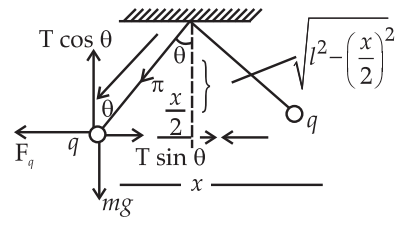
$T\cos\theta = mg$ ...(i) and $T\sin\theta = F_q$ ...(ii), so $\tan\theta = \frac{F_q}{mg}$
For $l >> x$: $\tan\theta \approx \frac{x}{2l}$, so $\frac{q^2}{4\pi\varepsilon_0x^2mg} = \frac{x}{2l}$
$q^2 = \frac{4\pi\varepsilon_0mg}{2l}x^3 \Rightarrow q \propto x^{3/2}$
Differentiating: $\frac{dq}{dt} \propto \frac{3}{2}x^{1/2}\frac{dx}{dt} \Rightarrow \frac{dq}{dt} \propto \sqrt{x}\,v$
Since $\frac{dq}{dt}$ is constant, $v \propto \frac{1}{\sqrt{x}} = x^{-1/2}$