Looking for classes? Ksquare Career Institute, Bengaluru →

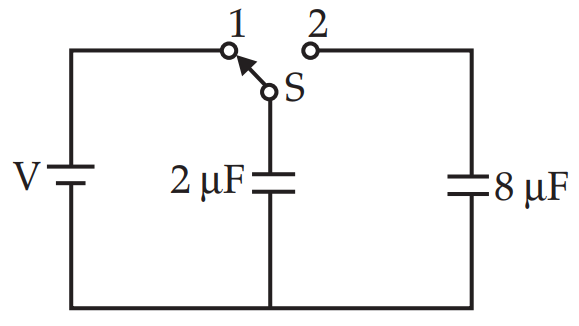
A capacitor of 2 $\mu F$ is charged as shown in the figure. When the switch S is turned to position 2, the percentage of its stored energy dissipated is
A
20%
B
75%
C
80%
D
0%
Explanation
Fraction lost $= C_2/(C_1 + C_2) = 8/10$.
Detailed Solution
Given $C_1 = 2\ \mu F$, $C_2 = 8\ \mu F$.
Case I (switch at 1): energy stored $E_1 = \frac{1}{2}C_1V^2 = \frac{1}{2}(2\times10^{-6})V^2$ ...(i)
Case II (switch at 2): charge flows from $C_1$ to $C_2$ until both are at the same potential $V_1 = \frac{q}{C_1 + C_2} = \frac{C_1V}{C_1 + C_2}$ (here $q = C_1V$).
Final energy $E_2 = \frac{1}{2}(C_1 + C_2)V_1^2 = \frac{1}{2}(2 + 8)\times10^{-6}\left(\frac{2V}{10}\right)^2 = \frac{4\times10^{-6}V^2}{2\times10}$
Percentage loss $= \left(\frac{E_1 - E_2}{E_1}\right)\times100 = \frac{\frac{2\times10^{-6}V^2}{2} - \frac{4\times10^{-6}V^2}{20}}{\frac{2\times10^{-6}V^2}{2}}\times100 = 80\%$
So 80% of the stored energy is dissipated.
Case I (switch at 1): energy stored $E_1 = \frac{1}{2}C_1V^2 = \frac{1}{2}(2\times10^{-6})V^2$ ...(i)
Case II (switch at 2): charge flows from $C_1$ to $C_2$ until both are at the same potential $V_1 = \frac{q}{C_1 + C_2} = \frac{C_1V}{C_1 + C_2}$ (here $q = C_1V$).
Final energy $E_2 = \frac{1}{2}(C_1 + C_2)V_1^2 = \frac{1}{2}(2 + 8)\times10^{-6}\left(\frac{2V}{10}\right)^2 = \frac{4\times10^{-6}V^2}{2\times10}$
Percentage loss $= \left(\frac{E_1 - E_2}{E_1}\right)\times100 = \frac{\frac{2\times10^{-6}V^2}{2} - \frac{4\times10^{-6}V^2}{20}}{\frac{2\times10^{-6}V^2}{2}}\times100 = 80\%$
So 80% of the stored energy is dissipated.