Looking for classes? Ksquare Career Institute, Bengaluru →

Two condensers, one of capacity $C$ and other of capacity $\dfrac{C}{2}$, are connected to a V-volt battery, as shown.
(The two condensers are connected in parallel across the battery.)
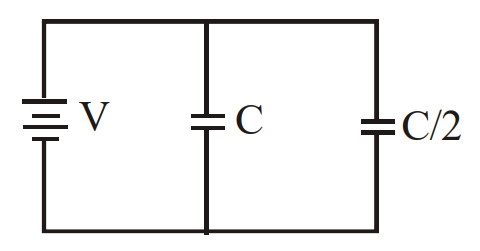
The work done in charging fully both the condensers is
(The two condensers are connected in parallel across the battery.)
The work done in charging fully both the condensers is
A
$\dfrac{1}{4}CV^2$
B
$\dfrac{3}{4}CV^2$
C
$\dfrac{1}{2}CV^2$
D
$2CV^2$
Detailed Solution
The two condensers are in parallel across the battery, so each is charged to the potential difference $V$.
Equivalent capacitance: $C_{eq} = C + \dfrac{C}{2} = \dfrac{3C}{2}$
Work done in charging = change in the stored energy $= \dfrac{1}{2}C_{eq}V^2$
$= \dfrac{1}{2}\left(C + \dfrac{C}{2}\right)V^2$
$= \dfrac{1}{2}\left(\dfrac{3C}{2}\right)V^2$
$= \dfrac{3}{4}CV^2$
Equivalent capacitance: $C_{eq} = C + \dfrac{C}{2} = \dfrac{3C}{2}$
Work done in charging = change in the stored energy $= \dfrac{1}{2}C_{eq}V^2$
$= \dfrac{1}{2}\left(C + \dfrac{C}{2}\right)V^2$
$= \dfrac{1}{2}\left(\dfrac{3C}{2}\right)V^2$
$= \dfrac{3}{4}CV^2$