Looking for classes? Ksquare Career Institute, Bengaluru →

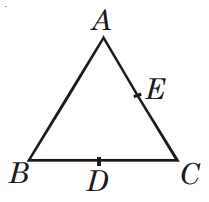
Three charges, each +q, are placed at the corners of an isosceles triangle ABC of sides BC and AC, 2a. D and E are the mid points of BC and CA. The work done in taking a charge Q from D to E is
A
Zero
B
$\frac{3qQ}{4\pi\varepsilon_0a}$
C
$\frac{3qQ}{8\pi\varepsilon_0a}$
D
$\frac{qQ}{4\pi\varepsilon_0a}$
Detailed Solution
Work done in moving a charge Q from D to E: $W = Q(V_E - V_D)$
BC = AC = 2a. D is the midpoint of BC, so DB = DC = a; E is the midpoint of CA, so EC = EA = a.
By the symmetry of the isosceles triangle about the bisector of angle C, the distance of D from A equals the distance of E from B: AD = BE.
$V_D = \frac{q}{4\pi\varepsilon_0}\left(\frac{1}{a} + \frac{1}{a} + \frac{1}{AD}\right)$
$V_E = \frac{q}{4\pi\varepsilon_0}\left(\frac{1}{a} + \frac{1}{a} + \frac{1}{BE}\right)$
Since AD = BE, $V_D = V_E$.
$W = Q(V_E - V_D) = 0$
BC = AC = 2a. D is the midpoint of BC, so DB = DC = a; E is the midpoint of CA, so EC = EA = a.
By the symmetry of the isosceles triangle about the bisector of angle C, the distance of D from A equals the distance of E from B: AD = BE.
$V_D = \frac{q}{4\pi\varepsilon_0}\left(\frac{1}{a} + \frac{1}{a} + \frac{1}{AD}\right)$
$V_E = \frac{q}{4\pi\varepsilon_0}\left(\frac{1}{a} + \frac{1}{a} + \frac{1}{BE}\right)$
Since AD = BE, $V_D = V_E$.
$W = Q(V_E - V_D) = 0$