Looking for classes? Ksquare Career Institute, Bengaluru →

A 1 kg stationary bomb is exploded in three parts having mass 1 : 1 : 3 respectively. Parts having same mass move in perpendicular directions with velocity 30 m s$^{-1}$, then the velocity of bigger part will be : -
A
$10\sqrt{2}$ m s$^{-1}$
B
$\dfrac{10}{\sqrt{2}}$ m s$^{-1}$
C
$15\sqrt{2}$ m s$^{-1}$
D
$\dfrac{15}{\sqrt{2}}$ m s$^{-1}$
Detailed Solution
Let the masses be m, m and 3m. The bomb was at rest, so the total momentum after the explosion is zero.
The two equal parts have momenta 30m each, in perpendicular directions. Their resultant is $\sqrt{(30m)^2 + (30m)^2} = 30\sqrt{2}m$.
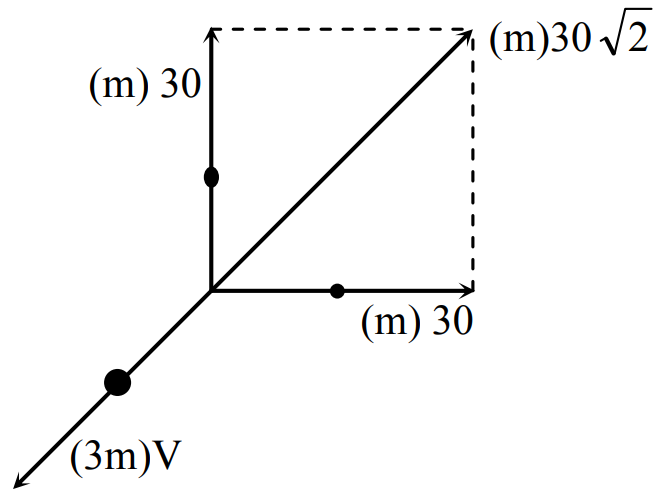
Apply conservation of linear momentum: the third part's momentum must be equal and opposite to this resultant.
$3mV = 30\sqrt{2}m$
$V = 10\sqrt{2}$ m s$^{-1}$
The two equal parts have momenta 30m each, in perpendicular directions. Their resultant is $\sqrt{(30m)^2 + (30m)^2} = 30\sqrt{2}m$.
Apply conservation of linear momentum: the third part's momentum must be equal and opposite to this resultant.
$3mV = 30\sqrt{2}m$
$V = 10\sqrt{2}$ m s$^{-1}$