2025 Mechanical Properties of FluidsSurface Tension Medium Question 1 of 3 in Surface Tension

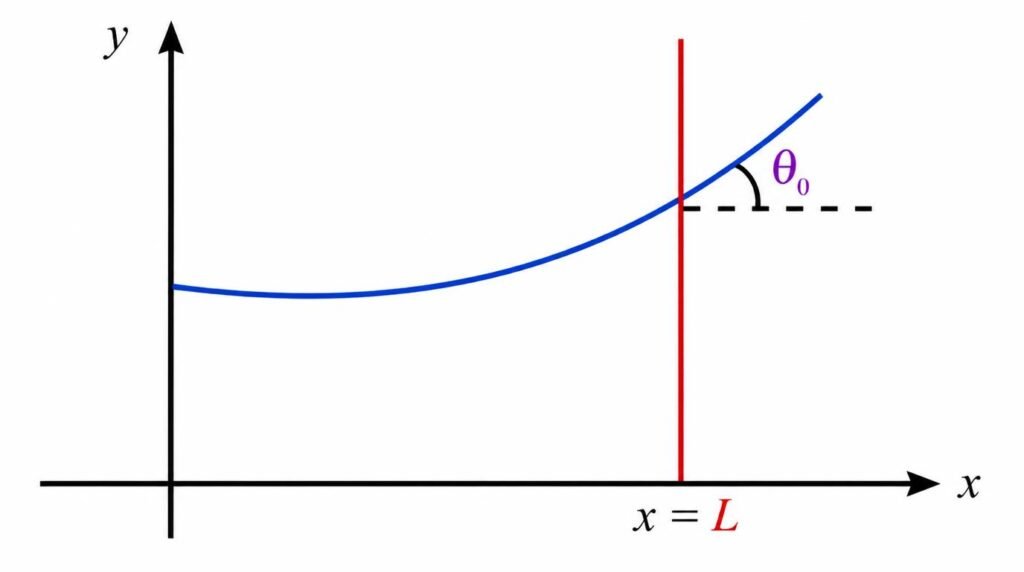
Consider a water tank shown in the figure. It has one wall at $x = L$ and can be taken to be very wide in the $z$ direction. When filled with a liquid of surface tension $S$ and density $\rho$, the liquid surface makes angle $\theta_{0} (\theta_{0} \ll 1)$ with the $x$-axis at $x = L$. If $y(x)$ is the height of the surface then the equation for $y(x)$ is:
(take $\theta(x) = \sin\theta(x) = \tan\theta(x) = \frac{dy}{dx}$, $g$ is the acceleration due to gravity)
A $\frac{d^2y}{dx^2} = \frac{\rho g}{S} x$
B $\frac{d^2y}{dx^2} = \frac{\rho g}{S} y$
C $\frac{d^2y}{dx^2} = \sqrt{\frac{\rho g}{S}}$
D $\frac{dy}{dx} = \sqrt{\frac{\rho g}{S}} x$

The answer is B.

Solution

Balancing the vertical surface tension force component with the weight of the elevated liquid yields $\frac{d^2y}{dx^2} = \frac{\rho g}{S} y$.

For an element of width $dx$ and length $z$ along the surface: The net vertical force due to surface tension is $dF_y = S z \, d\theta = S z \left(\frac{d^2y}{dx^2}\right) dx$. In equilibrium, this balances the weight of the liquid column lifted above the zero level, which is $dW = (dx \cdot z \cdot y) \rho g$. Equating them gives $S z \left(\frac{d^2y}{dx^2}\right) dx = \rho g z y \, dx \implies \frac{d^2y}{dx^2} = \frac{\rho g}{S} y$.

Concept Meniscus Curvature and Surface Tension

Surface Tension in past papers

3 questions from this chapter have appeared across 3 exam years.
