Looking for classes? Ksquare Career Institute, Bengaluru →

Under the influence of a uniform magnetic field a charged particle is moving in a circle of radius $R$ with constant speed $v$. The time period of the motion
A
depends on both $R$ and $v$
B
is independent of both $R$ and $v$
C
depends on $R$ and not on $v$
D
depends on $v$ and not on $R$
Detailed Solution
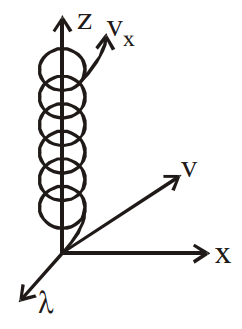
The magnetic force provides the centripetal force: $qvB = \dfrac{mv^2}{R}$
$\Rightarrow R = \dfrac{mv}{qB}$
Time period: $T = \dfrac{2\pi R}{v} = \dfrac{2\pi}{v} \times \dfrac{mv}{qB}$
$T = \dfrac{2\pi m}{qB}$
The speed $v$ cancels out: a faster particle moves in a proportionally bigger circle, so the time for one revolution is the same.
The time period depends only on the mass, the charge and the magnetic field, so it is independent of both $R$ and $v$.