Looking for classes? Ksquare Career Institute, Bengaluru →

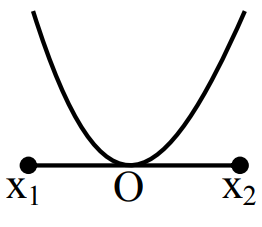
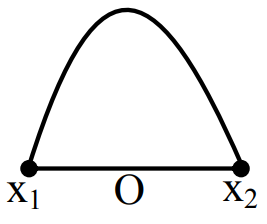
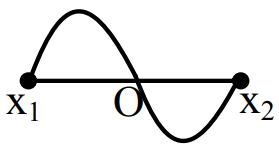
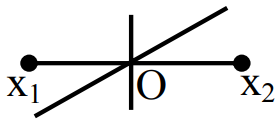
A particle of mass m oscillates with simple harmonic motion between points $x_1$ and $x_2$, the equilibrium position being O. Its potential energy is plotted. It will be as given below in the graph :
A
- 
B
- 
C
- 
D
- 
Detailed Solution
Potential energy in SHM: $U = \dfrac{1}{2}kx^2$, where x is the displacement from the equilibrium position O.
This is the equation of a parabola.
U is minimum (zero) at O ($x = 0$) and increases on both sides, reaching its maximum value $\dfrac{1}{2}kA^2$ at the extreme points $x_1$ and $x_2$.
U is never negative and is symmetric about O.
So the graph is an upward opening parabola with its minimum at O.
This is the equation of a parabola.
U is minimum (zero) at O ($x = 0$) and increases on both sides, reaching its maximum value $\dfrac{1}{2}kA^2$ at the extreme points $x_1$ and $x_2$.
U is never negative and is symmetric about O.
So the graph is an upward opening parabola with its minimum at O.