Looking for classes? Ksquare Career Institute, Bengaluru →

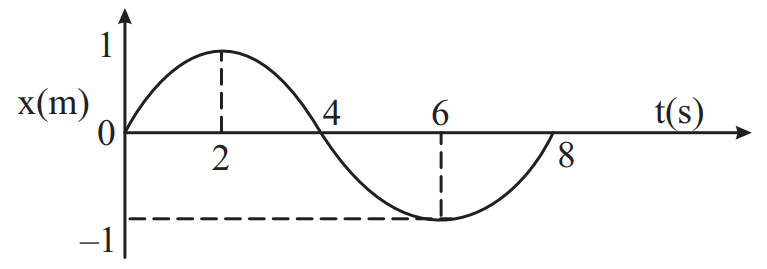
The x–t graph of a particle performing simple harmonic motion is shown in the figure. The acceleration of the particle at $t=2\ s$ is:
A
$-\frac{\pi^2}{16}\ ms^{-2}$
B
$\frac{\pi^2}{8}\ ms^{-2}$
C
$-\frac{\pi^2}{8}\ ms^{-2}$
D
$\frac{\pi^2}{16}\ ms^{-2}$
Explanation
From the graph $A=1$, $T=8$, so $\omega=\frac{\pi}{4}$ and $a=-\omega^2x=-\frac{\pi^2}{16}$ at $x=1$.
Detailed Solution
From the x–t graph, $A=1$, $T=8$
$\Rightarrow\omega=\frac{2\pi}{T}=\frac{\pi}{4}$
At $t=2$, $x=1$: $a=-\omega^2x$
$\Rightarrow a=-\frac{\pi^2}{16}\times1=-\frac{\pi^2}{16}\ m/s^2$