Looking for classes? Ksquare Career Institute, Bengaluru →

A plano convex lens fits exactly into a plano concave lens. Their plane surfaces are parallel to each other. If lenses are made of different materials of refractive indices $\mu_1$ and $\mu_2$ and R is the radius of curvature of the curved surface of the lenses, then the focal length of combination is
A
$\frac{2R}{(\mu_2 - \mu_1)}$
B
$\frac{R}{2(\mu_1 + \mu_2)}$
C
$\frac{R}{2(\mu_1 - \mu_2)}$
D
$\frac{R}{(\mu_1 - \mu_2)}$
Detailed Solution
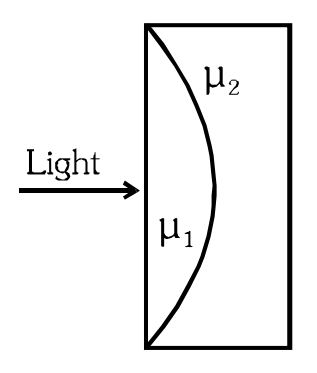
$\frac{1}{f_{eq}} = \frac{1}{f_1} + \frac{1}{f_2}$
$\frac{1}{f_{eq}} = (\mu_1 - 1)\left(\frac{1}{R}\right) + (\mu_2 - 1)\left(-\frac{1}{R}\right) = \frac{\mu_1 - \mu_2}{R}$
$f_{eq} = \frac{R}{\mu_1 - \mu_2}$