Looking for classes? Ksquare Career Institute, Bengaluru →

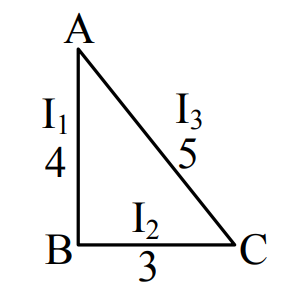
For the adjoining diagram, a triangular lamina is shown. The correct relation between $I_1$, $I_2$ and $I_3$ is (I – moment of inertia)
A
$I_1 \gt I_2$
B
$I_2 \gt I_1$
C
$I_3 \gt I_1$
D
$I_3 \gt I_2$
Detailed Solution
For a triangular lamina, the moment of inertia about a side depends on how far the mass lies from that side. About a side, $I = \dfrac{1}{6}Mh^2$, where h is the height (altitude) of the triangle on that side.
Altitude on AB (length 4) is BC = 3, so $I_1 = \dfrac{1}{6}M(3)^2 = 1.5M$.
Altitude on BC (length 3) is AB = 4, so $I_2 = \dfrac{1}{6}M(4)^2 = 2.67M$.
Altitude on AC (length 5) is $\dfrac{3 \times 4}{5} = 2.4$, so $I_3 = \dfrac{1}{6}M(2.4)^2 = 0.96M$.
So about the longest side the moment of inertia is least, and about the shortest side it is greatest: $I_2 \gt I_1 \gt I_3$.
Hence $I_2 \gt I_1$.
Altitude on AB (length 4) is BC = 3, so $I_1 = \dfrac{1}{6}M(3)^2 = 1.5M$.
Altitude on BC (length 3) is AB = 4, so $I_2 = \dfrac{1}{6}M(4)^2 = 2.67M$.
Altitude on AC (length 5) is $\dfrac{3 \times 4}{5} = 2.4$, so $I_3 = \dfrac{1}{6}M(2.4)^2 = 0.96M$.
So about the longest side the moment of inertia is least, and about the shortest side it is greatest: $I_2 \gt I_1 \gt I_3$.
Hence $I_2 \gt I_1$.