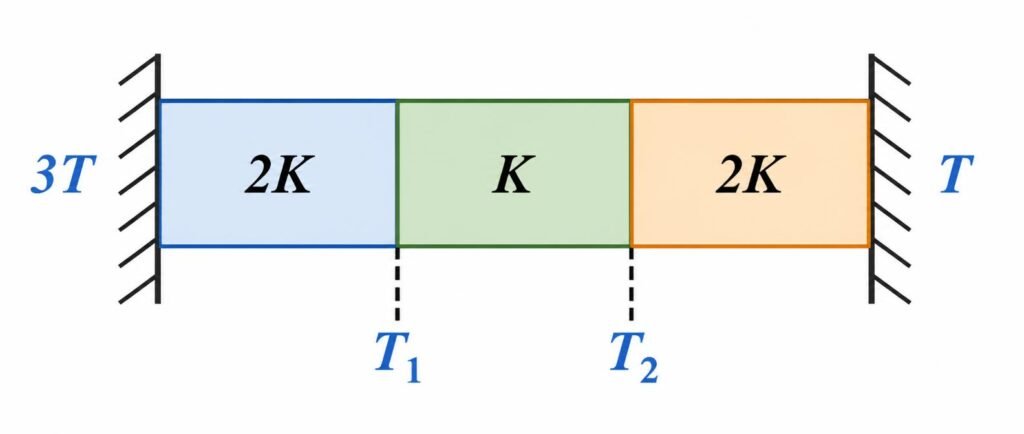
Three identical heat conducting rods are connected in series as shown in the figure. The rods on the sides have thermal conductivity $2K$ while that in the middle has thermal conductivity $K$. The left end of the combination is maintained at temperature $3T$ and the right end at $T$. The rods are thermally insulated from outside. In steady state, temperature at the left junction is $T_1$ and that at the right junction is $T_2$. The ratio $T_1 / T_2$ is:
A
$\frac{3}{2}$
B
$\frac{4}{3}$
C
$\frac{5}{3}$
D
$\frac{5}{4}$
The answer is C.
Solution
Steady-state heat rate is constant. Junction temperatures evaluate to $T_1 = \frac{5T}{2}$ and $T_2 = \frac{3T}{2}$, giving $T_1 / T_2 = 5/3$.
Since the rods are in series and insulated, the steady-state heat current is equal across all three sections: $H = \frac{2KA(3T - T_1)}{L} = \frac{KA(T_1 - T_2)}{L} = \frac{2KA(T_2 - T)}{L}$. Setting the thermal resistances: $R_1 = \frac{L}{2KA} = \frac{R}{2}$, $R_2 = \frac{L}{KA} = R$, $R_3 = \frac{L}{2KA} = \frac{R}{2}$. Total thermal resistance is $R_{eq} = \frac{R}{2} + R + \frac{R}{2} = 2R$. The heat current is $H = \frac{3T - T}{2R} = \frac{2T}{2R} = \frac{T}{R}$. Then: $3T - T_1 = H R_1 = \left(\frac{T}{R}\right)\left(\frac{R}{2}\right) = \frac{T}{2} \implies T_1 = 3T - \frac{T}{2} = \frac{5T}{2}$. Similarly, $T_2 - T = H R_3 = \frac{T}{2} \implies T_2 = T + \frac{T}{2} = \frac{3T}{2}$. Thus, the ratio is $\frac{T_1}{T_2} = \frac{5T/2}{3T/2} = \frac{5}{3}$.
ConceptThermal Resistance Analogy
Thermal Properties of Matter in past papers
49 questions from this chapter have appeared across 25 exam years.