Looking for classes? Ksquare Career Institute, Bengaluru →

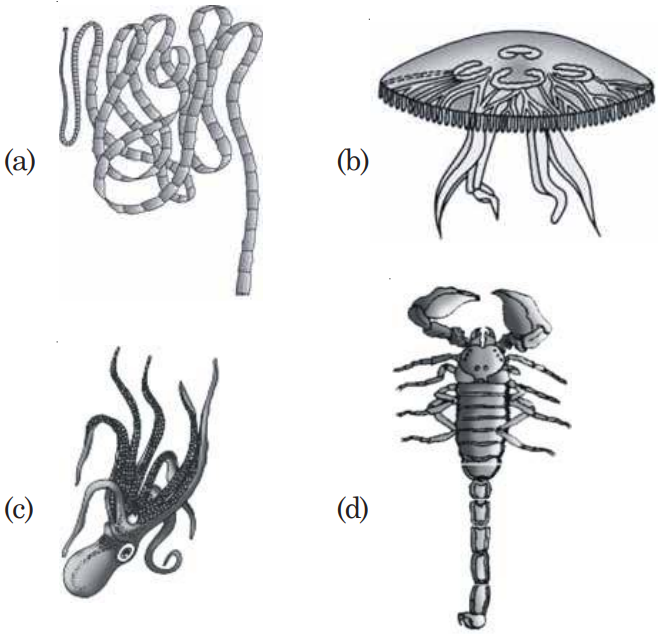
The figure shows four animals (a), (b), (c) and (d). Select the correct answer with respect to a common characteristic of two of these animals.
A
(a) and (d) have cnidoblasts for self-defence
B
(c) and (d) have a true coelom
C
(a) and (d) respire mainly through body wall
D
(b) and (c) show radial symmetry
Detailed Solution
The animals shown are: (a) tapeworm ($Taenia$, Platyhelminthes), (b) jellyfish ($Aurelia$, Cnidaria), (c) octopus (Mollusca) and (d) scorpion (Arthropoda).
Molluscs and arthropods are coelomates, so (c) octopus and (d) scorpion both have a true coelom. This statement is correct.
Cnidoblasts are present only in cnidarians, i.e., in (b); the tapeworm and the scorpion do not have them.
The tapeworm respires through its body surface, but the scorpion respires by book lungs.
The jellyfish is radially symmetrical, but the octopus is bilaterally symmetrical.
Hence the correct statement is that (c) and (d) have a true coelom.
Molluscs and arthropods are coelomates, so (c) octopus and (d) scorpion both have a true coelom. This statement is correct.
Cnidoblasts are present only in cnidarians, i.e., in (b); the tapeworm and the scorpion do not have them.
The tapeworm respires through its body surface, but the scorpion respires by book lungs.
The jellyfish is radially symmetrical, but the octopus is bilaterally symmetrical.
Hence the correct statement is that (c) and (d) have a true coelom.