Looking for classes? Ksquare Career Institute, Bengaluru →

Classification of animals
Appears in
Concepts tested here
- Characters of animal groups 2
- Animal characteristics
- Characters of phyla
- Class Insecta
- Coelom and symmetry
All Questions
2013 NEET 2 questions
-
Which of the following are correctly matched with respect to their taxonomic classification?House fly, butterfly, tsetse fly and silverfish are all insects.
Spiny anteater is a mammal, cuttlefish is a mollusc and silverfish is an insect, and spiders and scorpions are arachnids. -
Match the name of the animal (column I), with one characteristic (column II), and the phylum/class (column III) to which it belongs:Petromyzon (lamprey) is an ectoparasite on fishes and belongs to Cyclostomata.
Adamsia is a cnidarian, Ichthyophis is an amphibian and Limulus is an arthropod.
2012 AIPMT-PRE 1 question
-
In which one of the following, the genus name, its two characters and its phylum are not correctly matched, whereas the remaining three are correct?
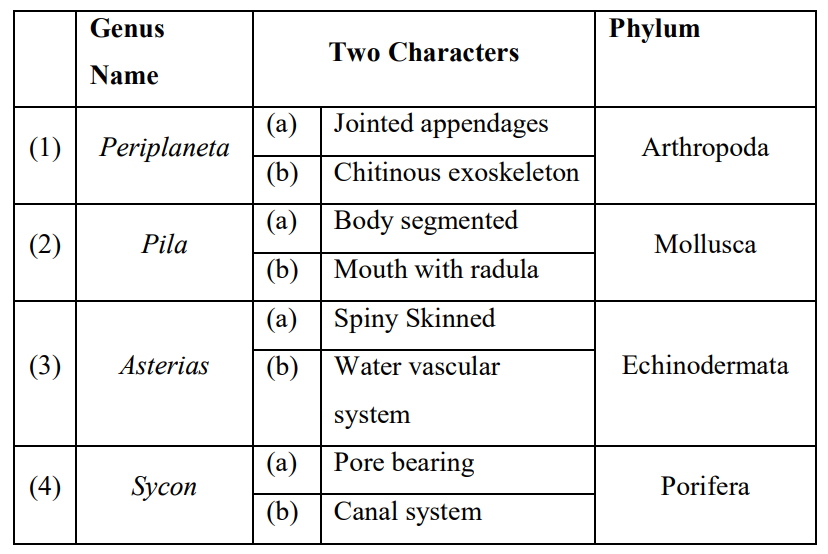 Pila is a mollusc; molluscs have a soft, unsegmented body with a head, muscular foot and visceral hump, and a mouth with a radula.
So 'body segmented' is wrong for Pila.
The characters given for Periplaneta, Asterias and Sycon are correct.
2011 AIPMT-MAINS 1 question
-
The figure shows four animals (a), (b), (c) and (d). Select the correct answer with respect to a common characteristic of two of these animals.
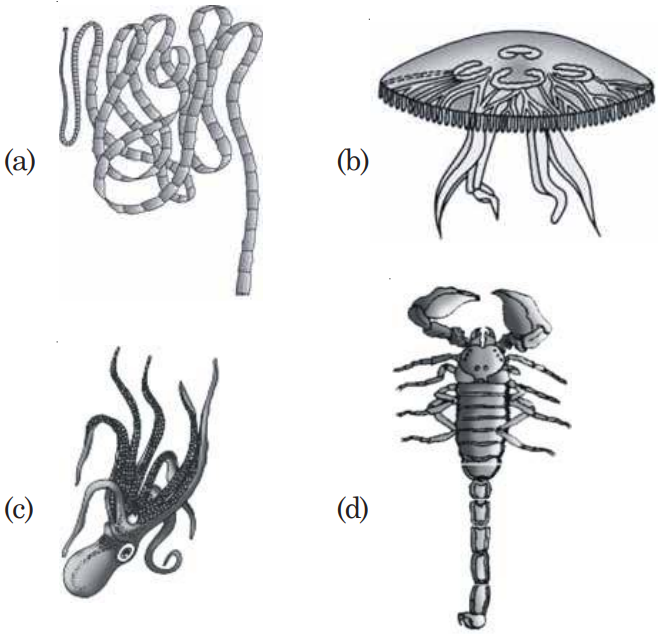 The animals shown are: (a) tapeworm ($Taenia$, Platyhelminthes), (b) jellyfish ($Aurelia$, Cnidaria), (c) octopus (Mollusca) and (d) scorpion (Arthropoda).
Molluscs and arthropods are coelomates, so (c) octopus and (d) scorpion both have a true coelom. This statement is correct.
Cnidoblasts are present only in cnidarians, i.e., in (b); the tapeworm and the scorpion do not have them.
The tapeworm respires through its body surface, but the scorpion respires by book lungs.
The jellyfish is radially symmetrical, but the octopus is bilaterally symmetrical.
Hence the correct statement is that (c) and (d) have a true coelom.
2011 AIPMT-PRE 1 question
-
In which one of the following are the genus name, its two characters and its class/phylum correctly matched?$Aurelia$ is a coelenterate with cnidoblasts, but coelenterates have a tissue level of organisation, not organ level, so this row is wrong.
$Ascaris$ has separate sexes, but its body is unsegmented and it belongs to Aschelminthes (Nematoda), not Annelida, so this row is wrong.
$Pteropus$ (flying fox) is a mammal with hair, but it is viviparous, not oviparous, so this row is wrong.
$Salamandra$ belongs to class Amphibia; in amphibians a tympanum represents the ear and fertilisation is described as external (NCERT general characters of Amphibia), so this row is taken as correct.
Hence the correctly matched genus is $Salamandra$.
2010 AIPMT-PRE 1 question
-
Which one of the following statements about all the four of $Spongilla$, Leech, Dolphin and Penguin is correct?$Spongilla$ is a fresh water sponge (phylum Porifera); sponges have collar cells or choanocytes lining the spongocoel and canals. Choanocytes are not found in the leech (Annelida), dolphin (Mammalia) or penguin (Aves). This statement is correct.
Sponges are mostly asymmetrical, so all four are not bilaterally symmetrical.
The dolphin is a mammal and, like the penguin (a bird), is homoiothermic; so the penguin is not the only warm-blooded one.
$Spongilla$ is a fresh water form, not marine, so the statement about the leech alone being a fresh water form is wrong.
Hence the correct statement is that $Spongilla$ has choanocytes, which are absent in the remaining three.