Looking for classes? Ksquare Career Institute, Bengaluru →

Biology
Animal Kingdom
123 questions from 38 papers, each with its answer.
- 123 questions
- 38 papers
- 3.49% of Biology
Topics in this chapter
Most asked
Squares are the last ten exam years: filled means it was asked that year.
- 1Classification of animals6 questionsPractise Classification of animals
- 2Phylum Chordata5 questionsPractise Phylum Chordata
- 3Phylum Arthropoda5 questionsPractise Phylum Arthropoda
- 4Salient Features of Animal Phyla4 questionsPractise Salient Features of Animal Phyla
- 5Class Mammalia4 questionsPractise Class Mammalia
All topics
In syllabus order. Each goes to its questions below.
- 1. Basis of Classification - Coelom 2 questions
- 2. Class Cyclostomata 3 questions
- 3. Phylum Chordata Classification 1 question
- 4. Phylum Echinodermata 2 questions
- 5. Body Cavity (Coelom) Types across Phyla 1 question
- 6. Characteristic Structures of Animal Phyla 1 question
- 7. Common Names of Fish Genera 1 question
- 8. Non-chordate vs Chordate Characteristics 1 question
- 9. Basis of Classification – Symmetry 1 question
- 10. Excretory Structures in Animals 1 question
- 11. Classes of Chordata – Mammalia 1 question
- 12. Phylum Chordata – Salient Features 2 questions
- 13. Aves – Salient Features 2 questions
- 14. Phylum Chordata – Subphyla 1 question
- 15. Salient Features of Animal Phyla 4 questions
- 16. Common Names of Animals 1 question
- 17. Classification of Animals – Coelom and Symmetry 1 question
- 18. Classes of Chordata – Cyclostomata, Chondrichthyes and Osteichthyes 1 question
- 19. Classification of Animals – Body Plan Features 1 question
- 20. Cyclostomata (jawless fish) characteristics 1 question
- 21. Adaptive modifications of birds 1 question
- 22. Osteichthyes classification 1 question
- 23. Sexual dimorphism in frogs 1 question
- 24. Animal phyla characteristics 1 question
- 25. Classification of vertebrates - examples 1 question
- 26. Body organisation and symmetry across phyla 1 question
- 27. Chordate characteristics and classification of Vertebrata 1 question
- 28. Distinctive characteristics of animal phyla/classes 1 question
- 29. Chordate characteristics and subphylum Vertebrata 1 question
- 30. Characteristics of phylum Annelida 1 question
- 31. Scientific names and common names of animals 1 question
- 32. Classification of the house fly 1 question
- 33. Structures and their representative organisms 1 question
- 34. Characteristics of Platyhelminthes, Ctenophora, and Porifera 1 question
- 35. Heart chambers in vertebrates 1 question
- 36. Examples of animal phyla 2 questions
- 37. Basis of classification - coelom and symmetry 1 question
- 38. Symmetry - Echinodermata 1 question
- 39. Class Reptilia 1 question
- 40. Phylum Chordata 5 questions
- 41. Class Aves – characteristic features 1 question
- 42. Thermoregulation – poikilotherms and homeotherms 1 question
- 43. Direct and indirect development 1 question
- 44. Phylum Porifera 3 questions
- 45. Class Mammalia – aquatic mammals 1 question
- 46. Hemichordata and Chordata 1 question
- 47. Class Chondrichthyes – characteristic features 1 question
- 48. Aves and Mammalia – comparison 1 question
- 49. Phylum Arthropoda vs Annelida 1 question
- 50. Vertebrate classes – characteristics 1 question
- 51. Phylum Arthropoda 5 questions
- 52. Phylum Aschelminthes 2 questions
- 53. Classification of chordates 2 questions
- 54. Class Mammalia 4 questions
- 55. Phylum Coelenterata 3 questions
- 56. Cyclostomata 1 question
- 57. Habitat of animal phyla 1 question
- 58. Animal cells 1 question
- 59. Phylum Platyhelminthes 2 questions
- 60. Chondrichthyes 1 question
- 61. Classification of animals 6 questions
- 62. Chordate and non-chordate classes 1 question
- 63. Chordate and non-chordate characters 1 question
- 64. Sexual dimorphism 2 questions
- 65. Basis of classification 3 questions
- 66. Connecting links 1 question
- 67. Phylum Annelida 1 question
- 68. Non-chordate and Chordate Phyla 1 question
- 69. Comparative Features of Animal Phyla 1 question
- 70. Class Aves 1 question
- 71. Annelida and Arthropoda 1 question
- 72. Aves and Mammalia 1 question
- 73. Chordates and Non-chordates 1 question
- 74. Economically Important Invertebrates 1 question
- 75. Characteristic Features of Animal Groups 1 question
- 76. Basis of Classification: Segmentation 1 question
- 77. Phylum Ctenophora 1 question
- 78. Class Mammalia and Aves 1 question
- 79. Characters of Non-chordate Phyla 1 question
- 80. Phylum Arthropoda: Metamorphosis 1 question
- 81. Phylum Arthropoda: Compound Eye 1 question
- 82. Phylum Platyhelminthes: Life Cycle of Liver Fluke 1 question
- 83. Protozoa: Ciliates 1 question
- 84. Phylum Chordata: Features 1 question
- 85. Respiratory Pigments 1 question
- 86. Regeneration 1 question
- 87. Levels of Organisation 1 question
Basis of Classification - Coelom
-
While trying to find out the characteristic of a newly found animal, a researcher did the histology of adult animal and observed a cavity with presence of mesodermal tissue towards the body wall but no mesodermal tissue was observed towards the alimentary canal. What could be the possible coelome of that animal?
A cavity lined by mesoderm only on the somatic/outer wall is a pseudocoelom.
In pseudocoelomate animals (e.g. Aschelminthes), the body cavity is derived from the blastocoel and is lined by mesoderm towards the body wall, but not towards the gut/endoderm (scattered mesodermal pouches). -
In contrast to Annelids the Platyhelminths showPlatyhelminthes (flatworms) are acoelomates: there is no body cavity between the body wall and the gut; the space is filled with mesenchyme (parenchyma).
Annelids are true coelomates, with a coelom lined by mesoderm.
So in contrast to annelids, the platyhelminths show the absence of a body cavity.
A pseudocoelom is found in Aschelminthes (roundworms), not in flatworms.
Both flatworms and annelids are bilaterally symmetrical, so bilateral symmetry is not a contrast; neither of them is radially symmetrical.
So the correct answer is the absence of body cavity.
Class Cyclostomata
-
All living members of the class Cyclostomata are:
All living cyclostomes are ectoparasites on marine and freshwater fishes.
All living members of class Cyclostomata (e.g., Petromyzon and Myxine) are ectoparasites on fishes, using their circular, suctorial mouth without jaws to attach and feed on host body fluids. -
Select the incorrect statements with respect to Cyclostomes. (a) They lack scales and paired fins. (b) They have circular mouth with jaws. (c) They bear 6-15 pairs of gills. (d) They migrate to deep sea for spawning. Choose the most appropriate answer from the options given below:(a) and (c) are correct. (b) is incorrect as cyclostomes have a sucking, circular mouth without jaws. (d) is incorrect as they migrate to fresh water for spawning.
-
Which one of the following pairs of animals comprises 'jawless fishes'?Jawless vertebrates form the group Agnatha, with the single living class Cyclostomata.
Cyclostomes have a sucking, circular mouth without jaws, and no scales or paired fins. Examples: $Petromyzon$ (lamprey) and $Myxine$ (hagfish).
Guppies, eels, mackerels and rohu are bony fishes (Osteichthyes) with jaws.
Hence the pair of jawless fishes is lampreys and hag fishes.
Phylum Chordata Classification
-
Assertion (A): All vertebrates are chordates but all chordates are not vertebrate.Reason (R): The members of subphylum vertebrata possess notochord, during the embryonic period, the notochord is replaced by a cartilaginous or bony vertebral column in adults.
All vertebrates belong to phylum Chordata, but protochordates lack a vertebral column; in vertebrates, the embryonic notochord is replaced by a vertebral column.
Phylum Chordata includes non-vertebrate protochordates (Urochordata and Cephalochordata) where the notochord is not replaced by a backbone. In subphylum Vertebrata, the embryonic notochord is replaced by a cartilaginous or bony vertebral column, making R the exact explanation of A.
Phylum Echinodermata
-
Role of the water vascular system in Echinoderms is:
A. Respiration and Locomotion
B. Excretion and Locomotion
C. Capture and transport of food
D. Digestion and Respiration
E. Digestion and Excretion
Choose the correct answer from the options given below:In echinoderms, water vascular system functions in locomotion, capture and transport of food, and respiration.
According to NCERT, the most distinctive feature of echinoderms is the presence of a water vascular system (ambulacral system) which helps in: locomotion, capture and transport of food, and respiration (A and C). Excretory organs are absent. -
The animals with bilateral symmetry in young stage and radial pentamerous symmetry in the adult stage, belong to the phylum -In phylum Echinodermata (starfish, sea urchin, sea cucumber, brittle star), the larvae (e.g. bipinnaria) are bilaterally symmetrical.
During metamorphosis they change into adults with radial symmetry based on five parts (pentamerous radial symmetry), e.g. the five arms of a starfish.
Molluscs and annelids are bilaterally symmetrical as adults. Cnidarians are radially symmetrical but not pentamerous, and their larva (planula) is not bilateral in this sense.
So these animals belong to the phylum Echinodermata.
Body Cavity (Coelom) Types across Phyla
-
Consider the following statements: A. Annelids are true coelomates B. Poriferans are pseudocoelomates C. Aschelminthes are acoelomates D. Platyhelminthes are pseudocoelomates Choose the correct answer from the options given below:A. Annelids are true coelomates – correct. B. Poriferans are acoelomates (cellular level of organisation), not pseudocoelomates – incorrect. C. Aschelminthes are pseudocoelomates, not acoelomates – incorrect. D. Platyhelminthes are acoelomates, not pseudocoelomates – incorrect. So A only is correct.
Characteristic Structures of Animal Phyla
-
Match List-I with List-II regarding animal structures and the phylum/class they belong to.
Pick the matching item from Column II for each row.
Column I
- A. $Pleurobrachia$
- B. Radula
- C. Stomochord
- D. Air bladder
Column II
- I. Mollusca
- II. Ctenophora
- III. Osteichthyes
- IV. Hemichordata
Correct answer: A → II, B → I, C → IV, D → III
$Pleurobrachia$ – phylum Ctenophora Radula (file-like rasping feeding organ) – Mollusca Stomochord (rudimentary notochord-like structure in the collar) – Hemichordata Air bladder (regulates buoyancy) – Osteichthyes Correct match: A-II, B-I, C-IV, D-III.
Common Names of Fish Genera
-
Match List-I with List-II regarding fish genera and their common names.
Pick the matching item from Column II for each row.
Column I
- A. $Pterophyllum$
- B. $Myxine$
- C. $Pristis$
- D. $Exocoetus$
Column II
- I. Hag fish
- II. Saw fish
- III. Angel fish
- IV. Flying fish
Correct answer: A → III, B → I, C → II, D → IV
$Pterophyllum$ – angel fish $Myxine$ – hag fish $Pristis$ – saw fish $Exocoetus$ – flying fish Correct match: A-III, B-I, C-II, D-IV.
Non-chordate vs Chordate Characteristics
-
The following are the statements about non-chordates: A. Pharynx is perforated by gill slits. B. Notochord is absent. C. Central nervous system is dorsal. D. Heart is dorsal if present. E. Post anal tail is absent. Choose the most appropriate answer from the options given below:A. Pharynx perforated by gill slits is a chordate feature; gill slits are absent in non-chordates – incorrect. B. Notochord is absent in non-chordates – correct. C. The central nervous system is ventral (not dorsal) in non-chordates – incorrect. D. Heart is dorsal, if present, in non-chordates – correct. E. Post-anal tail is absent in non-chordates – correct. So B, D and E only.
Basis of Classification – Symmetry
-
Radial symmetry is NOT found in adults of phylum
Hemichordates are bilaterally symmetrical; the other phyla are radially symmetrical as adults.
Radial symmetry: When any plane passing through the central axis of the body divides the organism into two identical halves. Bilateral symmetry: When the body can be divided into identical left and right halves in only one plane. The adult echinoderms are radially symmetrical but larvae are bilaterally symmetrical. Coelenterates and Ctenophores are radially symmetrical animals. Hemichordates are bilaterally symmetrical animals.
Excretory Structures in Animals
-
Match List-I with List-II.
Pick the matching item from Column II for each row.
Column I
- A. Taenia
- B. Paramoecium
- C. Periplaneta
- D. Pheretima
Column II
- I. Nephridia
- II. Contractile vacuole
- III. Flame cells
- IV. Urecose gland
Correct answer: A → III, B → II, C → IV, D → I
Taenia has flame cells, Paramoecium a contractile vacuole, Periplaneta urecose glands and Pheretima nephridia.
Flatworms (e.g., Taenia) have excretory systems called protonephridia with flame cells. Freshwater Paramoecium have osmoregulatory organelle called contractile vacuole. Urecose glands in Cockroaches (Periplaneta) help in excretion. In earthworms (Pheretima), the excretory organs are nephridia.
Classes of Chordata – Mammalia
-
The unique mammalian characteristics are:
Mammary glands, hair and external ears (pinnae) are the unique mammalian characteristics.
The most unique mammalian characteristic is the presence of mammary gland (milk producing glands), skin possessing hair and presence of external ear or pinnae.
Phylum Chordata – Salient Features
-
Select the correct statements with reference to chordates. A. Presence of a mid-dorsal, solid and double nerve cord. B. Presence of closed circulatory system. C. Presence of paired pharyngeal gills D. Presence of dorsal heart E. Triploblastic pseudocoelomate animals. Choose the correct answer from the options given below:
Chordates have a closed circulatory system and paired pharyngeal gill slits; the nerve cord is dorsal and hollow and the heart is ventral.
Phylum Chordata are characterised by the presence of a notochord, a dorsal hollow nerve cord, and paired pharyngeal gill slits. These are triploblastic, coelomate with organ-system level of organisation. Vertebrates have a ventral muscular heart with two, three or four chambers. -
Which of the following statements are true for the phylum-Chordata? (a) In Urochordata notochord extends from head to tail and it is present throughout their life. (b) In Vertebrata notochord is present during the embryonic period only. (c) Central nervous system is dorsal and hollow. (d) Chordata is divided into 3 subphyla: Hemichordata, Tunicata and Cephalochordata.(a) In Urochordata, the notochord is present only in the larval tail – incorrect. (b) In Vertebrata, the notochord is present during the embryonic period only (replaced by the vertebral column) – correct. (c) Chordates have a dorsal, hollow central nervous system – correct. (d) Chordata is divided into Urochordata, Cephalochordata and Vertebrata (Hemichordata is a separate phylum) – incorrect. So (b) and (c).
Aves – Salient Features
-
In which of the following animals, digestive tract has additional chambers like crop and gizzard?
-
Which one of the following organisms bears hollow and pneumatic long bones?
Phylum Chordata – Subphyla
-
All vertebrates are chordates but all chordates are not vertebrates.Reason: Notochord is replaced by vertebral column in the adult vertebrates
Salient Features of Animal Phyla
-
Match List-I with List-II.
Pick the matching item from Column II for each row.
Column I
- A. Metamerism
- B. Canal system
- C. Comb plates
- D. Cnidoblasts
Column II
- I. Coelenterata
- II. Ctenophora
- III. Annelida
- IV. Porifera
Correct answer: A → III, B → IV, C → II, D → I
-
Read the following statements. A. Metagenesis is observed in Helminths. B. Echinoderms are triploblastic and coelomate animals. C. Round worms have organ-system level of body organization. D. Comb plates present in ctenophores help in digestion. E. Water vascular system is characteristic of Echinoderms. Choose the correct answer from the options given below.
-
Match the following columns and select the correct option.
Pick the matching item from Column II for each row.
Column I
- A. Gregarious, polyphagous pest
- B. Adult with radial symmetry and larva with bilateral symmetry
- C. Book lungs
- D. Bioluminescence
Column II
- I. Asterias
- II. Scorpion
- III. Ctenoplana
- IV. Locusta
Correct answer: A → IV, B → I, C → II, D → III
-
Match the following organisms with their respective characteristics:
Pick the matching item from Column II for each row.
Column I
- A. Pila
- B. Bombyx
- C. Pleurobrachia
- D. Taenia
Column II
- I. Flame cells
- II. Comb plates
- III. Radula
- IV. Malpighian tubules
Correct answer: A → III, B → IV, C → II, D → I
Common Names of Animals
-
Match the following:
Pick the matching item from Column II for each row.
Column I
- A. Physalia
- B. Limulus
- C. Ancylostoma
- D. Pinctada
Column II
- I. Pearl oyster
- II. Portuguese Man of War
- III. Living fossil
- IV. Hookworm
Correct answer: A → II, B → III, C → IV, D → I
Classification of Animals – Coelom and Symmetry
-
Bilaterally symmetrical and acoelomate animals are exemplified by:Platyhelminthes (flatworms) are bilaterally symmetrical, triploblastic, acoelomate animals with organ level of organisation.
Classes of Chordata – Cyclostomata, Chondrichthyes and Osteichthyes
-
Match the following columns and select the correct option.
Pick the matching item from Column II for each row.
Column I
- A. 6 - 15 pairs of gill slits
- B. Heterocercal caudal fin
- C. Air Bladder
- D. Poison sting
Column II
- I. Trygon
- II. Cyclostomes
- III. Chondrichthyes
- IV. Osteichthyes
Correct answer: A → II, B → III, C → IV, D → I
Classification of Animals – Body Plan Features
-
Consider following features: (a) Organ system level of organisation (b) Bilateral symmetry (c) True coelomates with segmentation of body Select the correct option of animal groups which possess all the above characteristics.
Cyclostomata (jawless fish) characteristics
-
A group of researchers procured some fish-like animals and upon investigation the following characters were observed: I. Endoskeleton was made of cartilage. II. Ectoparasitic; as they were found attached on fish skin with their circular sucking mouth. III. Paired fins and scales were absent, but 7 pairs of gill slits were present. Which of the following species of animals did they consider to fit best with these characters?
Adaptive modifications of birds
-
The flightless bird with forelimbs modified as paddle-like structures suited for swimming is known as:
Osteichthyes classification
-
Select the set of fishes which belong to the class Osteichthyes:
Sexual dimorphism in frogs
-
Male frogs can be distinguished from female frogs due to the presence of: I. Bulging eyes II. Vocal sacs III. Webbed digits in feet IV. Copulatory pad on first digit of fore limbs V. Olive green-coloured skin with dark irregular spots Choose the CORRECT answer from the options given below:
Animal phyla characteristics
-
Select the INCORRECT statements from the following: I. Digestive system in Platyhelminthes is incomplete. II. Bilateral symmetry is a characteristic feature of adult Echinoderms. III. Pseudocoelom is possessed by Aschelminthes. IV. Notochord is persistent throughout life in the class Chondrichthyes. V. Members of class Reptilia maintain a constant body temperature. Choose the answer from the options given below:
Classification of vertebrates - examples
-
Match List-I with List-II and choose the correct answer from the options given below:
Pick the matching item from Column II for each row.
Column I
- A. Chondrichthyes
- B. Cyclostomata
- C. Osteichthyes
- D. Amphibia
Column II
- I. Clarias
- II. Carcharodon
- III. Myxine
- IV. Ichthyophis
Correct answer: A → II, B → III, C → I, D → IV
Chondrichthyes is exemplified by Carcharodon (A-II); Cyclostomata is exemplified by Myxine (B-III); Osteichthyes is exemplified by Clarias (C-I); Amphibia is exemplified by Ichthyophis (D-IV).
Body organisation and symmetry across phyla
-
Which of the following pairs is an incorrect match?Platyhelminthes (flatworms) are triploblastic organisms (having three germ layers), not diploblastic — so this pairing is incorrect. The other pairs are correctly matched: annelids/arthropods show bilateral symmetry, sponges are acoelomate, and coelenterates/ctenophores show radial symmetry.
Chordate characteristics and classification of Vertebrata
-
Members of subphylum vertebrata possess notochord during the embryonic period. The notochord is replaced by a cartilaginous or bony vertebral column in the adult.Reason: All chordates are vertebrates; not all vertebrates are chordates.Members of subphylum Vertebrata indeed possess a notochord during the embryonic period, which is replaced by a cartilaginous or bony vertebral column in the adult (Assertion is true). All vertebrates are chordates, but not all chordates are vertebrates (some chordates, like Urochordata and Cephalochordata, lack a vertebral column) — this is the correct statement, and the given Reason correctly explains why the vertebral column distinguishes vertebrates within the larger group of chordates.
Distinctive characteristics of animal phyla/classes
-
Match the following group of organisms with their respective distinctive characteristics and select the correct option
Pick the matching item from Column II for each row.
Column I
- a. Platyhelminthes
- b. Echinoderms
- c. Hemichordates
- d. Aves
Column II
- i. Cylindrical body with no segmentation
- ii. Warm blooded animals with direct development
- iii. Bilateral symmetry with incomplete digestive system
- iv. Radial symmetry with indirect development
Correct answer: a → iii, b → iv, c → i, d → ii
Platyhelminthes show bilateral symmetry with an incomplete digestive system (a-iii); Echinoderms show radial symmetry with indirect development (b-iv); Hemichordates have a cylindrical body with no segmentation (c-i); Aves are warm blooded animals with direct development (d-ii).
Chordate characteristics and subphylum Vertebrata
-
All vertebrates are chordates but all chordates are not vertebrates, why?In vertebrates (a subphylum of chordates), the embryonic notochord is replaced by a cartilaginous or bony vertebral column in the adult stage — a feature not present in other chordates (Urochordata, Cephalochordata), which is why all vertebrates are chordates, but not all chordates are vertebrates.
Characteristics of phylum Annelida
-
Which of the following options does correctly represent the characteristic features of phylum Annelida?Annelids are triploblastic, coelomate, metamerically segmented, and bilaterally symmetrical organisms.
Scientific names and common names of animals
-
Match the following columns and select the correct option:
Pick the matching item from Column II for each row.
Column I
- a. Aptenodytes
- b. Pteropus
- c. Pterophyllum
- d. Petromyzon
Column II
- i. Flying fox
- ii. Angel fish
- iii. Lamprey
- iv. Penguin
Correct answer: a → iv, b → i, c → ii, d → iii
Aptenodytes is the penguin (a-iv); Pteropus is the flying fox (b-i); Pterophyllum is the angel fish (c-ii); Petromyzon is the lamprey (d-iii).
Classification of the house fly
-
House fly belongs to _____ family.The house fly (Musca domestica) belongs to the family Muscidae.
Structures and their representative organisms
-
Match List-I with List-II.
Pick the matching item from Column II for each row.
Column I
- A. Contractile vacuole
- B. Water vascular system
- C. Canal system
- D. Flame cells
Column II
- I. Asterias
- II. Amoeba
- III. Spongilla
- IV. Taenia
Correct answer: A → II, B → I, C → III, D → IV
Contractile vacuole is found in Amoeba (A-II); Water vascular system is found in Asterias, a starfish (B-I); Canal system is found in Spongilla, a sponge (C-III); Flame cells are found in Taenia, a tapeworm (D-IV).
Characteristics of Platyhelminthes, Ctenophora, and Porifera
-
Select the correct statements: (A) Platyhelminthes are triploblastic pseudocoelomate and bilaterally symmetrical organisms. (B) Ctenophores reproduce only sexually and fertilization is external. (C) In tapeworm, fertilization is internal but sexes are not separate. (D) Ctenophores are exclusively marine, diploblastic and bioluminescent organisms. (E) In sponges, fertilization is external and development is direct. Choose the correct answer from the options given below:Ctenophores reproduce only sexually with external fertilization (B is correct); tapeworms (hermaphroditic, sexes not separate) show internal fertilization (C is correct); ctenophores are exclusively marine, diploblastic, and bioluminescent (D is correct). Platyhelminthes are actually acoelomate (not pseudocoelomate; A is incorrect). In sponges, fertilization is internal (not external) and development is indirect, via a larval stage (not direct; E is incorrect). So B, C, D only.
Heart chambers in vertebrates
-
Which of the following animals has three chambered heart?Pteropus (flying fox, Mammalia) has a four-chambered heart; Scoliodon (dogfish) and Hippocampus (sea horse) are fishes with two-chambered hearts; Chelone (turtle, Reptilia) has a three-chambered heart.
Examples of animal phyla
-
Match the following genera with their respective phylum. Select the correct option.
Pick the matching item from Column II for each row.
Column I
- A. Ophiura
- B. Physalia
- C. Pinctada
- D. Planaria
Column II
- I. Mollusca
- II. Platyhelminthes
- III. Echinodermata
- IV. Coelenterata
Correct answer: A → III, B → IV, C → I, D → II
-
Which one of the following is a matching set of phylum and its three examples ?Mollusca: Loligo (squid), Teredo (shipworm) and Octopus (devil fish) are all molluscs. This is a matching set.
Cnidaria: Physalia and Aurelia are cnidarians, but Bonellia is an echiuroid worm (related to annelids).
Platyhelminthes: Planaria and Schistosoma are flatworms, but Enterobius (pinworm) is a roundworm of phylum Aschelminthes.
Porifera: Spongilla and Euplectella are sponges, but Pennatula (sea pen) is a cnidarian.
So each of the other sets has one member from a different group.
The matching set is Mollusca - Loligo, Teredo, Octopus.
Basis of classification - coelom and symmetry
-
Which of the following animals are true coelomates with bilateral symmetry?
Symmetry - Echinodermata
-
Given below are two statements: Statement I: When any plane passing through the central axis of the body divides the organism into two identical halves, it is called radial symmetry. Statement II: In phylum Echinodermata, both adults and larvae are radially symmetrical. In the light of the above statements, choose the most appropriate answer from the options given below:Reference: NCERT Class XI, pages 38, 40.
Class Reptilia
-
Given below are two statements: Statement I: The class name Reptilia refers to creeping or crawling mode of locomotion. Statement II: All organisms belonging to Reptilia have three chambered heart. In the light of the above statements, choose the most appropriate answer from the options given below:Reference: NCERT Class XI, page 49.
Phylum Chordata
-
Which of the following is not a characteristic of chordates?Reference: NCERT Class XI, page 46.
-
Which one of the following statements is totally wrong about the occurrence of notochord, while the other three are correct?The notochord is a fundamental character of all chordates; every chordate has it at least in the embryonic stage.
Humans are vertebrates: the notochord is present in the embryo and is later replaced by the vertebral column. So saying it is absent throughout life from the very beginning is totally wrong.
In $Amphioxus$ (Cephalochordata) the notochord extends from head to tail and persists throughout life – correct.
In Ascidians (Urochordata) the notochord is present only in the larval tail – correct.
In the frog, a vertebrate, the notochord is replaced by a vertebral column in the adult – correct.
Hence the wrong statement is that it is absent throughout life in humans. -
Crocodile and penguin are similar to whale and dogfish in which one of the following features?Crocodile (Reptilia), penguin (Aves), whale (Mammalia) and dogfish (Chondrichthyes) are all chordates.
All chordates have a notochord, a dorsal hollow nerve cord and paired pharyngeal gill slits at some stage of their life (in reptiles, birds and mammals only in the embryo).
Their central nervous system is dorsal, hollow and single; a solid, ventral, double nerve cord is a non-chordate feature.
The whale is viviparous, so not all of them lay eggs.
The dogfish has a cartilaginous skeleton, so not all of them have a bony skeleton.
Hence the common feature is that they have gill slits at some stage. -
In which of the following notochord is present in embryonic stage : -The notochord is a flexible, rod-like supporting structure on the dorsal side, between the gut and the nerve cord.
It is one of the fundamental characters of phylum Chordata, and it is present in all chordates at least at the embryonic stage.
In urochordates it is present only in the larval tail; in cephalochordates it persists throughout life; in vertebrates it is replaced by the vertebral column in the adult.
Non-chordates never have a notochord.
So the notochord is present at the embryonic stage in all chordates. -
Which of the following characters is not found in all the chordates :All chordates have, at least in the embryo, a notochord, a dorsal hollow nerve cord and pharyngeal gill slits. They are also coelomates.
A muscular diaphragm separating the thoracic and abdominal cavities is found only in mammals.
So the diaphragm is not found in all chordates.
Class Aves – characteristic features
-
Identify the vertebrate group of animals characterized by crop and gizzard in its digestive system
Birds have a crop for storage and a gizzard for grinding.
The digestive tract of Aves has additional chambers: crop and gizzard. Crop is concerned with storage of food grains; gizzard is a masticatory organ in birds used to crush food grains.
Thermoregulation – poikilotherms and homeotherms
-
Which one of these animals is not a homeotherm?
$Chelone$ is a reptile; the others are mammals or birds.
Homeotherms are animals that maintain a constant body temperature, irrespective of surrounding temperature. Birds and mammals are homeotherms. $Chelone$ (turtle) belongs to class Reptilia, which is poikilothermic (cold-blooded).
Direct and indirect development
-
Which of the following animals does not undergo metamorphosis?
Earthworm has direct development without a larva.
Metamorphosis refers to the transformation of a larva into an adult. Animals that perform metamorphosis are said to have indirect development. In earthworm, development is direct, which means no larval stage and hence no metamorphosis.
Phylum Porifera
-
In case of poriferans the spongocoel is lined with flagellated cells called:
Collar cells (choanocytes) line the spongocoel.
Choanocytes (collar cells) line the spongocoel in poriferans (sponges). Flagella of collar cells circulate water in the water canal system. -
Body having meshwork of cells, internal cavities lined with food filtering flagellated cells and indirect development are the characteristics of phylum:
-
Sycon belongs to a group of animals, which are best described as : -Sycon (Scypha) is a sponge, belonging to phylum Porifera.
Sponges are multicellular animals, but their cells are loosely aggregated and do not form true tissues. This is the cellular level of organisation.
Instead of a gut, they have a water canal system (ostia, spongocoel, osculum) lined by collar cells (choanocytes); there is no gastrovascular cavity (that is found in cnidarians).
So Sycon is best described as multicellular without any tissue organisation.
Class Mammalia – aquatic mammals
-
Which among these is the correct combination of aquatic mammals?
Sharks and $Trygon$ are fishes.
Sharks and $Trygon$ (sting ray) are members of Chondrichthyes (cartilaginous fish), while whales, dolphins and seals are aquatic mammals belonging to class Mammalia.
Hemichordata and Chordata
-
An important characteristic that Hemichordates share with Chordates is
Both groups have pharyngeal gill slits.
Pharyngeal gill slits are present in hemichordates as well as in chordates. Notochord is present in chordates only. A ventral nerve cord is a characteristic feature of non-chordates.
Class Chondrichthyes – characteristic features
-
Which of the following characteristic features always holds true for the corresponding group of animals?
All Chondrichthyes have a cartilaginous endoskeleton; the other features have exceptions.
Animals of class Chondrichthyes are marine with a streamlined body. The mouth is ventral. Their endoskeleton is cartilaginous. The notochord is persistent throughout life. Gill slits are separate and without operculum.
So a cartilaginous endoskeleton always holds true for Chondrichthyes.
Aves and Mammalia – comparison
-
Which one of the following characteristics is not shared by birds and mammals?
Birds lay eggs.
Birds are oviparous whereas mammals are viviparous, so viviparity is not shared. The remaining characteristics are shared by both.
Phylum Arthropoda vs Annelida
-
Which of the following features is not present in the phylum–Arthropoda?
Parapodia are annelid structures.
Parapodia are paired lateral appendages found in annelids like $Nereis$, which help in swimming. They are not present in arthropods.
Vertebrate classes – characteristics
-
Choose the correct statement.
Phylum Arthropoda
-
Which of the following characteristics is mainly responsible for diversification of insects on land?The chitinous exoskeleton separates arthropods from other segmented invertebrates; it prevents water loss and lets insects thrive in harsh terrestrial conditions.
-
One of the representatives of Phylum Arthropoda is:Silverfish (Lepisma) is an insect, so it belongs to Phylum Arthropoda.
Flying fish and pufferfish are true fishes; cuttlefish is a mollusc. -
Which group of animals belong to the same phylum?Prawn, scorpion and Locusta all belong to Phylum Arthropoda.
The other groups mix different phyla. -
Two common characters found in centipede, cockroach, and crab are -Centipede (class Chilopoda), cockroach (class Insecta) and crab (class Crustacea) all belong to the phylum Arthropoda.
The two characters shared by all arthropods are jointed appendages (the name arthropod means jointed legs) and a body covered by a chitinous exoskeleton.
Anal cerci are found in the cockroach but not in the crab.
Green glands are the excretory organs of crustaceans only, and tracheae are absent in the crab, which respires by gills.
Book lungs are found in arachnids such as scorpions and spiders, not in these three.
So the two common characters are jointed legs and a chitinous exoskeleton. -
In Arthropoda, head and thorax are often fused to form cephalothorax, but in which one of the following classes, is the body divided into head, thorax and abdomen ?In class Insecta, the body is clearly divided into three parts: head, thorax and abdomen. The thorax bears three pairs of legs and usually two pairs of wings.
In Crustacea (e.g. prawn) and Arachnida (e.g. spider, scorpion), the head and thorax are fused to form a cephalothorax, so the body has only two parts.
In Myriapoda (centipedes, millipedes), the body has a head and a long trunk of many similar segments.
So the body is divided into head, thorax and abdomen in the class Insecta.
Phylum Aschelminthes
-
Which of the following endoparasites of humans does show viviparity?In Trichinella spiralis the eggs hatch inside the uterus of the female, which lays living larvae in the small intestine of the host — it is viviparous.
-
Ascaris is characterized by :Ascaris (the roundworm) belongs to the phylum Aschelminthes (Nematoda).
Aschelminthes are pseudocoelomates: the body cavity is not lined by mesoderm; instead the mesoderm is present as scattered pouches between the ectoderm and endoderm. So a true coelom is absent.
The body is long, cylindrical and circular in cross-section, and it is unsegmented, so metamerism is also absent.
They have the organ-system level of organisation, bilateral symmetry and a complete alimentary canal with a well-developed muscular pharynx.
A true coelom together with metamerism is found in annelids, not in roundworms.
So Ascaris is characterised by the presence of neither a true coelom nor metamerism.
Classification of chordates
-
Which of the following represents the correct combination without any exception?Chondrichthyes: ventral mouth, gills without operculum, placoid scales and persistent notochord — correct without exception.
Mammalia: whales lack pinnae.
Cyclostomata: paired appendages are absent.
Aves: skin is dry and without glands (except the oil gland). -
Which one of the following groups of animals is correctly matched with its one characteristic feature without even a single exception?All members of class Chondrichthyes (sharks, rays, skates) have a cartilaginous endoskeleton; there is no exception.
Mammalia: the egg-laying mammals (monotremes such as the platypus, $Ornithorhynchus$) do not give birth to young ones.
Reptilia: crocodiles have a four-chambered heart.
Chordata: cyclostomes (lampreys and hagfishes) are jawless (Agnatha), and protochordates also lack jaws.
Hence the group matched without exception is Chondrichthyes: possess cartilaginous endoskeleton.
Class Mammalia
-
Which of the following animals is not viviparous?The duck-billed platypus of Australia is an egg-laying (oviparous) mammal.
-
Which of the following characters is not typical of the class Mammalia -Mammals have 12 pairs of cranial nerves, not 10.
Ten pairs of cranial nerves are found in fishes and amphibians (anamniotes).
So 'ten pairs of cranial nerves' is not typical of mammals.
Mammals do have alveolar lungs, in which gaseous exchange takes place in alveoli.
Almost all mammals have seven cervical vertebrae, whether the neck is long (giraffe) or short (whale).
Mammals have thecodont dentition: the teeth are embedded in sockets of the jaw bones.
So the character not typical of the class Mammalia is ten pairs of cranial nerves. -
One of the following is a very unique feature of the mammalian body -A feature is unique to mammals only if no other group of animals has it.
Mammals have a muscular diaphragm that separates the thoracic cavity from the abdominal cavity and plays a major role in breathing. No other vertebrate group has a true diaphragm.
A four-chambered heart is also found in birds and crocodiles; homeothermy (warm-bloodedness) is also found in birds; a rib cage is present in reptiles and birds too.
(Mammary glands and hair are the other unique features of mammals.)
So the very unique feature of the mammalian body among the given ones is the presence of the diaphragm. -
What is true for mammalia :Most mammals are viviparous, but the monotremes, platypus (Ornithorhynchus) and spiny anteater (Echidna), lay eggs. So the platypus is oviparous; true.
Bats have hair, not feathers (feathers are found only in birds); elephants are viviparous; and all mammals have a diaphragm.
So the true statement is that platypus is oviparous.
Phylum Coelenterata
-
Metagenesis refers to:
-
In which animal nerve cell is present but brain is absent : -Hydra (a cnidarian) has nerve cells arranged as a diffuse nerve net throughout the body wall, but no brain or central nervous system.
Sponges have no nerve cells at all.
Earthworm and cockroach have a brain (cerebral ganglia) and a ventral nerve cord.
So in Hydra nerve cells are present but the brain is absent. -
In Hydra, waste material of food digestion and nitrogenous waste material are removed from : -Hydra has a blind sac-like gastrovascular cavity with a single opening, the mouth (incomplete digestive system).
Undigested food is thrown out through the mouth.
Nitrogenous waste (mainly ammonia) is very soluble in water and diffuses out from the cells directly through the body wall into the surrounding water.
So undigested waste is removed from the mouth and nitrogenous waste from the body wall.
Cyclostomata
-
A jawless fish, which lays eggs in fresh water and whose ammocoetes larvae after metamorphosis return to the ocean is:
Habitat of animal phyla
-
Select the Taxon mentioned that represents both marine and fresh water species:Cnidarians are mostly marine, but some, such as Hydra, live in fresh water.
Echinoderms, ctenophores and cephalochordates are exclusively marine.
Animal cells
-
Which one of the following living organisms completely lacks a cell wall?Sea-fan (Gorgonia) is an animal (a cnidarian), and animal cells have no cell wall.
Cyanobacteria (blue-green algae) and the yeast Saccharomyces have cell walls.
Phylum Platyhelminthes
-
Planaria possess high capacity of:Planaria, a flatworm, has a very high capacity for regeneration: a cut piece can grow into a complete animal.
-
One example of animals having a single opening to the outside that serves both as mouth as well as anus isA digestive system with only a single opening to the outside, which serves as both mouth and anus, is called an incomplete digestive system (blind-sac plan).
It is found in coelenterates and in platyhelminthes.
$Fasciola$ (liver fluke) is a flatworm of phylum Platyhelminthes, so it has an incomplete alimentary canal with a single opening.
$Octopus$ (Mollusca), $Asterias$ (Echinodermata) and $Ascidia$ (Urochordata) have a complete digestive system with separate mouth and anus.
Hence the example is $Fasciola$.
Chondrichthyes
-
A marine cartilaginous fish that can produce electric current is:Torpedo (electric ray) is a cartilaginous fish that has electric organs.
Trygon (sting ray) has a poison sting; Pristis is the saw fish and Scoliodon the dog fish.
Classification of animals
-
Which of the following are correctly matched with respect to their taxonomic classification?House fly, butterfly, tsetse fly and silverfish are all insects.
Spiny anteater is a mammal, cuttlefish is a mollusc and silverfish is an insect, and spiders and scorpions are arachnids. -
Match the name of the animal (column I), with one characteristic (column II), and the phylum/class (column III) to which it belongs:Petromyzon (lamprey) is an ectoparasite on fishes and belongs to Cyclostomata.
Adamsia is a cnidarian, Ichthyophis is an amphibian and Limulus is an arthropod. -
In which one of the following, the genus name, its two characters and its phylum are not correctly matched, whereas the remaining three are correct?
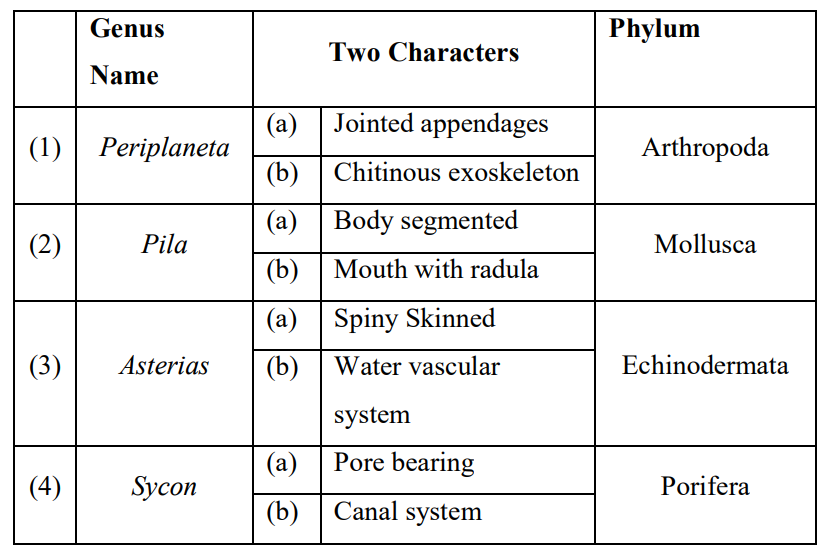 Pila is a mollusc; molluscs have a soft, unsegmented body with a head, muscular foot and visceral hump, and a mouth with a radula.
So 'body segmented' is wrong for Pila.
The characters given for Periplaneta, Asterias and Sycon are correct. -
The figure shows four animals (a), (b), (c) and (d). Select the correct answer with respect to a common characteristic of two of these animals.
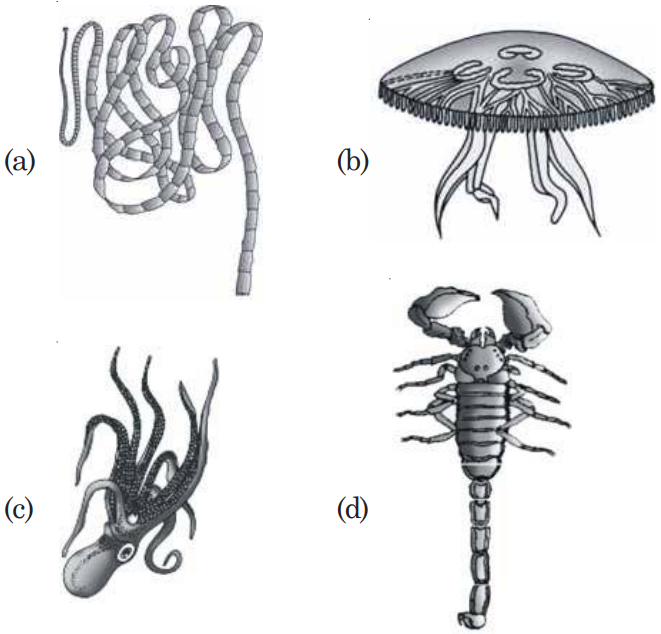 The animals shown are: (a) tapeworm ($Taenia$, Platyhelminthes), (b) jellyfish ($Aurelia$, Cnidaria), (c) octopus (Mollusca) and (d) scorpion (Arthropoda).
Molluscs and arthropods are coelomates, so (c) octopus and (d) scorpion both have a true coelom. This statement is correct.
Cnidoblasts are present only in cnidarians, i.e., in (b); the tapeworm and the scorpion do not have them.
The tapeworm respires through its body surface, but the scorpion respires by book lungs.
The jellyfish is radially symmetrical, but the octopus is bilaterally symmetrical.
Hence the correct statement is that (c) and (d) have a true coelom. -
In which one of the following are the genus name, its two characters and its class/phylum correctly matched?$Aurelia$ is a coelenterate with cnidoblasts, but coelenterates have a tissue level of organisation, not organ level, so this row is wrong.
$Ascaris$ has separate sexes, but its body is unsegmented and it belongs to Aschelminthes (Nematoda), not Annelida, so this row is wrong.
$Pteropus$ (flying fox) is a mammal with hair, but it is viviparous, not oviparous, so this row is wrong.
$Salamandra$ belongs to class Amphibia; in amphibians a tympanum represents the ear and fertilisation is described as external (NCERT general characters of Amphibia), so this row is taken as correct.
Hence the correctly matched genus is $Salamandra$. -
Which one of the following statements about all the four of $Spongilla$, Leech, Dolphin and Penguin is correct?$Spongilla$ is a fresh water sponge (phylum Porifera); sponges have collar cells or choanocytes lining the spongocoel and canals. Choanocytes are not found in the leech (Annelida), dolphin (Mammalia) or penguin (Aves). This statement is correct.
Sponges are mostly asymmetrical, so all four are not bilaterally symmetrical.
The dolphin is a mammal and, like the penguin (a bird), is homoiothermic; so the penguin is not the only warm-blooded one.
$Spongilla$ is a fresh water form, not marine, so the statement about the leech alone being a fresh water form is wrong.
Hence the correct statement is that $Spongilla$ has choanocytes, which are absent in the remaining three.
Chordate and non-chordate classes
-
Which one of the following categories of animals is correctly described with no single exception in it?Bony fishes (class Osteichthyes) have four pairs of gills that are covered by an operculum on each side; this holds for the class without exception.
Mammals: not all are viviparous, since the monotremes (e.g., platypus, $Ornithorhynchus$) are oviparous.
Reptiles: crocodiles have a four-chambered heart, so 'three chambered heart' has an exception.
Sponges: most are marine but some, such as $Spongilla$, live in fresh water.
Hence the category described with no exception is the bony fishes.
Chordate and non-chordate characters
-
Which one of the following pairs of animals are similar to each other pertaining to the feature stated against them?The sea horse ($Hippocampus$) and the flying fish ($Exocoetus$) are both bony fishes (Osteichthyes), and all fishes are cold blooded (poikilothermal). The pair is correctly matched.
$Pteropus$ (flying fox) is a viviparous mammal, but $Ornithorhynchus$ (platypus) is an egg-laying (oviparous) mammal.
The garden lizard has a three-chambered heart, but the crocodile has a four-chambered heart.
$Ascaris$ and $Ancylostoma$ are roundworms (Aschelminthes), which are unsegmented; metameric segmentation is seen in annelids.
Hence the similar pair is the sea horse and the flying fish, both cold blooded.
Sexual dimorphism
-
What will you look for to identify the sex of the following?In cartilaginous fishes the males have claspers on the pelvic fins, used to transfer sperm; so a male shark is identified by its claspers. This is correct.
In $Ascaris$ it is the male that is smaller and has a curved posterior end; the female is longer with a straight posterior end.
The male frog has a copulatory pad on the first digit of the fore limbs, not the hind limbs (and also has vocal sacs).
Anal cerci are present in both male and female cockroaches; the male is identified by the anal styles, which are absent in the female.
Hence the correct identification is male shark – claspers borne on pelvic fins. -
Similarity in Ascaris lumbricoides and Anopheles stephensi :In Ascaris, the male is smaller than the female and has a curved posterior end with penial spicules, while the female is larger and straight. So the sexes are clearly distinguishable (sexual dimorphism).
In Anopheles mosquitoes, the male has bushy (plumose) antennae and the female has sparsely hairy antennae; only the female sucks blood. This is also sexual dimorphism.
Ascaris is unsegmented and endoparasitic, while Anopheles is segmented and free-living; Anopheles respires aerobically.
So the similarity is sexual dimorphism.
Basis of classification
-
Which one of the following kinds of animals are triploblastic?Triploblastic animals have three embryonic germ layers: ectoderm, mesoderm and endoderm.
Platyhelminthes (flat worms) to chordates are triploblastic; flat worms are triploblastic, acoelomate and bilaterally symmetrical.
Corals (coelenterates) and ctenophores are diploblastic, with only ectoderm and endoderm separated by mesoglea.
Sponges have a cellular level of organisation without true germ layers or tissues.
Hence flat worms are triploblastic. -
Which one of the following statements about certain given animals is correct?In round worms (Aschelminthes) the body cavity is not lined by mesoderm; the mesoderm is present as scattered pouches between the ectoderm and endoderm. Such a cavity is a pseudocoelom, so round worms are pseudocoelomates. This statement is correct.
Flat worms (Platyhelminthes) have no body cavity at all; they are acoelomates.
Molluscs have a true coelom lined by mesoderm; they are coelomates.
Insects (arthropods) are also true coelomates.
Hence the correct statement is that round worms are pseudocoelomates. -
Which one of the following groups of animals is bilaterally symmetrical and triploblastic?Sponges are mostly asymmetrical and have a cellular level of organisation without true germ layers.
Coelenterates and ctenophores are radially symmetrical and diploblastic (two germ layers, ectoderm and endoderm).
Aschelminthes (round worms) are bilaterally symmetrical, triploblastic and pseudocoelomate animals with an organ-system level of organisation.
Hence the group that is bilaterally symmetrical and triploblastic is Aschelminthes.
Connecting links
-
$Peripatus$ is a connecting link between$Peripatus$ (the walking worm, phylum Onychophora) shows characters of two phyla.
Annelid characters: a soft, worm-like body with a thin cuticle, unjointed stumpy legs, segmentally arranged nephridia and simple eyes.
Arthropod characters: claws on the legs, tracheae for respiration, a haemocoel and a dorsal tubular heart with ostia.
Because it combines the features of both groups, it is regarded as a connecting link between Annelida and Arthropoda.
Hence the answer is Annelida and Arthropoda.
Phylum Annelida
-
Which one of the following is NOT a characteristic of phylum Annelida?Annelids are triploblastic, bilaterally symmetrical animals with the organ-system level of organisation.
They are true coelomates: the body cavity is a true coelom lined by mesoderm on both sides.
A pseudocoelom, in which the body cavity is not lined by mesoderm, is characteristic of Aschelminthes (roundworms), not Annelida.
Their body is metamerically segmented, which gives the phylum its name (annulus = little ring).
They have a closed circulatory system, and the nervous system consists of paired ganglia connected by lateral nerves to a double ventral nerve cord.
So segmentation, a ventral nerve cord and a closed circulatory system are characters of Annelida, but a pseudocoelom is not.
Non-chordate and Chordate Phyla
-
Which one of the following phyla is correctly matched with its two general characteristics?Mollusca: molluscs are usually dioecious and oviparous, with indirect development through a larval stage, the trochophore or the veliger larva. Both characters are correct as general features of the phylum.
Echinodermata: the adults do show pentamerous radial symmetry, but fertilisation is usually external, not internal.
Arthropoda: the body is divided into head, thorax and abdomen, but respiration by tracheae is not a general character; arthropods respire by gills, book gills, book lungs or the tracheal system in different groups.
Chordata: a notochord is present at some stage, but separate anal and urinary openings to the outside are not a general character; many chordates have a common opening, the cloaca.
So the phylum correctly matched with both its general characteristics is Mollusca.
Comparative Features of Animal Phyla
-
Which one of the following groups of three animals each is correctly matched with their one characteristic morphological feature?
(Each option gives three animals followed by the morphological feature.)Scorpion, spider and cockroach are all arthropods. Like all non-chordates, they have a ventral, solid and double nerve cord (central nervous system). So this group is correctly matched.
Cockroach and locust show metameric segmentation, but Taenia (tapeworm) does not; its body is divided into proglottids, which is pseudo-segmentation.
Liver fluke is bilaterally symmetrical, but the sea anemone (a cnidarian) is radially symmetrical and the adult sea cucumber (an echinoderm) basically has radial symmetry.
Centipede and prawn are arthropods with jointed appendages, but the sea urchin is an echinoderm; it has tube feet, not jointed appendages.
So the correctly matched group is scorpion, spider, cockroach - ventral solid central nervous system.
Class Aves
-
Which one of the following in birds, indicates their reptilian ancestry?Birds have evolved from reptilian ancestors and are sometimes called glorified reptiles.
The skin of birds is dry and covered with feathers, but the hind limbs still bear epidermal scales, which are similar to the horny epidermal scales of reptiles.
This reptilian feature retained on the hind limbs indicates their reptilian ancestry.
The crop and gizzard are additional chambers of the digestive tract that are special adaptations of birds.
A four-chambered heart is an advanced feature of birds (shared with mammals and crocodiles) and is not typical of reptiles, most of which have a three-chambered heart.
Hard calcareous egg shells are characteristic of birds, while most reptiles lay eggs with leathery shells.
So the feature indicating reptilian ancestry is the scales on their hind limbs.
Annelida and Arthropoda
-
What is true about Nereis, scorpion, cockroach and silver fish?Nereis belongs to class Polychaeta of phylum Annelida, while scorpion, cockroach and silver fish belong to phylum Arthropoda.
So they do not all belong to the same phylum.
Nereis is a marine annelid, so it is not true that none of them is aquatic.
Jointed paired appendages are found only in arthropods; Nereis has unjointed lateral appendages called parapodia.
All non-chordates that have a heart have it on the dorsal side. In Nereis the main pumping vessel is dorsal, and in the scorpion, cockroach and silver fish the heart is dorsal and tubular.
So the feature common to all four is that they all possess a dorsal heart.
Aves and Mammalia
-
What is common between parrot, platypus and kangaroo?Parrot is a bird (class Aves); platypus (a prototherian) and kangaroo (a metatherian) are mammals.
Only birds and mammals are homoiothermous (warm-blooded): they maintain a constant body temperature irrespective of the temperature of the surroundings.
So homoiothermy is common to all three.
Oviparity is not common: the parrot and the platypus lay eggs, but the kangaroo is viviparous and gives birth to immature young that complete their development in the pouch.
Toothless jaws are found in the parrot (beak) and the adult platypus, but the kangaroo has teeth.
A functional tail is not a feature shared in the same way by all three.
So the common feature is homoiothermy.
Chordates and Non-chordates
-
Which one of the following is a matching pair of a body feature and the animal possessing it?Leech is an annelid, a non-chordate. In non-chordates the central nervous system is ventral, solid and double.
The leech has a nerve ring and a solid, double, mid-ventral nerve cord with ganglia. So ventral central nervous system - leech is a matching pair.
Chamaeleon is a reptile, i.e. a chordate. All chordates have pharyngeal gill slits at some stage of life, at least in the embryo, so they are not absent in its embryo.
Scorpion is an arthropod, a non-chordate; its heart is dorsal, not ventral. A ventral heart is a chordate character.
Octopus is a mollusc, a non-chordate; a post-anal tail is a chordate character and is absent in it.
So the matching pair is ventral central nervous system - leech.
Economically Important Invertebrates
-
Which one of the following pairs is mismatched?Pearls are produced by the pearl oyster Pinctada (for example Pinctada vulgaris), a bivalve mollusc, which deposits layers of nacre around a foreign particle.
Pila globosa is the apple snail, a gastropod mollusc; it does not produce pearls.
So the pair Pila globosa - pearl is mismatched.
Apis indica is the Indian honey bee, which produces honey.
Kerria lacca (Laccifer lacca) is the lac insect, which secretes lac.
Bombyx mori is the mulberry silkworm, which produces silk.
These three pairs are correctly matched.
Characteristic Features of Animal Groups
-
Which of the following pairs are correctly matched?
Animals - Morphological features
(i) Crocodile - 4-chambered heart
(ii) Sea urchin - Parapodia
(iii) Obelia - Metagenesis
(iv) Lemur - Thecodont(i) Crocodile belongs to class Reptilia. Most reptiles have a three-chambered heart, but crocodiles have a four-chambered heart. Correct.
(ii) Sea urchin is an echinoderm; it moves by tube feet of the water vascular system. Parapodia are the lateral appendages of polychaete annelids such as Nereis. Incorrect.
(iii) In Obelia, the polyps produce medusae asexually and the medusae form the polyps sexually. Such alternation of asexual and sexual phases in the life cycle is called metagenesis. Correct.
(iv) Lemur is a mammal (a primate). In mammals the teeth are embedded in the sockets of the jaw bones, a condition known as thecodont. Correct.
So the correctly matched pairs are (i), (iii) and (iv).
Basis of Classification: Segmentation
-
Metameric segmentation is the characteristic of -In metameric segmentation (metamerism) the body is divided, externally and internally, into a series of similar segments, with a serial repetition of at least some organs.
It is seen in annelids (for example the earthworm), in arthropods and in chordates.
In Annelida the segments (metameres) are distinctly marked and mostly similar.
In Arthropoda the body is also segmented, with the segments grouped into head, thorax and abdomen.
Platyhelminthes are unsegmented (the proglottids of tapeworms are a false segmentation), and molluscs and echinoderms are unsegmented.
So among the given pairs, metameric segmentation is characteristic of Annelida and Arthropoda.
Phylum Ctenophora
-
Biradial symmetry and lack of cnidoblasts are the characteristics of -Ctenophores, commonly known as sea walnuts or comb jellies, are exclusively marine, diploblastic animals with the tissue level of organisation.
Their symmetry is biradial: the body can be divided into two equal halves along only two planes.
They do not have cnidoblasts (stinging cells); instead their tentacles bear adhesive cells called colloblasts for capturing prey.
They have eight external rows of ciliated comb plates, which help in locomotion.
Ctenoplana and Beroe are both ctenophores.
Sea anemone, Aurelia and Hydra are cnidarians and possess cnidoblasts; starfish is an echinoderm and Paramecium is a protist.
So biradial symmetry and the lack of cnidoblasts are characteristics of Ctenoplana and Beroe.
Class Mammalia and Aves
-
In which one of the following sets of animals do all the four give birth to young ones ?Animals that give birth to young ones are viviparous; those that lay eggs are oviparous.
All birds are oviparous, and among mammals only the monotremes (platypus and echidna) lay eggs.
Kangaroo (a marsupial), hedgehog, dolphin and loris are all mammals that give birth to young ones, so all four are viviparous.
The first set includes the ostrich, a bird that lays eggs.
The second set includes the platypus, an egg-laying mammal, and the penguin, a bird.
The third set includes the kiwi, a flightless bird that lays eggs.
So the set in which all four give birth to young ones is Kangaroo, Hedgehog, Dolphin, Loris.
Characters of Non-chordate Phyla
-
From the following statements select the wrong one -Sponges (phylum Porifera) are mostly marine, but they are not exclusively marine.
Some sponges, such as Spongilla (freshwater sponge), live in fresh water.
So the statement that animals belonging to phylum Porifera are exclusively marine is wrong.
Prawn, a crustacean, has two pairs of antennae (antennules and antennae); true.
Millipedes (Diplopoda) have two pairs of legs on most body segments, because each apparent segment is formed by the fusion of two segments; true.
Nematocysts (stinging cells, cnidoblasts) are characteristic of phylum Cnidaria; true.
So the wrong statement is the one about Porifera being exclusively marine.
Phylum Arthropoda: Metamorphosis
-
Which one of the following is a matching pair of an animal and a certain phenomenon it exhibits :Musca (housefly) shows complete metamorphosis (holometaboly): egg, larva (maggot), pupa and adult are distinct stages. Correctly matched.
Pheretima (earthworm) is hermaphrodite (bisexual), so there is no sexual dimorphism.
Chameleon changes its colour to match the background, which is camouflage (protective colouration) rather than mimicry of another species.
Polymorphism (different forms of individuals in one species, e.g. polyps and medusae) is a feature of cnidarians such as Obelia, not Taenia.
So the matching pair is Musca – complete metamorphosis.
Phylum Arthropoda: Compound Eye
-
Ommatidia serve the purpose of photoreception in : -Ommatidia are the visual units of the compound eyes of arthropods such as insects and crustaceans.
Each compound eye of a cockroach has about 2000 hexagonal ommatidia. Each ommatidium has its own lens (cornea), crystalline cone and photosensitive rhabdome, and forms a part of the image.
This produces mosaic vision, which is very sensitive to movement but less sharp.
Frogs and humans have camera-type eyes with a single lens and retina; the sunflower has no eyes.
So ommatidia serve the purpose of photoreception in the cockroach.
Phylum Platyhelminthes: Life Cycle of Liver Fluke
-
During its life-cycle, Fasciola hepatica (liver fluke) infects its intermediate host and primary host at the following larval stage respectively :The liver fluke has two hosts: the primary (definitive) host is the sheep (or cattle), and the intermediate host is a freshwater snail (Lymnaea).
Eggs pass out with the faeces of the sheep and hatch in water into ciliated miracidium larvae. The miracidium bores into the snail; so the miracidium is the stage infective to the intermediate host.
Inside the snail it develops through sporocyst, redia and cercaria stages.
Cercariae leave the snail, encyst on grass or aquatic plants, and become metacercariae. When a sheep eats this grass, the metacercaria infects it; so the metacercaria is the stage infective to the primary host.
So the stages are miracidium (intermediate host) and metacercaria (primary host).
Protozoa: Ciliates
-
In which of the animal dimorphic nucleus is found : -Ciliate protozoans such as Paramecium have two different kinds of nuclei (nuclear dimorphism).
The large macronucleus (vegetative nucleus) controls the everyday metabolic activities of the cell.
The small micronucleus (reproductive nucleus) takes part in sexual reproduction (conjugation).
Amoeba, Trypanosoma and Plasmodium have only one kind of nucleus.
So a dimorphic nucleus is found in Paramecium caudatum.
Phylum Chordata: Features
-
In which of the following animals post anal tail is foundA post-anal tail (a tail extending beyond the anus) is one of the characteristic features of chordates, present at least in the embryo.
The snake is a chordate (vertebrate, reptile), and its long body continues behind the cloacal opening as a tail.
Earthworm, scorpion and other invertebrates are non-chordates; the anus is at the end of the body, so there is no post-anal tail (the scorpion's 'tail' is part of its abdomen).
So a post-anal tail is found in the snake.
Respiratory Pigments
-
In which of the following haemocyanin pigment is found : -Haemocyanin is a copper-containing respiratory pigment that turns blue when oxygenated. It occurs mainly in molluscs and many arthropods (crustaceans, arachnids).
Annelids mostly have haemoglobin or chlorocruorin (green), dissolved in the plasma; some annelids have other pigments.
As per the answer key, haemocyanin is linked here to Annelida.
(This is doubtful: none of the four options is the usual textbook answer, which is Mollusca or Crustacea.)
So, as per the answer key, the answer is Annelida.
Regeneration
-
During regeneration, modification of an organ to another organ is known as : -Regeneration is of two main types:
Epimorphosis: replacement of a lost part by growth of new tissue from the cut surface (e.g. regrowth of the tail of a lizard, limbs of salamander).
Morphallaxis: regeneration by remodelling (reorganisation) of the existing tissues without much new growth, e.g. a small piece of Hydra or Planaria re-forming a whole animal.
As per the answer key, the modification of one organ into another during regeneration is called epimorphosis.
(This answer is doubtful: transformation of existing tissue into another organ is usually described as morphallaxis.)
So, as per the answer key, the answer is epimorphosis.
Levels of Organisation
-
Which of the following animals have scattered cells with cell–tissue grade organisation :Sponges have a cellular level of organisation: their cells are loosely aggregated and do not form true tissues.
In cnidarians such as Hydra, the cells performing the same function are arranged into tissues (tissue level of organisation), though many cells are still scattered (e.g. interstitial cells, nerve net).
Liver fluke and Ascaris have the organ (and organ system) level of organisation.
So, as per the answer key, Hydra has scattered cells with a cell–tissue grade of organisation.
That is every question in Animal Kingdom.
Want a score?
Answers here are not saved. Practise as a test to be marked and see your progress.
Practise as a testQuestions per paper
Asked in 16 of the last 16 papers (2017–2026).
- 2026: 5 questions
- 2026 Re-NEET: 3 questions
- 2025: 4 questions
- 2024: 4 questions
- 2024 Re-NEET: 3 questions
- 2023: 4 questions
- 2023 Manipur: 3 questions
- 2022: 2 questions
- 2022 Phase 2: 2 questions
- 2021: 4 questions
- 2020: 4 questions
- 2020 Phase-2: 4 questions
- 2019: 2 questions
- 2019 Odisha: 2 questions
- 2018: 3 questions
- 2017: 3 questions
Concepts tested
- Characters of animal groups 2
- distinguishing features of animal phyla 2
- Absence of cell wall in animals
- acoelomate animals
- Acoelomate flatworms
- Agnatha
- Animal characteristics
- Animals and their products
- aquatic-mammals
- aves-crop-gizzard
- Basis of classification - coelom and symmetry
- birds-oviparous
- Body Cavity / Coelom Types
- Body divisions in insects
- Body organisation and symmetry across phyla
- Cellular level of organisation in sponges
- characteristics of chordates
- Characteristics of phylum Annelida