Looking for classes? Ksquare Career Institute, Bengaluru →

Ecosystem
Ecological Pyramids
9 questions from 8 papers, each with its answer.
- questions
- 9
- papers
- 8
- years asked, 2017–2026
- 4 of 10
- of Ecosystem
- 10.59%
Appears in
Concepts tested
- Pyramid of numbers 2
- inverted pyramids
- inverted-pyramid-biomass
- Parameters of ecological pyramids
- pyramid of biomass in sea
- Pyramid of energy
- Spindle-shaped pyramid of numbers
All Questions
2026 1 question
-
Ecological pyramids represent the relationship between the organisms at different trophic levels and they are generally inverted for:
2021 1 question
-
Which of the following statements is not correct?
2019 1 question
-
Which of the following ecological pyramids is generally inverted?
2018 1 question
-
What type of ecological pyramid would be obtained with the following data? Secondary consumer : 120 g, Primary consumer : 60 g, Primary producer : 10 g
Biomass increasing up the trophic levels gives an inverted pyramid.
The given data depict an inverted pyramid of biomass, usually found in aquatic ecosystems. A pyramid of energy is always upright. Upright pyramids of biomass and numbers are not possible, as the data show the primary producer is less than the primary consumer, which is less than the secondary consumer.
2012 AIPMT-PRE 2 questions
-
The upright pyramid of number is absent inIn grassland, pond and lake ecosystems the producers are the most numerous, so the pyramid of numbers is upright.
In a forest (tree) ecosystem a few large trees support many insects and birds, so the pyramid of numbers is not upright. -
Given below is an imaginary pyramid of numbers. What could be one of the possibilities about certain organisms at some of the different levels?
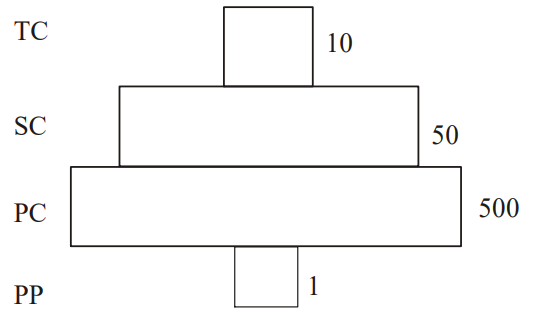 The pyramid has one primary producer (PP = 1), which means a single large tree.
A single tree supports a large number of insects as primary consumers (PC = 500), which are eaten by a smaller number of small insectivorous birds as secondary consumers (SC = 50).
Rats do not feed in hundreds on one tree, phytoplankton would be far more numerous than 1, and sheep are herbivores, not secondary consumers.
2011 AIPMT-PRE 1 question
-
Which one of the following statements for pyramid of energy is incorrect, whereas the remaining three are correct?The pyramid of energy shows the amount of energy present at each trophic level in a given time (per unit area per year).
When energy flows from one trophic level to the next, some energy is always lost as heat at each step; only about 10% is transferred (10 per cent law).
So the energy at a lower trophic level is always more than that at the higher level: the base (producers) is broad and the pyramid is upright.
The pyramid of energy can never be inverted (unlike the pyramid of biomass in the sea or the pyramid of numbers on a tree).
Hence the incorrect statement is that it is inverted in shape.
2010 AIPMT-MAINS 1 question
-
Which of the following representations shows the pyramid of numbers in a forest ecosystem?
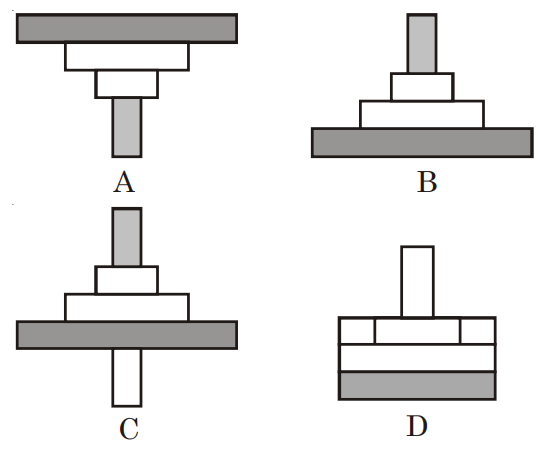 A pyramid of numbers shows the number of individuals at each successive trophic level, with the producers at the base.
In most ecosystems the producers are more numerous than the herbivores, and the herbivores more numerous than the carnivores, so the pyramid is upright: broadest at the base and narrowing towards the top.
The answer accepted in the key is the upright pyramid, labelled B, taking the forest as a whole with its large number of producers.
The pyramid of numbers becomes inverted only when a single large tree is considered as the ecosystem, since one tree supports many insects and birds.
2006 AIPMT-PRE 1 question
-
Which one of the following is not used for construction of ecological pyramids ?An ecological pyramid is a graphic representation of the relationship between the successive trophic levels of an ecosystem.
There are three types of ecological pyramids.
The pyramid of numbers is based on the number of individuals at each trophic level.
The pyramid of biomass is based on the biomass at each trophic level, which is measured as dry weight.
The pyramid of energy is based on the rate of energy flow (energy per unit area per unit time) through each trophic level.
Fresh weight is not used, because the water content of organisms varies greatly from one organism to another and with conditions, so it does not give a true measure of the organic matter present.
So the one not used for the construction of ecological pyramids is fresh weight.