Looking for classes? Ksquare Career Institute, Bengaluru →

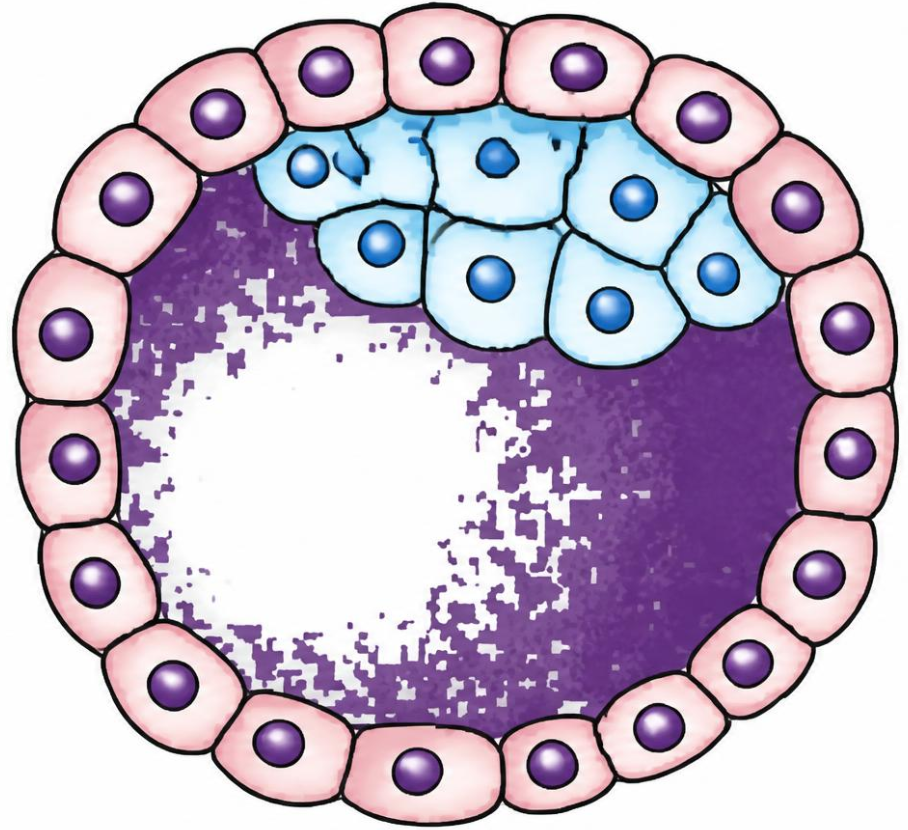
Identify the human developmental stage shown below as well as the related right place of its occurrence in a normal pregnant woman, and select the right option for the two together.
A
8-celled morula – Starting point of Fallopian tube
B
Late morula – Middle part of Fallopian tube
C
Blastula – End part of Fallopian tube
D
Blastocyst – Uterine wall
Detailed Solution
The figure shows a hollow stage with an outer layer of cells (trophoblast), a group of cells attached to one side inside (inner cell mass) and a fluid-filled cavity; this is the blastocyst.
A morula is a solid ball of 8–16 blastomeres without any cavity, so the figure is not a morula.
Cleavage occurs while the embryo moves through the Fallopian tube; the morula continues to divide and becomes a blastocyst as it moves further into the uterus.
The trophoblast layer of the blastocyst attaches to the endometrium and the blastocyst becomes embedded in the uterine wall (implantation).
Hence the stage is the blastocyst and its site of occurrence is the uterine wall.
A morula is a solid ball of 8–16 blastomeres without any cavity, so the figure is not a morula.
Cleavage occurs while the embryo moves through the Fallopian tube; the morula continues to divide and becomes a blastocyst as it moves further into the uterus.
The trophoblast layer of the blastocyst attaches to the endometrium and the blastocyst becomes embedded in the uterine wall (implantation).
Hence the stage is the blastocyst and its site of occurrence is the uterine wall.