Looking for classes? Ksquare Career Institute, Bengaluru →

Locomotion and Movement
Skeletal system
5 questions from 5 papers, each with its answer.
- questions
- 5
- papers
- 5
- of Locomotion and Movement
- 7.69%
Appears in
Concepts tested
- Axial and appendicular skeleton
- Counts of human body parts
- Functions of skeleton
- Pelvic girdle
- Ribs and vertebrae in humans
All Questions
2015 AIPMT-II 1 question
-
Which of the following is not a function of the skeletal system?
2011 AIPMT-MAINS 1 question
-
Three of the following pairs of the human skeletal parts are correctly matched with their respective inclusive skeletal category and one pair is not matched. Identify the non-matching pair.The clavicle (collar bone) and the scapula form the pectoral girdle; the glenoid cavity is the depression of the scapula that articulates with the head of the humerus to form the shoulder joint.
So the clavicle and glenoid cavity belong to the pectoral girdle, not the pelvic girdle. (The pelvic girdle is made of the coxal bones and has the acetabulum.)
Humerus and ulna are bones of the fore limb, which is part of the appendicular skeleton (correct).
Malleus, incus and stapes are the three ear ossicles (correct).
The sternum and ribs, with the skull and vertebral column, form the axial skeleton (correct).
Hence the non-matching pair is clavicle and glenoid cavity – pelvic girdle.
2009 AIPMT 1 question
-
Which one of the following is the correct matching of three items and their grouping category?Each half of the pelvic girdle is a coxal bone, formed by the fusion of three bones: ilium, ischium and pubis. This matching is correct.
The pyrimidines are cytosine, uracil and thymine; thiamine is vitamin $B_1$, not a nitrogenous base.
The ear ossicles are malleus, incus and stapes; the cochlea is the coiled part of the internal ear.
Actin and myosin are muscle proteins, but rhodopsin is the visual pigment of the rod cells of the retina.
Hence the correct matching is ilium, ischium, pubis – coxal bones of the pelvic girdle.
2008 AIPMT 1 question
-
Which one of the following items gives its correct total number?Humans have 12 pairs of ribs.
The first seven pairs are true ribs (attached directly to the sternum), and the 8th, 9th and 10th pairs are false or vertebrochondral ribs (attached to the seventh rib through hyaline cartilage).
The last 2 pairs (11th and 12th) are not connected ventrally and are called floating ribs. Two pairs means 4 floating ribs in total, so this item is correct.
The number of cervical vertebrae in humans, as in almost all mammals, is 7, not 8.
The number of amino acids found in proteins is 20, not 16.
Diabetes is generally of two types: diabetes mellitus and diabetes insipidus.
So the item with the correct total number is floating ribs in humans - 4.
2007 AIPMT-PRE 1 question
-
In human body, which one of the following is anatomically correct?
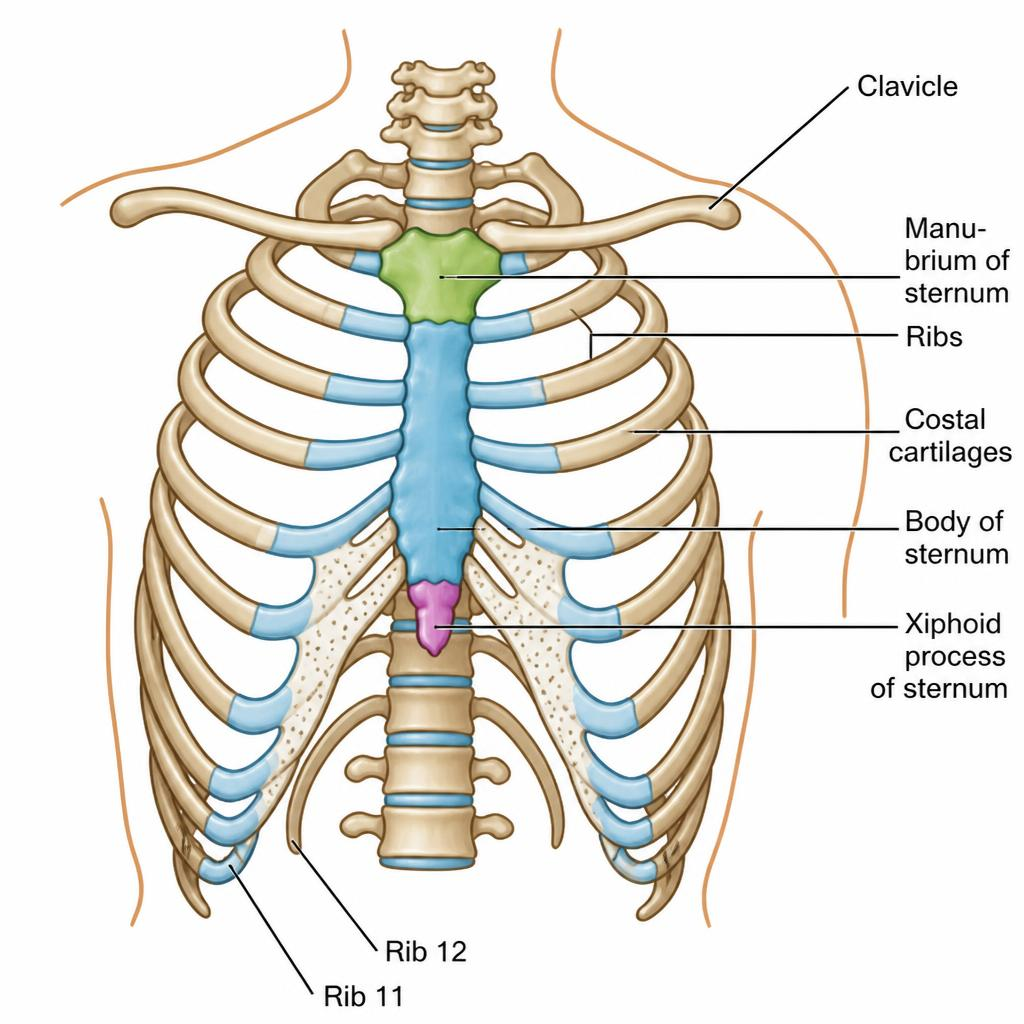
Humans have 12 pairs of ribs: 7 pairs of true ribs, 3 pairs of false (vertebrochondral) ribs and 2 pairs of floating ribs.
The floating ribs are the 11th and 12th pairs, which are not attached to the sternum ventrally. So floating ribs - 2 pairs is correct.
The collar bones (clavicles) are 1 pair, not 3 pairs.
The salivary glands are 3 pairs (parotid, sub-maxillary or sub-mandibular, and sub-lingual), not 1 pair.
The cranial nerves in humans are 12 pairs, not 10 pairs.
So the anatomically correct statement is floating ribs - 2 pairs.