Looking for classes? Ksquare Career Institute, Bengaluru →

Biology
Mineral Nutrition
63 questions from 32 papers, each with its answer.
- 63 questions
- 32 papers
- 1.79% of Biology
Biological nitrogen fixation
-
Which of the following is a flowering plant with nodules containing filamentous nitrogen-fixing micro-organismCasuarina equisetifolia is a flowering plant (angiosperm), although its needle-like branchlets with scale leaves make it look like a pine; it is often called the Australian pine, she-oak or horsetail tree.
Its roots bear nodules that contain Frankia, a filamentous nitrogen-fixing actinomycete.
So it is a flowering plant with nodules containing a filamentous nitrogen-fixing micro-organism.
Crotalaria juncea (sunn hemp) and Cicer arietinum (gram) are legumes; their root nodules contain Rhizobium, which is a rod-shaped bacterium and not filamentous.
Cycas revoluta has coralloid roots containing the filamentous cyanobacteria Anabaena and Nostoc, but Cycas is a gymnosperm and not a flowering plant.
So the answer is Casuarina equisetifolia.
Essential mineral elements
-
Which one of the following elements is not an essential micronutrient for plant growth?Essential elements are divided into two groups according to the quantity in which they are required.
Macronutrients are needed in large amounts (more than 10 mmole per kg of dry matter): C, H, O, N, P, K, S, Ca and Mg.
Micronutrients or trace elements are needed in very small amounts (less than 10 mmole per kg of dry matter): Fe, Mn, Cu, Mo, Zn, B, Cl and Ni.
Zn, Cu and Mn are micronutrients.
Calcium (Ca) is a macronutrient; it is needed in large amounts for the calcium pectate of the middle lamella, for the mitotic spindle and for membrane function.
So the element that is not an essential micronutrient is Ca.
Role of Macronutrients
-
A plant requires magnesium for
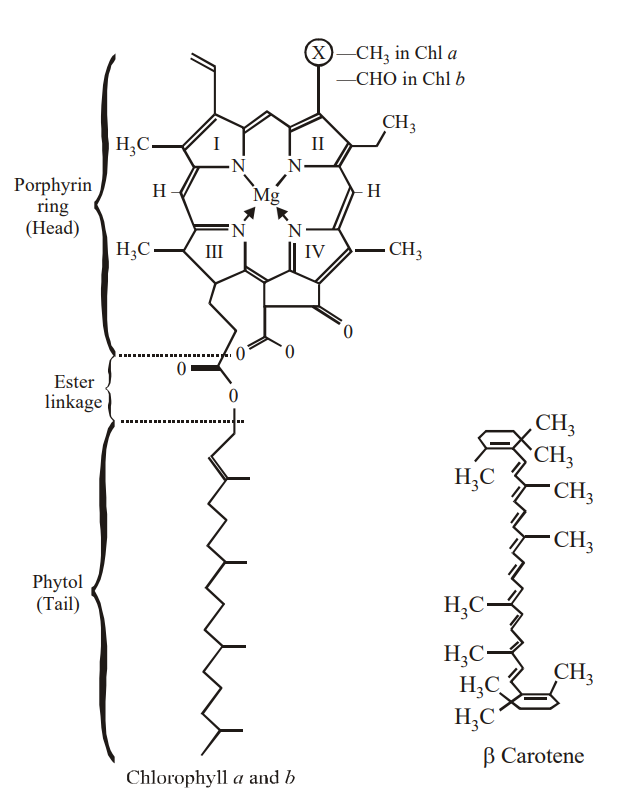
Magnesium is absorbed by plants in the form of the divalent ion $Mg^{2+}$.
It is a constituent of the ring structure of chlorophyll: the chlorophyll molecule has a porphyrin head made of four pyrrole rings, and all four rings are bound to a magnesium atom ($Mg^{2+}$) present at the centre.
So a plant requires magnesium for chlorophyll synthesis; its deficiency causes chlorosis.
Magnesium also activates the enzymes of respiration and photosynthesis, is involved in the synthesis of DNA and RNA, and helps to maintain the structure of ribosomes.
Cell wall development and holding the cells together are functions of calcium, which forms calcium pectate of the middle lamella.
So the answer is chlorophyll synthesis.
That is every question in Mineral Nutrition for this filter.
Want a score?
Answers here are not saved. Practise as a test to be marked and see your progress.
Practise as a test