Looking for classes? Ksquare Career Institute, Bengaluru →

Biology
Organisms and Populations
90 questions from 35 papers, each with its answer.
- 90 questions
- 35 papers
- 2.55% of Biology
Population Interactions
-
Study the four statements (a–d) given below and select the two correct ones out of them.
(a) A lion eating a deer and a sparrow feeding on grain are ecologically similar in being consumers
(b) Predator star fish $Pisaster$ helps in maintaining species diversity of some invertebrates
(c) Predators ultimately lead to the extinction of prey species
(d) Production of chemicals such as nicotine, strychnine by the plants are metabolic disorders
The two correct statements are(a) is correct: both the lion (a carnivore) and the sparrow feeding on grain (a herbivore) depend on other organisms for food, so ecologically both are consumers.
(b) is correct: in the rocky intertidal communities of the American Pacific coast, the starfish $Pisaster$ is an important predator; when it was removed experimentally, more than 10 species of invertebrates became extinct within a year because of interspecific competition. So it maintains species diversity.
(c) is wrong: predators in nature are 'prudent'; if a predator over-exploited its prey, the prey would become extinct and the predator would follow. Prey species have also evolved defences.
(d) is wrong: nicotine, strychnine, caffeine, quinine and opium are chemicals produced by plants as defences against grazers and browsers; they are not metabolic disorders.
Hence the two correct statements are (a) and (b).
Responses to abiotic factors
-
The figure given below is a diagrammatic representation of response of organisms to abiotic factors. What do a, b and c represent respectively?
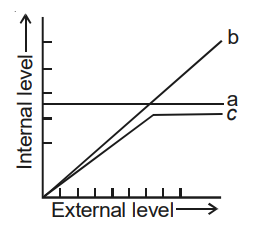 The graph plots the internal level of a factor (e.g., body temperature or osmotic concentration) against the external level.
Line a is horizontal: the internal level stays constant whatever the external level, so the organism maintains homeostasis. It is a regulator (e.g., birds and mammals).
Line b is a straight diagonal: the internal level changes in direct proportion to the external level. It is a conformer (about 99% of animals and nearly all plants).
Line c stays constant over a limited range of the external level and beyond that range changes with it. It is a partial regulator.
Hence a is regulator, b is conformer and c is partial regulator.
That is every question in Organisms and Populations for this filter.
Want a score?
Answers here are not saved. Practise as a test to be marked and see your progress.
Practise as a test