Looking for classes? Ksquare Career Institute, Bengaluru →

Biology
Organisms and Populations
90 questions from 35 papers, each with its answer.
- 90 questions
- 35 papers
- 2.55% of Biology
Population Interactions
-
Choose the correct statements regarding population interactions between two species. I. In both parasitism and commensalism, only one species benefits and the other species is harmed. II. Both species benefit in mutualism. III. Both species benefit in commensalism. IV. In parasitism, only one species benefits and the other species is harmed. V. In amensalism, one species is harmed and the other is unaffected. Choose the CORRECT answer from the options given below:
-
Match List-I (Interacting species) with List-II (Name of Interaction).
Pick the matching item from Column II for each row.
Column I
- A. A Leopard and a Lion in a forest/ grassland
- B. A Cuckoo laying egg in a Crow's nest
- C. Fungi and root of a higher plant in Mycorrhizae
- D. A cattle egret and a Cattle in a field
Column II
- I. Competition
- II. Brood parasitism
- III. Mutualism
- IV. Commensalism
Correct answer: A → I, B → II, C → III, D → IV
Leopard and lion compete; cuckoo shows brood parasitism; mycorrhiza is mutualism; cattle egret and cattle is commensalism.
Competition is a -/- interaction that occurs when individuals of different species compete for a resource that limits the survival and reproduction of each species, e.g., a leopard and a lion in a forest or grassland. Brood parasitism or the laying of one's eggs in the nest of another individual, is a reproductive strategy whereby parasites foist the cost of rearing their offspring onto another individual, the host, e.g., a cuckoo laying eggs in a crow's nest. Mutualism is an interspecific interaction that benefits both species (+/+), e.g., fungi and roots of a higher plant in mycorrhizae. Commensalism is the interaction in which one species benefits and the other is neither harmed nor benefited, e.g., a cattle egret and a cattle in a field. -
The following graph depicts changes in two populations (A and B) of herbivores in a grassy field. A possible reason for these changes is that [add image]Population A is stable at first and then declines sharply, while population B rises gradually and then rapidly.
Both are herbivores feeding on the same resource, so population B outcompeted population A for food. -
Which one of the following is categorised as a parasite in true sense?A true parasite lives on or in the host, obtains its food from the host and usually completes its life cycle there, harming the host.
The head louse lives on the human scalp, feeds on human blood and also lays its eggs on the hair; it is an ectoparasite in the true sense.
The female $Anopheles$ needs blood only for reproduction and visits the host just to feed; NCERT states that the female mosquito is not considered a parasite.
The koel laying eggs in the crow's nest is brood parasitism, in which only parental care is exploited.
A foetus drawing nourishment from its mother is a normal part of reproduction of the same species, not parasitism.
Hence the true parasite is the head louse. -
Study the four statements (a–d) given below and select the two correct ones out of them.
(a) A lion eating a deer and a sparrow feeding on grain are ecologically similar in being consumers
(b) Predator star fish $Pisaster$ helps in maintaining species diversity of some invertebrates
(c) Predators ultimately lead to the extinction of prey species
(d) Production of chemicals such as nicotine, strychnine by the plants are metabolic disorders
The two correct statements are(a) is correct: both the lion (a carnivore) and the sparrow feeding on grain (a herbivore) depend on other organisms for food, so ecologically both are consumers.
(b) is correct: in the rocky intertidal communities of the American Pacific coast, the starfish $Pisaster$ is an important predator; when it was removed experimentally, more than 10 species of invertebrates became extinct within a year because of interspecific competition. So it maintains species diversity.
(c) is wrong: predators in nature are 'prudent'; if a predator over-exploited its prey, the prey would become extinct and the predator would follow. Prey species have also evolved defences.
(d) is wrong: nicotine, strychnine, caffeine, quinine and opium are chemicals produced by plants as defences against grazers and browsers; they are not metabolic disorders.
Hence the two correct statements are (a) and (b).
Logistic Population Growth Equation
-
The equation of Verhulst-Pearl logistic growth is $\frac{dN}{dt}=rN\left[\frac{K-N}{K}\right]$. From this equation, K indicates:In the logistic growth equation $\frac{dN}{dt} = rN\left[\frac{K-N}{K}\right]$, N is population density, r is the intrinsic rate of natural increase and K is the carrying capacity. Carrying capacity is the maximum population size that the environment can support with its available resources.
Gause's Competitive Exclusion Principle
-
Given below are two statements: Statement I: Gause's competitive exclusive principle states that two closely related species competing for different resources cannot exist indefinitely. Statement II: According to Gause's principle, during competition, the inferior will be eliminated. This may be true if resources are limiting. In the light of the above statements, choose the most appropriate answer from the options given below:Gause's competitive exclusion principle states that two closely related species competing for the same resources cannot co-exist indefinitely. During competition, the competitively inferior species will be eliminated; this may be true if resources are limiting. As per the solution in the source, both statements are treated as true.
Population Interactions – Competition
-
Given below are two statements: Statement I: Gause's 'Competitive Exclusive Principle' states that two closely related species competing for the same resources cannot co-exist indefinitely and competitively inferior one will be eliminated eventually. Statement II: In general, carnivores are more adversely affected by competition than herbivores. In the light of the above statements, choose the correct answer from the options given below:
Statement I is Gause's principle; herbivores and plants (not carnivores) are more adversely affected by competition.
Gause's 'Competitive Exclusion Principle' states that two closely related species competing for the same resources cannot co-exist indefinitely and the competitively inferior one will be eliminated eventually. In general, herbivores and plants appear to be more adversely affected by competition than carnivores. -
Two different species can not live for long duration in the same niche or habitat. This law is : -G. F. Gause, working with two species of Paramecium, showed that two closely related species competing for the same resources cannot coexist indefinitely; the inferior competitor is eliminated.
This is called the competitive exclusion principle (it is also known as Gause's principle).
Allen's rule relates to shorter extremities in mammals of colder climates; Weismann's theory concerns the continuity of germplasm.
So, as per the answer key, this law is the competitive exclusion principle.
Population Attributes – Growth Models and Age Pyramids
-
Match List-I with List-II.
Pick the matching item from Column II for each row.
Column I
- A. Logistic growth
- B. Exponential growth
- C. Expanding age pyramid
- D. Stable age pyramid
Column II
- I. Unlimited resource availability condition
- II. Limited resource availability condition
- III. The percent individuals of pre-reproductive age is largest followed by reproductive and post reproductive age groups
- IV. The percent individuals of pre-reproductives and reproductive age group are same
Correct answer: A → II, B → I, C → III, D → IV
Logistic growth occurs with limited resources and exponential growth with unlimited resources.
Logistic growth – A population growing in a habitat with limited resources. Exponential growth – Any species growing exponentially under unlimited resource conditions can reach enormous population densities in a short time. Expanding age pyramids – The percent individuals of pre-reproductive age is largest followed by reproductive and post reproductive age groups. Stable age pyramid – The percent individuals of pre-reproductives and reproductive age group are same.
Responses to Abiotic Factors – Adaptations
-
Match List-I with List-II:
Pick the matching item from Column II for each row.
Column I
- A. Allen's Rule
- B. Physiological adaptation
- C. Behavioural adaptation
- D. Biochemical adaptation
Column II
- I. Kangaroo rat
- II. Desert lizard
- III. Marine fish at depth
- IV. Polar seal
Correct answer: A → IV, B → I, C → II, D → III
Responses to Abiotic Factors – Altitude Sickness
-
A person goes to high altitude and experiences 'altitude sickness' with symptoms like breathing difficulty and heart palpitations.Reason: Due to low atmospheric pressure at high altitude, the body does not get sufficient oxygen.
Population Attributes
-
A country with a high rate of population growth took measures to reduce it. The figure below shows age-sex pyramids of populations A and B twenty years apart. Select the correct interpretation about them.
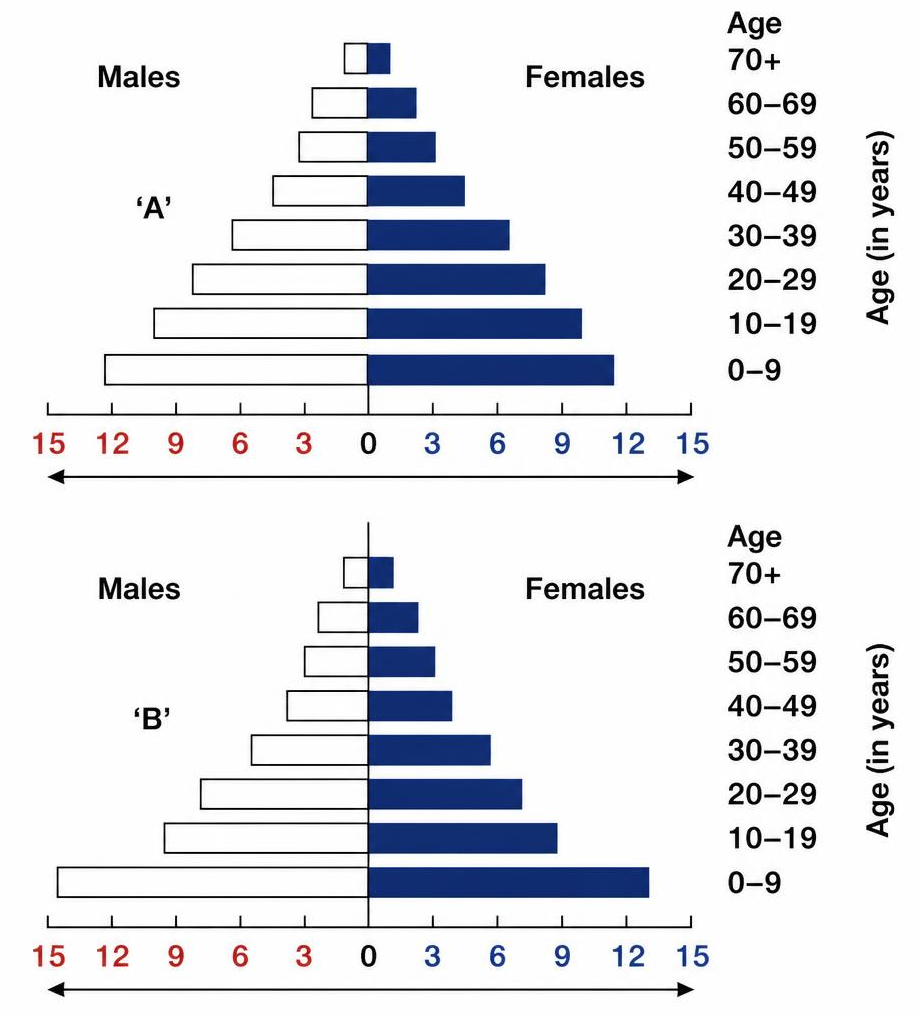 An age pyramid with a very broad base has a large proportion of young (pre-reproductive) individuals and represents a rapidly growing population.
When measures to reduce population growth take effect, fewer children are born, so the base of the pyramid becomes narrower in relation to the bars above it.
In the figure, pyramid B has the broader base (a steeply triangular shape), so it is the earlier pyramid of the fast-growing population.
Pyramid A has a slightly narrower base, showing that the youngest age groups have shrunk a little; it is therefore the more recent pyramid and shows a slight reduction in the growth rate.
Hence the correct interpretation is that 'A' is more recent and shows a slight reduction in the growth rate.
Logistic population growth model
-
Which of the following equations depicts Verhulst-Pearl logistic population growth?
Population density and growth
-
When will the population density increase, under special conditions? When the number of:Population density at time $t+1$: $N_{t+1}=N_t+[(B+I)-(D+E)]$. Population density increases when births plus immigrants (B+I) exceed deaths plus emigrants (D+E).
Types of species interactions
-
Match List-I with List-II and choose the correct answer from the options given below:
Pick the matching item from Column II for each row.
Column I
- A. Predator
- B. Mutualism
- C. Parasitism
- D. Sexual deceit
Column II
- I. Ophrys
- II. Pisaster
- III. Female wasp and fig
- IV. Plasmodium
Correct answer: A → II, B → III, C → IV, D → I
Predator is exemplified by Pisaster, a keystone predator (A-II); Mutualism is exemplified by the female wasp and fig relationship (B-III); Parasitism is exemplified by Plasmodium (C-IV); Sexual deceit is exemplified by Ophrys, an orchid that mimics a female insect (D-I).
Types of competition and its outcomes
-
Match List-I with List-II and choose the correct answer from the options given below:
Pick the matching item from Column II for each row.
Column I
- A. Migratory flamingoes and resident fish in South American lakes
- B. Abingdon tortoise became extinct after introduction of goats in their habitat
- C. Chathamalus expands its distributional range in the absence of Balanus
- D. Five closely related species of Warblers feeding in different locations on same tree
Column II
- I. Interference competition
- II. Competitive release
- III. Resource Partitioning
- IV. Interspecific competition
Correct answer: A → IV, B → I, C → II, D → III
Migratory flamingoes and resident fish in South American lakes is an example of interspecific competition (A-IV); Abingdon tortoise becoming extinct after introduction of goats is an example of interference competition (B-I); Chathamalus expanding its distributional range in the absence of Balanus is an example of competitive release (C-II); Five closely related species of Warblers feeding in different locations on the same tree is an example of resource partitioning (D-III).
Population growth models - exponential and logistic
-
What do 'a' and 'b' represent in the following population growth curve?
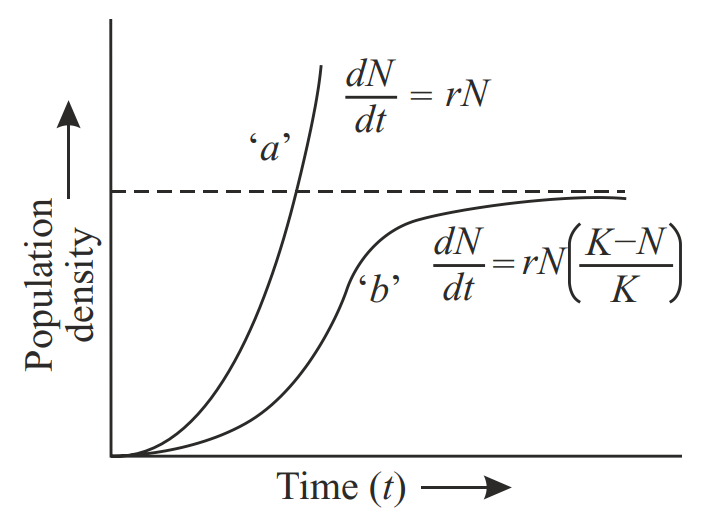 The equation $\dfrac{dN}{dt}=rN$ describes exponential (J-shaped) growth, occurring when resources are not limiting. The equation $\dfrac{dN}{dt}=rN\left(\dfrac{K-N}{K}\right)$ describes logistic (S-shaped) growth, occurring when resources become limiting as the population approaches the carrying capacity K.
Factors affecting population density
-
The impact of immigration on population density isImmigration adds individuals to a population, so it has a positive impact on population density (increasing it), unlike emigration which decreases it.
Types of interspecific interactions
-
Match the items in Column I with those in Column II:
Pick the matching item from Column II for each row.
Column I
- a. Herbivores-Plants
- b. Mycorrhiza-Plants
- c. Sheep-Cattle
- d. Orchid-Tree
Column II
- i. Commensalism
- ii. Mutualism
- iii. Predation
- iv. Competition
Correct answer: a → iii, b → ii, c → iv, d → i
Herbivores-Plants is an example of predation (a-iii); Mycorrhiza-Plants is an example of mutualism (b-ii); Sheep-Cattle is an example of competition (c-iv); Orchid-Tree is an example of commensalism (d-i).
Mutualism - plant-pollinator interactions
-
Plants offer rewards to animals in the form of pollen and nectar and the animals facilitate the pollination process. This is an example of:This is a classic example of mutualism, where both species benefit: plants get pollinated, and animals receive food rewards (pollen/nectar).
Chemical defence in plants against herbivory
-
For chemical defence against herbivores, Calotropis has:Calotropis produces cardiac glycosides as a chemical defence mechanism, which are toxic/distasteful to most herbivores, deterring them from feeding on it.
Birth rate (natality) calculation
-
If there are 250 snails in a pond, and within a year their number increases to 2500 by reproduction. What should be their birth rate per snail per year?Increase in population $=2500-250=2250$. Birth rate per capita $=\dfrac{2250}{250}=9$ per snail per year.
Population growth models
-
The population of an insect species shows an explosive increase in numbers during rainy season followed by its disappearance at the end of the season. What does this show?When resources are abundant, a population grows in an exponential or geometric fashion; the numbers increase slowly at first and then explosively.
The curve obtained by plotting the numbers against time is J-shaped.
In such growth the population overshoots the carrying capacity of the environment and then crashes suddenly, when an environmental factor (such as the end of the favourable season or a shortage of food) becomes limiting.
The explosive increase of the insect population in the rainy season, followed by its sudden disappearance at the end of the season, is exactly this pattern.
Similar J-shaped curves are seen in algal blooms and in a reindeer population allowed to grow in a predator-free environment.
In S-shaped (sigmoid) growth the population would level off at the carrying capacity and remain stable instead of crashing.
So this shows that its population growth curve is of J-type.
Population growth – logistic model
-
Asymptote in a logistic growth curve is obtained when
Growth stops when N reaches carrying capacity K.
A population growing in a habitat with limited resources shows a logistic growth curve. For logistic growth: $\frac{dN}{dt} = rN\left(\frac{K - N}{K}\right)$ If K = N then $\frac{K - N}{K} = 0$, so $\frac{dN}{dt} = 0$ and the population reaches the asymptote. -
When does the growth rate of a population following the logistic modal equals zero? The logistic model is given as $\frac{dN}{dt} = rN\left(1 - \frac{N}{K}\right)$
Growth stops exactly when N = K.
$\frac{dN}{dt} = rN\left(\frac{K - N}{K}\right)$, where N = population density, r = intrinsic rate of natural increase, K = carrying capacity
When $\frac{N}{K} = 1$, $\frac{K - N}{K} = 0$, therefore $\frac{dN}{dt} = 0$.
Body size and metabolic rate
-
It is much easier for a small animal to run uphill than for a large animal, because
Smaller animals have higher mass-specific metabolic rates.
The metabolic rate of an organism at rest at normal temperature is its basal metabolic rate (BMR). BMR is inversely proportional to body weight.
Small animals have a higher BMR, so they get more energy and can run uphill more easily than larger animals.
Responses to abiotic factors
-
People who have migrated from the planes to an area adjoining Rohtang Pass about six months backAt high altitude the atmospheric pressure is low, so less oxygen is available.
Over time the body acclimatises: it increases red blood cell production, decreases the binding affinity of haemoglobin (so oxygen is released more easily to tissues) and increases the breathing rate.
After six months these people are acclimatised, so they have more RBCs and haemoglobin with a lower binding affinity; altitude sickness occurs only in the first few days. -
The figure given below is a diagrammatic representation of response of organisms to abiotic factors. What do a, b and c represent respectively?
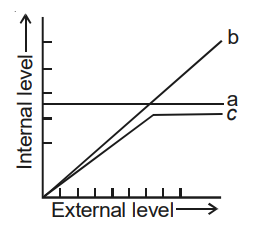 The graph plots the internal level of a factor (e.g., body temperature or osmotic concentration) against the external level.
Line a is horizontal: the internal level stays constant whatever the external level, so the organism maintains homeostasis. It is a regulator (e.g., birds and mammals).
Line b is a straight diagonal: the internal level changes in direct proportion to the external level. It is a conformer (about 99% of animals and nearly all plants).
Line c stays constant over a limited range of the external level and beyond that range changes with it. It is a partial regulator.
Hence a is regulator, b is conformer and c is partial regulator.
Adaptations, age pyramids and population interactions
-
Consider the following statements (A)–(D), each with one or two blanks.
(A) Bears go into ____(1)____ during winter to ____(2)____ cold weather
(B) A conical age pyramid with a broad base represents ____(3)____ human population
(C) A wasp pollinating a fig flower is an example of ____(4)____
(D) An area with high levels of species richness is known as ____(5)____
Which one of the following options gives the correct fill ups for the respective blank numbers from (1) to (5) in the statements?(1) and (2): bears go into hibernation (winter sleep) during winter to escape the cold weather. Aestivation is summer sleep, used to avoid heat and desiccation.
(3): a conical (triangular) age pyramid with a broad base has a large pre-reproductive group, so it represents an expanding (growing) population; a stable population has a bell-shaped pyramid.
(4): the fig and its pollinating wasp both benefit (the wasp gets a site for egg laying and food for its larvae, the fig gets pollinated), so this is mutualism, not commensalism.
(5): an area with a high level of species richness and endemism is called a biodiversity hot spot.
The only option in which every fill-up is correct is (1) – hibernation, (2) – escape, (3) – expanding, (5) – hot spot.
Adaptations
-
Consider the following four statements (i-iv) about certain desert animals such as kangaroo-rat.
(i) They have dark colour and high rate of reproduction and excrete solid urine
(ii) They do not drink water, breathe at a slow rate to conserve water and have their body covered with thick hairs
(iii) They feed on dry seeds and do not require drinking water
(iv) They excrete very concentrated urine and do not use water to regulate body temperature
Out of these four, which two are correct -The kangaroo rat of the North American deserts is a classic example of adaptation to scarcity of water.
(iii) is correct: it feeds on dry seeds and does not need to drink water. It meets all its water requirements through the internal oxidation of fat, in which water is a by-product (metabolic water).
(iv) is correct: it has the ability to concentrate its urine, so that only a minimal volume of water is used to remove excretory products. It also does not use water for cooling the body (no sweating or panting); it avoids heat by staying in burrows during the day.
(i) is not correct: it is not dark coloured, and it excretes highly concentrated liquid urine, not solid urine.
(ii) is not correct: a covering of thick hairs and a slow breathing rate are not its adaptations for conserving water.
So the two correct statements are (iii) and (iv).
Prey Defence against Predators
-
Animals have the innate ability to escape from predation. Examples for the same are given below. Select the incorrect examplePrey animals have evolved various defences to escape predation.
Colour change in the chameleon is camouflage: it blends with the background and is not easily seen by predators.
Melanism in moths (as in the peppered moth on soot-covered tree trunks) is also camouflage against predatory birds.
The puffer fish swallows water or air and inflates its body to a large, spiny ball that predators find difficult to swallow; this is a defence against predators.
Poison fangs in snakes are mainly a means of capturing and killing prey; they are an offensive adaptation of a predator, not an innate means of escaping from predation.
So the incorrect example is poison fangs in snakes.
Note: the answer key of the source gives the puffer fish option; that is changed here because inflation of the puffer fish is a classic anti-predator defence.
Population Attributes and Age Pyramids
-
Certain characteristic demographic features of developing countries are -In developing countries like India, the birth rate (fertility) remains high.
At the same time, the death rate (mortality) has fallen rapidly because of better medical facilities, vaccination, sanitation and food supply.
High birth rate together with low or falling death rate results in rapid population growth (population explosion).
Because many children are born every year, a large proportion of the population is young. The age pyramid is broad at the base (expanding, triangular shape).
So the characteristic features are high fertility, low or rapidly falling mortality rate, rapid population growth and a very young age distribution.
Exponential Growth
-
The semilog of per minute growing bacteria is plotted against time. What will be the shape of graph : -In the growth phase, the rate of increase of bacteria is proportional to their number: $\dfrac{dN}{dt} = \mu N$
Integrating: $N = N_0e^{\mu t}$
Taking logarithms: $\log N = \log N_0 + \mu t$ (in natural log form)
This has the form $y = mx + c$ with $y = \log N$, $m = \mu$ (positive) and $x = t$.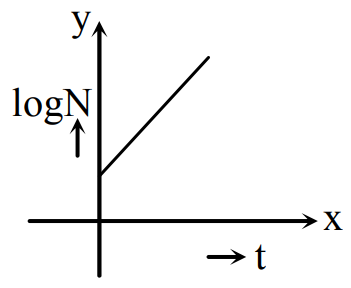
So a semilog plot (log of number against time) of growing bacteria is an ascending straight line.
That is every question in Organisms and Populations for this filter.
Want a score?
Answers here are not saved. Practise as a test to be marked and see your progress.
Practise as a test