Looking for classes? Ksquare Career Institute, Bengaluru →

Biology
Structural Organisation in Animals
92 questions from 36 papers, each with its answer.
- 92 questions
- 36 papers
- 2.61% of Biology
Frog Respiratory System
-
Frogs respire in water by skin and buccal cavity and on land by skin, buccal cavity and lungs.
Choose the correct answer from the following:In water, frogs respire solely by skin (cutaneous); on land, they respire via skin, buccal cavity, and lungs.
In aquatic conditions, skin serves as the aquatic respiratory organ (cutaneous respiration only). On land, respiration is carried out by skin, buccopharyngeal cavity, and lungs (pulmonary respiration). Hence the statement is false for water but true for land.
Types of Muscle Tissue and Their Locations
-
Three type of muscles are given as a, b and c. Identify the correct matching pair along with their location in human body.
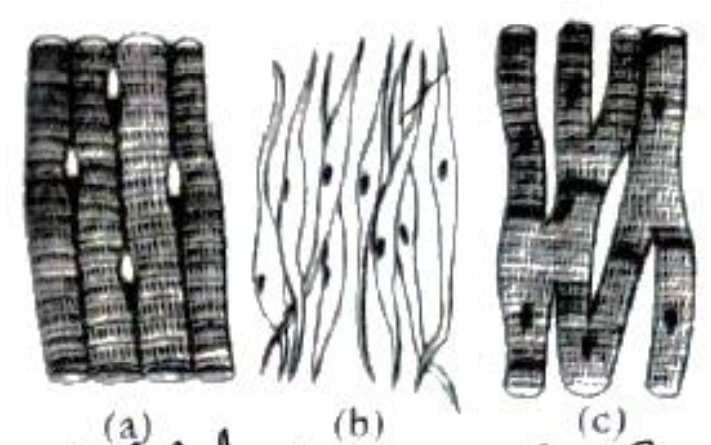 (a) Striated, unbranched fibres bundled in parallel – skeletal muscle, e.g. triceps/biceps.
(b) Spindle-shaped, non-striated fibres – smooth muscle, found in the walls of internal organs such as the stomach and intestine.
(c) Striated, branched fibres with intercalated discs – cardiac muscle, found only in the heart.
So (a) Skeletal – Triceps, (b) Smooth – Stomach, (c) Cardiac – Heart.
Types of Epithelial Tissue and Example Locations
-
Match List-I with List-II regarding types of epithelium and their locations.
Pick the matching item from Column II for each row.
Column I
- A. Unicellular glandular epithelium
- B. Compound epithelium
- C. Multicellular glandular epithelium
- D. Endocrine glandular epithelium
Column II
- I. Salivary glands
- II. Pancreas
- III. Goblet cells of alimentary canal
- IV. Moist surface of buccal cavity
Correct answer: A → III, B → IV, C → I, D → II
Unicellular glandular epithelium – goblet cells of the alimentary canal Compound epithelium – lines the moist surface of the buccal cavity Multicellular glandular epithelium – salivary glands Endocrine glandular epithelium – pancreas (secretes hormones) Correct match: A-III, B-IV, C-I, D-II.
Animal Tissues – Connective Tissue
-
Given below are two statements: Statement I: Ligaments are dense irregular tissue Statement II: Cartilage is dense regular tissue. In the light of above statements choose the correct answer from the option given below:
Ligaments are dense regular connective tissue and cartilage is a specialised connective tissue, so both statements are false.
Ligaments are dense regular connective tissue that connect bone to bone. Cartilage is one of the types of specialised connective tissues.
Animal Tissues – Epithelial and Connective Tissue
-
Match List-I with List-II.
Pick the matching item from Column II for each row.
Column I
- A. Mast cells
- B. Inner surface of bronchiole
- C. Blood
- D. Tubular parts of nephron
Column II
- I. Ciliated epithelium
- II. Areolar connective tissue
- III. Cuboidal epithelium
- IV. specialised connective tissue
Correct answer: A → II, B → I, C → IV, D → III
Mast cells lie in areolar tissue, bronchioles have ciliated epithelium, blood is specialised connective tissue, and nephron tubules have cuboidal epithelium.
Mast cells – Areolar tissue serves as support frame work for epithelium. Inner surface of bronchiole – Ciliated epithelium bear cilia on their free surface that help to move particles in specific direction. Blood – Specialised connective tissues. Tubular parts of nephrons – Cuboidal epithelium help in secretion and absorption.
Cockroach – Excretory System
-
In cockroach, excretion is brought about by- A. Phallic gland B. Urecose gland C. Nephrocytes D. Fat body E. Collaterial glands Choose the correct answer from the options given below:
Cockroach excretion involves the fat body, nephrocytes and urecose glands.
Insects like cockroach are uricotelic (excrete uric acid). In addition, the fat body, nephrocytes and urecose glands also help in excretion.
Animal Tissues
-
The four sketches (A, B, C and D) given below represent four different types of animal tissues. Which one of these is correctly identified in the options given, along with its correct location and function?
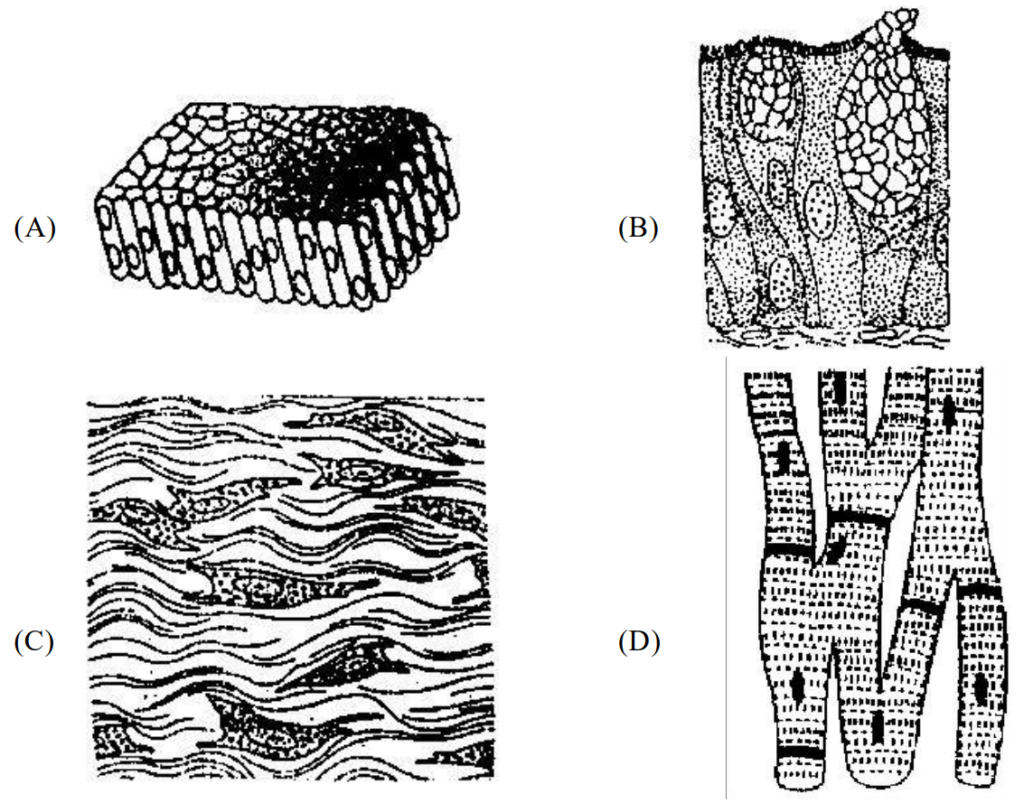 Sketch (B) shows glandular epithelium (columnar cells specialised for secretion, including unicellular goblet cells); it occurs in the lining of the intestine and its function is secretion. This row is fully correct.
Sketch (A): columnar epithelium lines the stomach and intestine; the tubules of the nephron are lined by cuboidal epithelium, so the location is wrong.
Sketch (C): the structure that attaches skeletal muscles to bones is a tendon (dense regular connective tissue), not cartilage, so the row is wrong.
Sketch (D): smooth muscle is found in the walls of blood vessels, stomach and intestine; the heart is made of cardiac muscle, so the row is wrong.
Hence the correct identification is (B) glandular epithelium, found in the intestine, with the function of secretion.
Cockroach – Morphology and Digestive System
-
Which of the following characteristics is incorrect with respect to cockroach?
Animal Tissues – Epithelial Tissue (Cell Junctions)
-
Identify the types of cell junctions that help to stop the leakage of the substances across a tissue and facilitation of communication with neighbouring cells via rapid transfer of ions and molecules.
Earthworm – Morphology
-
Following are the statements about prostomium of earthworm. A. It serves as a covering for mouth. B. It helps to open cracks in the soil into which it can crawl. C. It is one of the sensory structures. D. It is the first body segment. Choose the correct answer from the options given below.
Animal Tissues – Epithelial Tissue
-
Cuboidal epithelium with brush border of microvilli is found in:Cuboidal epithelium with a brush border of microvilli is found in the proximal convoluted tubule (PCT) of the nephron, where it increases the surface area for reabsorption.
-
The ciliated epithelial cells are required to move particles or mucus in a specific direction. In humans, these cells are mainly present in:
Cockroach – Neural System
-
If the head of cockroach is removed, it may live for few days because:In cockroach, the head holds only a small proportion of the nervous system (supra-oesophageal ganglion), while the rest is situated along the ventral part of the body (ventral nerve cord with segmental ganglia). So if the head is cut off, the cockroach can still live for a few days.
Cockroach – Digestive System
-
Select the correct sequence of organs in the alimentary canal of cockroach starting from mouth:
Reproductive system of cockroach
-
Which of the following is/are present in female cockroach? A. Collateral gland B. Mushroom gland C. Spermatheca D. Anal style E. Phallic gland. Choose the most appropriate answer from the options given below:The collateral glands (which secrete the material for the ootheca/egg case) and spermatheca (which stores sperm received during mating) are present in the female cockroach. Mushroom gland, phallic gland and anal style are structures found in the male cockroach. So A and C only.
Connective tissues and fibre-secreting cells
-
In which of the following connective tissues, the cells secrete fibres of collagen or elastin? A. Cartilage B. Bone C. Adipose tissue D. Blood E. Areolar tissue. Choose the most appropriate answer from the options given below:Cartilage, bone, adipose tissue and areolar tissue all contain cells that secrete fibres of collagen or elastin (structural proteins). Blood does not contain such fibre-secreting cells (fibroblasts); it is a fluid connective tissue without a fibrous matrix of this kind.
Types of epithelial tissue and their location
-
Match List-I with List-II and choose the correct answer from the options given below:
Pick the matching item from Column II for each row.
Column I
- A. Squamous Epithelium
- B. Ciliated Epithelium
- C. Glandular Epithelium
- D. Compound Epithelium
Column II
- I. Goblet cells of alimentary canal
- II. Inner lining of pancreatic ducts
- III. Walls of blood vessels
- IV. Inner surface of Fallopian tubes
Correct answer: A → III, B → IV, C → I, D → II
Squamous Epithelium lines the walls of blood vessels (A-III); Ciliated Epithelium lines the inner surface of Fallopian tubes (B-IV); Glandular Epithelium (e.g. goblet cells) is found in the alimentary canal (C-I); Compound Epithelium lines the inner lining of pancreatic ducts (D-II). -
Match List-I with List-II.
Pick the matching item from Column II for each row.
Column I
- A. Columnar epithelium
- B. Ciliated epithelium
- C. Squamous epithelium
- D. Cuboidal epithelium
Column II
- I. Ducts of glands
- II. Inner lining of stomach and intestine
- III. Inner lining of bronchioles
- IV. Endothelium
Correct answer: A → II, B → III, C → IV, D → I
Columnar epithelium lines the stomach and intestine (A-II); Ciliated epithelium lines the bronchioles (B-III); Squamous epithelium forms the endothelium (lining of blood vessels) (C-IV); Cuboidal epithelium lines the ducts of glands (D-I).
Digestive and structural features of cockroach
-
Match the following columns with reference to cockroach and select the correct option:
Pick the matching item from Column II for each row.
Column I
- a. Grinding of the food particles
- b. Secrete gastric juice
- c. 10 pairs
- d. Anal Cerci
Column II
- i. Hepatic caecal
- ii. 10th segment
- iii. Proventriculus
- iv. Spiracles
Correct answer: a → iii, b → i, c → iv, d → ii
Grinding of food particles is done by the proventriculus/gizzard (a-iii); Secretion of gastric juice is done by hepatic caecae (b-i); 10 pairs refers to spiracles (c-iv); Anal cerci are found on the 10th abdominal segment (d-ii).
Cell types and tissues
-
Select the incorrectly matched pair from following:Chondrocytes are cartilage cells, not smooth muscle cells — so this pairing is incorrect. (Osteocytes are bone cells, neurons are nerve cells, and fibroblasts are found in areolar tissue — all correctly matched.)
Digestive system of cockroach - foregut
-
In cockroach, identify the parts of the foregut in correct sequence:The correct sequence of the foregut in a cockroach is: Mouth $\to$ Pharynx $\to$ Oesophagus $\to$ Crop $\to$ Gizzard (proventriculus).
Types of glands - unicellular and exocrine
-
Given below are two statements:- Statement I: Goblet cells are unicellular glands. Statement II: Earwax is the secretion of exocrine gland. In the light of the above statements, choose the correct answer from the options given below:Goblet cells are indeed unicellular glands (secreting mucus) found within epithelial tissue (Statement I is true). Earwax (cerumen) is secreted by ceruminous glands, which are a type of exocrine gland (Statement II is true).
Wings of cockroach
-
Given below are two statements: Statement I: In cockroach, the forewings are transparent and prothoracic in origin. Statement II: In cockroach, the hind wings are opaque, leathery and mesothoracic in origin. In the light of the above statements, choose the correct answer from the options given below:In a cockroach, the forewings (tegmina) are actually opaque and leathery (not transparent), and they arise from the mesothorax (not the prothorax) — so Statement I is false. The hind wings are actually membranous/transparent (not opaque and leathery), and they arise from the metathorax (not the mesothorax) — so Statement II is also false. Both statements have the wing descriptions and segments of origin reversed/incorrect.
Connective tissue
-
Given below is the diagrammatic sketch of a certain type of connective tissue. Identify the parts labelled A, B, C and D, and select the right option about them.
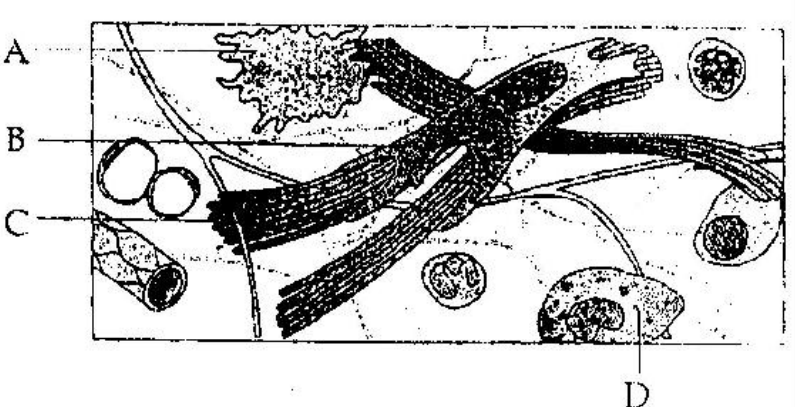 The sketch is of areolar tissue, a loose connective tissue present beneath the skin, with cells and fibres loosely arranged in a semi-fluid ground substance.
A is a macrophage: a large irregular cell that engulfs foreign particles.
B is a fibroblast: a flattened, spindle-shaped cell with processes that produces and secretes the fibres.
C represents collagen fibres: wavy bundles of fibres running through the matrix.
D is a mast cell: a rounded cell packed with granules that releases histamine and heparin.
So A is macrophage, B is fibroblast, C is collagen fibres and D is mast cell.
Cell junctions
-
Match the following cell structures with their characteristic feature. Select the correct option.
Pick the matching item from Column II for each row.
Column I
- A. Tight junctions
- B. Adhering junctions
- C. Gap junctions
- D. Synaptic junctions
Column II
- I. Cement neighbouring cells together to form sheet
- II. Transmit information through chemical to another cells
- III. Establish a barrier to prevent leakage of fluid across epithelial cells
- IV. Cytoplasmic channels to facilitate communication between adjacent cells
Correct answer: A → III, B → I, C → IV, D → II
Cockroach - morphology and anatomy
-
Which of the following statements is INCORRECT?
Cockroach – sexual dimorphism
-
Which of the following features is used to identify a male cockroach from a female cockroach?
Only male cockroaches have anal (caudal) styles.
Males bear a pair of short, thread-like anal styles which are absent in females. Anal/caudal styles arise from the $9^{th}$ abdominal segment in the male cockroach.
Frog – male reproductive system
-
Select the correct route for the passage of sperms in male frogs:
Sperm pass through the kidney via Bidder's canal to the urinogenital duct.
In male frogs, sperms move from Testes $\rightarrow$ Vasa efferentia $\rightarrow$ Kidney $\rightarrow$ Bidder's canal $\rightarrow$ Urinogenital duct $\rightarrow$ Cloaca.
Cockroach – features
-
Which of the following features is not present in $Periplaneta\ americana$?
Arthropods (protostomes) show determinate spiral cleavage.
During embryonic development, $Periplaneta\ americana$ shows determinate cleavage, not indeterminate and radial cleavage. It develops into a nymph similar to its parent.
Cockroach
-
Select the correct statement from the ones given below with respect to Periplaneta americanaMale cockroaches bear a pair of short, thread-like anal styles, which are absent in females.
Food is also ground in the gizzard; the nerve cord is ventral, not dorsal; and there are 100–150 Malpighian tubules. -
Which of the following is correctly stated as it happens in the common cockroach?The cockroach has biting and chewing mouth parts; the mandibles crush the food, and the gizzard (proventriculus), which has six chitinous teeth, grinds the food particles further. This statement is correct.
Malpighian tubules (100–150 yellow filaments) arise at the junction of the midgut and hindgut, not from the colon.
The haemolymph has no respiratory pigment; oxygen reaches the tissues directly through the tracheal system.
The cockroach is uricotelic: its nitrogenous waste is uric acid, not urea.
Hence the correct statement is that the food is ground by mandibles and gizzard. -
Which one of the following is the true description about an animal concerned?Cockroach: the respiratory system consists of a network of tracheae that open to the outside through 10 pairs of small holes called spiracles, present on the lateral side of the body.
Of these, 2 pairs are on the thorax and 8 pairs are on the abdomen. So this description is true.
Rat: the right kidney is slightly higher (more anterior) in position than the left one, so the statement given is wrong.
Earthworm: the correct sequence of the alimentary canal is buccal cavity, pharynx, oesophagus, gizzard, stomach and intestine. The gizzard comes before the stomach, so the given sequence is wrong.
Frog: the body is divisible into head and trunk only; the neck and tail are absent.
So the true description is that of the cockroach with 10 pairs of spiracles.
Earthworm
-
One very special feature in the earthworm $Pheretima$ is thatA characteristic feature of the intestine of the earthworm, after the 26th segment, is an internal median fold of the dorsal wall called the typhlosole.
The typhlosole increases the effective area of absorption in the intestine. This statement is correct.
The earthworm has a closed circulatory system with blood vessels and lateral hearts in segments; a long dorsal tubular heart is a feature of the cockroach.
Fertilisation and development take place outside the body, within the cocoon deposited in the soil.
The S-shaped setae help in locomotion, not in defence.
Hence the special feature is the typhlosole that increases the absorptive area of the intestine. -
Which one of the following correctly describes the location of some body parts in the earthworm $Pheretima$?The earthworm is hermaphrodite. It has two pairs of testes, present in the 10th and 11th segments. This statement is correct.
The two pairs of accessory glands are present one pair each in the 17th and 19th segments, not in segments 16–18.
The four pairs of spermathecae are located in the 6th to 9th segments (one pair in each), not in segments 4–7.
The one pair of ovaries is attached at the intersegmental septum of the 12th and 13th segments, not the 14th and 15th.
Hence the correct description is two pairs of testes in the 10th and 11th segments.
Frog
-
Ureters act as urinogenital ducts inIn the male frog, the vasa efferentia from the testis enter the kidney and open into Bidder's canal, which finally communicates with the ureter.
So the ureter of the male frog carries both urine and sperms; it acts as a urinogenital duct and opens into the cloaca.
In the female frog the ureters and the oviducts open separately into the cloaca, so the ureters carry only urine.
In humans the ureters carry only urine from the kidney to the urinary bladder in both sexes; in human males it is the urethra that is the common urinogenital passage.
Hence ureters act as urinogenital ducts in male frogs.
Neural Tissue
-
Which cells do not form a layer and remain structurally separate : -Epithelial and gland cells are packed closely into layers, and muscle cells form bundles and sheets.
Nerve cells (neurons) are structurally separate units. They do not form a continuous layer, and they are not even in direct cytoplasmic contact with each other; they communicate across synapses (small gaps).
So nerve cells do not form a layer and remain structurally separate.
Connective Tissue: Cartilage
-
During an injury nasal septum gets damaged and for its recovery which cartilage is preferred : -The nasal septum, the tip of the nose, the trachea and the ends of long bones are made of hyaline cartilage.
To repair the nasal septum, the same type of cartilage, hyaline cartilage, is preferred, because it has the right firmness and flexibility.
Elastic cartilage is found in the pinna and epiglottis, and fibrous cartilage in intervertebral discs.
So hyaline cartilage is preferred.
Glands of Mammals
-
Which gland secretes odourous secretion in mammals :Many mammals have anal (scent) glands near the anus that produce strong-smelling secretions, used for marking territory, communication and defence (e.g. the skunk and civet).
Bartholin's glands lubricate the vagina, the prostate secretes part of the seminal fluid, and the liver secretes bile.
So the anal gland secretes odourous secretion.
Earthworm: Excretory System
-
Primary function of enteronephric nephridia of Pheretima :Earthworm has three types of nephridia: septal, integumentary and pharyngeal.
Septal and pharyngeal nephridia open into the gut (alimentary canal); they are called enteronephric nephridia. They discharge their wastes into the gut, which helps conserve water.
Nephridia remove nitrogenous wastes (ammonia, urea) and also help in osmoregulation.
So, as per the answer key, their primary function is excretion of nitrogenous waste.
That is every question in Structural Organisation in Animals for this filter.
Want a score?
Answers here are not saved. Practise as a test to be marked and see your progress.
Practise as a test