Looking for classes? Ksquare Career Institute, Bengaluru →

Biology
Respiration in Plants
48 questions from 31 papers, each with its answer.
- 48 questions
- 31 papers
- 1.36% of Biology
Enzyme Inhibition
-
Inhibition of Succinic dehydrogenase enzyme by malonate is a classical example of:Malonate closely resembles the substrate succinate in structure. It competes with succinate for the active site of succinic dehydrogenase and blocks it, so the enzyme cannot convert succinate to fumarate. This is a classical example of competitive inhibition.
Enzyme Cofactors
-
The cofactor of the enzyme carboxypeptidase is:Carboxypeptidase is a metalloenzyme. Zinc is its cofactor, which is essential for its catalytic activity in the hydrolysis of peptide bonds.
Cellular Location of Respiratory Pathway Steps
-
Match List-I with List-II regarding the location of steps of cellular respiration.
Pick the matching item from Column II for each row.
Column I
- A. Citric acid cycle
- B. Glycolysis
- C. Electron transport system
- D. Proton gradient
Column II
- I. Cytoplasm
- II. Mitochondrial matrix
- III. Intermembrane space of mitochondria
- IV. Inner mitochondrial membrane
Correct answer: A → II, B → I, C → IV, D → III
Citric acid cycle – mitochondrial matrix Glycolysis – cytoplasm Electron transport system – inner mitochondrial membrane Proton gradient – intermembrane space of mitochondria Correct match: A-II, B-I, C-IV, D-III.
Glycolysis
-
ATP is used at two steps in glycolysis.Reason: First ATP is used in converting glucose into glucose-6-phosphate and second ATP is used in conversion of fructose-6-phosphate into fructose-1,6-diphosphate.
ATP is used in the conversion of glucose to glucose-6-phosphate and fructose-6-phosphate to fructose-1,6-bisphosphate.
ATP is utilised at two steps: first in the conversion of glucose into glucose 6-phosphate and second in the conversion of fructose 6-phosphate to fructose 1, 6-bisphosphate.
Aerobic Respiration – Steps of Cellular Respiration
-
Match List-I with List-II
Pick the matching item from Column II for each row.
Column I
- A. Oxidative decarboxylation
- B. Glycolysis
- C. Oxidative phosphorylation
- D. Tricarboxylic acid cycle
Column II
- I. Citrate synthase
- II. Pyruvate
- III. Electron transport system
- IV. EMP pathway
Correct answer: A → II, B → IV, C → III, D → I
Pyruvate undergoes oxidative decarboxylation; glycolysis is the EMP pathway; the TCA cycle uses citrate synthase.
Pyruvate when enters into mitochondrial matrix, it undergoes oxidative decarboxylation by a complex set of reactions catalysed by pyruvic dehydrogenase. Glycolysis is often referred to as the EMP pathway. Oxidative phosphorylation is a process embedded in the inner membrane of mitochondria (called electron transport chain and ATP synthase). The reaction in TCA cycle is catalysed by the enzyme citrate synthase.
Fermentation
-
What amount of energy is released from glucose during lactic acid fermentation?
-
The energy-releasing metabolic process in which substrate is oxidised without an external electron acceptor is calledIn aerobic respiration the electrons removed from the substrate are finally passed to an external electron acceptor, molecular oxygen.
In fermentation there is no external electron acceptor: glucose is only partially oxidised to pyruvic acid, and the NADH produced is re-oxidised by transferring its electrons to an internal organic molecule derived from the substrate itself.
In alcoholic fermentation acetaldehyde is reduced to ethanol; in lactic acid fermentation pyruvic acid is reduced to lactic acid.
Only a small amount of energy is released (net gain of 2 ATP per glucose).
Glycolysis by itself only produces pyruvate and NADH; photorespiration consumes energy.
Hence the process is fermentation. -
The energy-releasing process in which the substrate is oxidized without an external electron acceptor is called:In aerobic respiration the electrons removed from the substrate are finally passed to oxygen, which is an external electron acceptor.
Fermentation takes place in the absence of oxygen, and no external electron acceptor is used.
The $NADH + H^+$ produced in glycolysis is reoxidised to $NAD^+$ by passing its electrons to an organic molecule formed from the substrate itself: pyruvic acid (giving lactic acid) or acetaldehyde (giving ethanol and $CO_2$).
So in fermentation the substrate is only partially oxidised, and an internal organic compound acts as the electron acceptor. Only a small amount of energy (a net gain of 2 ATP per glucose) is released.
Glycolysis is only the first step, common to both aerobic respiration and fermentation, and by itself does not include the fate of the reduced coenzymes.
Photorespiration is not an energy-releasing process; it consumes energy.
So the process is fermentation. -
In alcohol fermentation : -In glycolysis, glyceraldehyde-3-phosphate (a triose phosphate) is oxidised; it gives electrons (and $H^+$) to $NAD^+$, forming NADH. So triose phosphate is the electron donor.
In alcoholic fermentation by yeast, pyruvic acid is first decarboxylated to acetaldehyde: $CH_3COCOOH \rightarrow CH_3CHO + CO_2$
Acetaldehyde then accepts electrons from NADH and is reduced to ethanol: $CH_3CHO + NADH + H^+ \rightarrow C_2H_5OH + NAD^+$
So acetaldehyde is the final electron acceptor. (Pyruvic acid is the acceptor in lactic acid fermentation.) Oxygen is not involved.
So in alcohol fermentation, triose phosphate is the electron donor while acetaldehyde is the electron acceptor.
Electron Transport System and Oxidative Phosphorylation
-
Which of the following statements is incorrect?
Tricarboxylic Acid Cycle
-
The number of substrate level phosphorylations in one turn of citric acid cycle is:In one turn of the citric acid cycle, there is one substrate level phosphorylation: Succinyl-CoA $\xrightarrow{succinate\ thiokinase}$ succinate, with GDP → GTP (which then forms ATP from ADP).
-
All enzymes of TCA cycle are located in the mitochondrial matrix except one which is located in inner mitochondrial membranes in eukaryotes and in cytosol in prokaryotes. This enzyme isThe enzymes of the TCA (Krebs) cycle are present in the mitochondrial matrix, with one exception.
Succinate dehydrogenase, which oxidises succinate to fumarate and reduces FAD to $FADH_2$, is bound to the inner mitochondrial membrane.
It is a part of complex II of the electron transport system (succinate : ubiquinone oxidoreductase), and so it provides a direct link between the citric acid cycle and the membrane-bound electron transport chain.
The enzyme contains a covalently bound FAD group and iron-sulphur clusters, through which the electrons from succinate are passed on to ubiquinone.
Isocitrate dehydrogenase and malate dehydrogenase are soluble enzymes of the matrix.
Lactate dehydrogenase is not an enzyme of the TCA cycle at all; it is a cytoplasmic enzyme of lactic acid fermentation.
So the enzyme is succinate dehydrogenase.
Respiratory Quotient
-
Respiratiory Quotient (RQ) value of tripalmitin is:
Respiratory Quotient (RQ) for fat substrate
-
$2(C_{51}H_{98}O_6) + 145\,O_2 \rightarrow 102\,CO_2 + 98\,H_2O + energy$ The Respiratory Quotient (RQ) of a biomolecule used for respiration, as per the above equation, would be:
Cellular respiration - locations of processes
-
Match List I with List II:
Pick the matching item from Column II for each row.
Column I
- i. Glycolysis
- ii. ETS
- iii. Accumulation of protons
- iv. Krebs' cycle
Column II
- a. Inner mitochondrial membrane
- b. Mitochondrial matrix
- c. Cytoplasm
- d. Intermembrane space
Correct answer: i → c, ii → a, iii → d, iv → b
Electron transport system (ETS) complexes
-
Match List-I with List-II and choose the correct answer from the options given below:
Pick the matching item from Column II for each row.
Column I
- A. ETS Complex I
- B. ETS Complex II
- C. ETS Complex III
- D. ETS Complex IV
Column II
- I. NADH Dehydrogenase
- II. Cytochrome bC1
- III. Cytochrome C oxidase
- IV. Succinate Dehydrogenase
Correct answer: A → I, B → IV, C → II, D → III
ETS Complex I is NADH Dehydrogenase (A-I); ETS Complex II is Succinate Dehydrogenase (B-IV); ETS Complex III is Cytochrome $bc_1$ (C-II); ETS Complex IV is Cytochrome C oxidase (D-III).
Overview of cellular respiration
-
Which of the following are correct about cellular respiration? A. Cellular respiration is the breaking of C-C bonds of complex organic molecules by oxidation. B. The entire cellular respiration takes place in Mitochondria. C. Fermentation takes place under anaerobic condition in germinating seeds. D. The fate of pyruvate formed during glycolysis depends on the type of organism also. E. Water is formed during respiration as a result of $O_2$ accepting electrons and getting reduced. Choose the correct answer from the options given below:Statements A, C, D and E are correct. Statement B is incorrect because glycolysis (the first step of cellular respiration) occurs in the cytoplasm, not entirely within the mitochondria.
Pyruvate dehydrogenase and cofactors
-
Pyruvate dehydrogenase activity during aerobic respiration requires:The pyruvate dehydrogenase enzyme complex, which catalyses the conversion of pyruvate to acetyl CoA (the link reaction), requires magnesium ($Mg^{2+}$) as a cofactor.
TCA cycle - decarboxylation steps
-
How many times decarboxylation occurs during each TCA cycle?Decarboxylation occurs twice in each turn of the TCA (Krebs) cycle: once when isocitrate is converted to alpha-ketoglutarate, and again when alpha-ketoglutarate is converted to succinyl-CoA, releasing two molecules of $CO_2$ per cycle.
Beta-oxidation of fatty acids linking to respiration
-
Fatty acids are connected with the respiratory pathway through:Fatty acids, after beta-oxidation, are broken down into acetyl CoA units, which then enter the TCA cycle — thus fatty acids connect to the respiratory pathway via acetyl CoA.
Decarboxylation steps in Krebs cycle
-
The number of time(s) decarboxylation of isocitrate occurs during single TCA cycle is:In a single Krebs cycle decarboxylation occurs at two steps: isocitrate is oxidatively decarboxylated to 5-C $\alpha$-ketoglutarate, and $\alpha$-ketoglutarate is decarboxylated to 4-C succinyl-CoA. Isocitrate itself is decarboxylated only once.
Porins, leg-haemoglobin, proton gradient and amphibolic pathway
-
Match List - I with List - II. Choose the correct answer.
Pick the matching item from Column II for each row.
Column I
- A. Porins
- B. leg haemoglobin
- C. $H^+$ accumulation
- D. Respiration
Column II
- I. Pink coloured nodules
- II. Lumen of thylakoid
- III. Amphibolic pathway
- IV. Huge pores in outer membrane of mitochondria
Correct answer: A → IV, B → I, C → II, D → III
Porins are proteins that form huge pores in the outer membranes of plastids, mitochondria and bacteria. Leg-haemoglobin is the pink pigment of root nodules that acts as an oxygen scavenger. $H^+$ accumulates in the lumen of the thylakoid during light reactions. Respiration is an amphibolic pathway as it involves both anabolism and catabolism.
Krebs (TCA) cycle
-
Which statement is wrong for Krebs' cycle?
Acetyl CoA condenses with OAA, not pyruvate.
The Krebs cycle starts with condensation of acetyl CoA (2C) with oxaloacetic acid (4C) to form citric acid (6C), not with pyruvic acid.
Aerobic respiration
-
The three boxes in this diagram represent the three major biosynthetic pathways in aerobic respiration. Arrows represent net reactants or products.
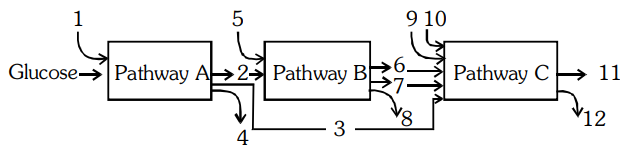
Arrows numbered 4, 8 and 12 can all be:Pathway A is glycolysis, B is the Krebs cycle and C is the electron transport system. ATP is produced in all three, so arrows 4, 8 and 12 can all be ATP.
Respiratory Balance Sheet
-
How many ATP molecules could maximally be generated from one molecule of glucose, if the complete oxidation of one mole of glucose to $CO_2$ and $H_2O$ yields 686 kcal and the useful chemical energy available in the high energy phosphate bond of one mole of ATP is 12 kcal ?Energy released by the complete oxidation of one mole of glucose = 686 kcal.
Energy stored in the high energy phosphate bond of one mole of ATP = 12 kcal.
If all the energy released could be trapped in ATP, the maximum number of ATP molecules formed per molecule of glucose would be:
$\dfrac{686}{12} = 57.1$
So a maximum of about 57 ATP molecules could be generated.
In actual aerobic respiration only 36 to 38 ATP molecules are formed per glucose molecule, because the rest of the energy is lost as heat; but the question asks for the theoretical maximum.
So the answer is fifty-seven.
That is every question in Respiration in Plants for this filter.
Want a score?
Answers here are not saved. Practise as a test to be marked and see your progress.
Practise as a test