Looking for classes? Ksquare Career Institute, Bengaluru →

Biology
Plant Kingdom
105 questions from 36 papers, each with its answer.
- 105 questions
- 36 papers
- 2.98% of Biology
Pteridophytes Life Cycle
-
Given below are the stages in the life cycle of pteridophytes. Arrange the following stages in the correct sequence.
A. Prothallus stage
B. Meiosis in spore mother cells
C. Fertilisation
D. Formation of archegonia and antheridia in gametophyte.
E. Transfer of antherozoids to the archegonia in presence of water.
Choose the correct answer from the options given below:Sequence: Meiosis in SMC (B) -> Prothallus (A) -> Sex organs form (D) -> Flagellated transfer (E) -> Fertilization (C).
In pteridophytes: Spore mother cells in sporangia undergo meiosis (B) to form haploid spores. Spores germinate into a prothallus gametophyte (A). The gametophyte develops antheridia and archegonia (D). Flagellated antherozoids swim through water to archegonia (E), leading to fertilization (C).
Bryophytes Life Cycle
-
The correct sequence of events in the life cycle of bryophytes is:
A. Fusion of antherozoid with egg.
B. Attachment of gametophyte to substratum.
C. Reduction division to produce haploid spores.
D. Formation of sporophyte.
E. Release of antherozoids into water.
Choose the correct answer from the option given below:Sequence is B -> E -> A -> D -> C.
In bryophytes, the gametophyte attaches to substratum via rhizoids (B); flagellated antherozoids are released into water (E); antherozoids fuse with egg in archegonium (A); zygote produces multicellular sporophyte (D); spore mother cells in sporophyte capsule undergo reduction division to produce spores (C).
Gymnosperms – Pollination and Fertilisation
-
In gymnosperms the pollen grains are released from the microsporangium and carried by air currents.Reason: Air currents carry the pollen grains to the mouth of the archegonia where the male gametes are discharged and pollen tube is not formed.
In gymnosperms a pollen tube does form and carries the male gametes towards the archegonia.
In gymnosperms, the pollen grain is released from the microsporangium. They are carried in air currents and come in contact with the opening of the ovules borne on megasporophylls. The pollen tube carrying the male gametes grows towards archegonia in the ovules and discharge their contents near the mouth of the archegonia.
Algae – Classification and Food Reserves
-
Which of the following is incorrectly matched?
Algae – Economic Importance
-
Which one of the following statements is wrong?
Plant Life Cycles and Alternation of Generations
-
Match the plant with the kind of life cycle it exhibits:
Pick the matching item from Column II for each row.
Column I
- A. Spirogyra
- B. Fern
- C. Funaria
- D. Cycas
Column II
- I. Dominant diploid sporophyte vascular plant, with highly reduced male or female gametophyte
- II. Dominant haploid free-living gametophyte
- III. Dominant diploid sporophyte alternating with reduced gametophyte called prothallus
- IV. Dominant haploid leafy gametophyte alternating with partially dependent multicellular sporophyte
Correct answer: A → II, B → III, C → IV, D → I
Algae – Food Reserves
-
Floridean starch has structure similar to:Floridean starch is the stored food of red algae (Rhodophyceae). Its structure is very similar to amylopectin and glycogen.
Pteridophytes
-
Which one of the following is a correct statement?In heterosporous pteridophytes such as Selaginella and Salvinia the female gametophyte is retained on the parent sporophyte for a variable period, and the zygote develops into a young embryo there.
This event is a precursor to the seed habit, so the origin of the seed habit can be traced in pteridophytes.
Protonema and leafy stages are found in mosses, the gymnosperm female gametophyte is not free-living, and antheridiophores and archegoniophores occur in liverworts such as Marchantia. -
$Selaginella$ and $Salvinia$ are considered to represent a significant step toward evolution of seed habit because$Selaginella$ and $Salvinia$ are heterosporous pteridophytes: they produce two kinds of spores, small microspores and large megaspores.
The megaspores germinate into female gametophytes, which are retained on the parent sporophyte for variable periods.
The development of the zygote into a young embryo takes place within this female gametophyte.
NCERT describes this event as a precursor to the seed habit and an important step in evolution.
There is no seed coat or endosperm in these plants, the female gametophyte is not shed free like a seed, and it does bear archegonia.
Hence the reason is that the embryo develops in the female gametophyte which is retained on the parent sporophyte. -
In the prothallus of a vascular cryptogam, the antherozoids and eggs mature at different times. As a resultVascular cryptogams are the pteridophytes. Their gametophyte is a small, free-living, mostly photosynthetic thallus called the prothallus.
In most ferns the prothallus is monoecious; it bears both antheridia (male sex organs) and archegonia (female sex organs).
When the antherozoids and the eggs of the same prothallus mature at different times (usually the antheridia mature first, a condition called protandry), the antherozoids cannot fertilise the eggs of the same prothallus.
The eggs are then fertilised by antherozoids coming from another prothallus.
So self-fertilisation is prevented and cross-fertilisation is promoted, which brings about genetic variation.
It does not cause sterility or apomixis, and it does change the pattern of fertilisation.
Hence the result is that self-fertilization is prevented.
Pteridophytes – Evolution of the Seed Habit
-
From evolutionary point of view, retention of the female gametophyte with developing young embryo on the parent sporophyte for some time, is first observed in:
Gymnosperms - naked ovules
-
Which of the following statements is correct?
Gymnosperm ovules are exposed, not enclosed in an ovary.
Gymnosperms have naked ovules. They are called phanerogams without womb/ovary, i.e. ovules are not enclosed by an ovary wall.
Gymnosperms - vascular tissue
-
Which one of the following is not found in Gymnosperms?Gymnosperms lack vessels in their xylem (xylem consists mainly of tracheids); their phloem lacks companion cells, having albuminous cells instead of them, along with sieve cells.
Classification of Pteridophytes
-
Identify the incorrect pair:Adiantum belongs to class Pteropsida, not Sphenopsida (whose example is Equisetum), so the pair Sphenopsida–Adiantum is incorrect.
Examples of plant groups
-
Which of the following is the correct match?Cedrus, Pinus and Sequoia are all gymnosperms, making option (a) the correct match. (Sequoia is a gymnosperm, not angiosperm; Polysiphonia is an alga, not a bryophyte; Ginkgo is a gymnosperm, not a pteridophyte.)
Characteristics of gymnosperms
-
Which of the following statements is incorrect about gymnosperms?In gymnosperms, the male and female gametophytes are not free-living; they are retained within (dependent on) the sporophyte — so the statement that they are free living is incorrect.
Examples of pteridophyte classes
-
Match List-I List-II.
Pick the matching item from Column II for each row.
Column I
- A. Pteropsida
- B. Lycopsida
- C. Psilopsida
- D. Sphenopsida
Column II
- I. Psilotum
- II. Equisetum
- III. Adiantum
- IV. Selaginella
Correct answer: A → III, B → IV, C → I, D → II
Pteropsida is exemplified by Adiantum (A-III); Lycopsida is exemplified by Selaginella (B-IV); Psilopsida is exemplified by Psilotum (C-I); Sphenopsida is exemplified by Equisetum (D-II).
Accessory pigments in algal classes
-
Which classes of algae possess pigment fucoxanthin and pigment phycoerythrin, respectively?Phaeophyceae (brown algae) possess the pigment fucoxanthin (giving their brown colour). Rhodophyceae (red algae) possess the pigment phycoerythrin (giving their red colour).
Life cycle patterns across plant groups
-
Which of the following statements is true?All pteridophytes exhibit a haplo-diplontic life cycle pattern, with both a dominant diploid sporophyte and a free-living haploid gametophyte generation.
Algae - Chlorophyceae (Chara)
-
Read the following statements and identify the characters related to the alga shown in the diagram
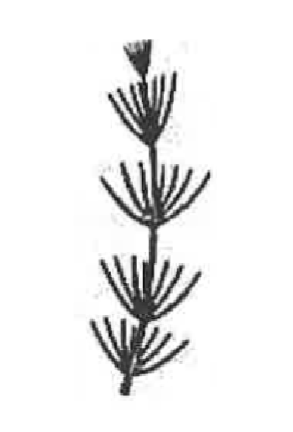
(a) It is a member of Chlorophyceae
(b) Food is stored in the form of starch
(c) It is a monoecious plant showing oogonium and antheridium
(d) Food is stored in the form of laminarin or mannitol
(e) It shows dominance of pigments Chlorophyll a, c and Fucoxanthin
Choose the correct answer from the options given below:The alga is Chara, a member of Chlorophyceae (green algae). Food is stored as starch in pyrenoids, and Chara is monoecious with male and female sex organs on the same plant. Laminarin/mannitol storage and chlorophyll a, c with fucoxanthin are characters of brown algae.
Gymnosperms
-
Gymnosperms are also called soft wood spermatophytes because they lackThe wood of gymnosperms is made mainly of tracheids; vessels and xylem fibres are absent.
Because it lacks xylem fibres it is called soft wood (non-porous wood).
Gymnosperms do have cambium and thick-walled tracheids. -
A prokaryotic autotrophic nitrogen fixing symbiont is found inA prokaryotic, autotrophic nitrogen fixer is a cyanobacterium (blue-green alga) such as $Anabaena$ or $Nostoc$, which is photosynthetic.
$Cycas$ has specialised coralloid roots that are associated with nitrogen-fixing cyanobacteria ($Anabaena\ cycadae$, $Nostoc$).
$Pisum$ (pea) and $Cicer$ (gram) are legumes whose root nodules contain $Rhizobium$, which is prokaryotic but heterotrophic.
$Alnus$ root nodules contain $Frankia$, an actinomycete, which is also heterotrophic.
Hence the prokaryotic autotrophic nitrogen-fixing symbiont is found in $Cycas$. -
Which one of the following is monoecious?A monoecious plant bears both male and female reproductive structures on the same individual; in a dioecious plant they are on different individuals.
In $Pinus$ the male cones (microsporangiate strobili) and female cones (macrosporangiate strobili) are borne on the same tree, so it is monoecious.
In $Cycas$ the male cones and megasporophylls are borne on different trees (dioecious).
$Marchantia$ has separate male and female thalli (dioecious), and the date palm has separate male and female trees (dioecious).
Hence $Pinus$ is monoecious. -
Which one of the following plants is monoecious?In a monoecious plant the male and female reproductive structures are borne on the same plant; in a dioecious plant they are on different plants.
In $Pinus$ the male cones and female cones are borne on the same tree, so it is monoecious.
Papaya has separate male and female plants (dioecious).
$Marchantia$ has separate male and female thalli (dioecious), and in $Cycas$ male cones and megasporophylls are borne on different trees (dioecious).
Hence the monoecious plant is $Pinus$. -
Select one of the following pairs of important features distinguishing Gnetum from Cycas and Pinus and showing affinities with angiosperms:Gnetum is the most advanced gymnosperm and shows several resemblances with angiosperms.
Its xylem contains true vessel elements, whereas the xylem of Cycas and Pinus has only tracheids and no vessels.
Archegonia are absent in the female gametophyte of Gnetum, whereas distinct archegonia are present in Cycas and Pinus.
The presence of vessels and the absence of archegonia are both characteristic features of angiosperms.
Gnetum also has broad leaves with reticulate venation like dicots, but the other pairs given do not correctly combine two such distinguishing features.
So the pair of features is the presence of vessel elements and the absence of archegonia. -
In which one of the following, male and female gametophytes do not have free-living independent existence?Cedrus (deodar) is a gymnosperm.
In gymnosperms the male and female gametophytes do not have an independent free-living existence.
They remain within the sporangia, which are retained on the sporophyte: the male gametophyte is the highly reduced pollen grain, and the female gametophyte develops inside the megasporangium (ovule).
Polytrichum and Funaria are mosses (bryophytes), in which the gametophyte is the dominant, green, free-living plant body.
Pteris is a fern (pteridophyte), in which the gametophyte is a small but independent, free-living, photosynthetic prothallus.
So the male and female gametophytes are not free-living in Cedrus. -
In gymnosperms, the pollen chamber representsIn gymnosperms the ovules are naked, and the pollen grains are carried by wind directly to the micropyle of the ovule.
At the micropylar end, some cells of the nucellus break down to form a small cavity called the pollen chamber.
The pollen grains are drawn into the ovule with the pollination drop and come to rest in this pollen chamber, where they are stored after pollination.
They stay there for some time and then germinate, forming pollen tubes that grow through the nucellus towards the archegonia.
So the pollen chamber is a part of the ovule (megasporangium), not of the microsporangium; the microsporangium is the pollen sac in which the pollen grains develop.
It is also not an opening in the female gametophyte, and not a cell of the pollen grain.
So the pollen chamber represents a cavity in the ovule in which pollen grains are stored after pollination. -
Plant group with largest ovule, largest tree and largest gametes :Gymnosperms hold several records in the plant kingdom:
Largest ovules: Cycas has the largest ovules (up to about 6 cm).
Largest (tallest) trees: Sequoia (redwood), over 100 m tall.
Largest male gametes (sperms): Cycas has large, multiciliate sperms visible to the naked eye, and large egg cells.
So the plant group with the largest ovule, largest tree and largest gametes is the gymnosperms.
Algae and bryophytes – reproductive features
-
Which one is wrongly matched?
Red algae have no flagellated stages.
$Polysiphonia$ is a genus of red algae, where asexual spores and gametes are non-motile (non-flagellated). The other three pairs are correctly matched.
Gymnosperms and pteridophytes – sexuality and spores
-
Select the mismatch:
$Pinus$ is monoecious; $Cycas$ is dioecious.
$Pinus$ is a monoecious plant having both male and female cones on the same plant.
Life cycle patterns in algae
-
Life cycle of $Ectocarpus$ and $Fucus$ respectively are
$Ectocarpus$ is haplodiplontic; $Fucus$ is diplontic.
$Ectocarpus$ has a haplodiplontic life cycle and $Fucus$ has a diplontic life cycle.
Life cycle patterns – haplontic
-
Zygotic meiosis is characteristic of
Haplontic organisms undergo zygotic meiosis.
$Chlamydomonas$ has a haplontic life cycle, hence it shows zygotic (initial) meiosis.
Bryophytes, pteridophytes and gymnosperms
-
Read the following five statements (A to E) and select the option with all correct statements:
(A) Mosses and Lichens are the first organisms to colonise a bare rock
(B) Selaginella is a homosporous pteridophyte
(C) Coralloid roots in Cycas have VAM
(D) Main plant body in bryophytes is gametophytic, whereas in pteridophytes it is sporophytic
(E) In gymnosperms, male and female gametophytes are present within sporangia located on sporophyte(B) is incorrect: Selaginella is a heterosporous pteridophyte, producing microspores and megaspores.
(C) is incorrect: coralloid roots of Cycas have cyanobacteria (Nostoc and Anabaena in the cortical region), not VAM.
(A), (D) and (E) are correct.
Algae
-
Which one of the following is wrong about Chara?In Chara the female organ (oogonium or nucule) lies above and the male organ (antheridium or globule) lies below it, both on the same plant.
So 'upper antheridium and lower oogonium' is wrong. -
Monoecious plant of Chara shows occurrence of:In monoecious Chara the oogonium (nucule) lies above the antheridium (globule) on the same plant.
Features of plant groups
-
Which one is a wrong statement?
Bryophytes
-
Examine the figure given below and select the right option giving all the four parts (A, B, C, D) correctly identified.
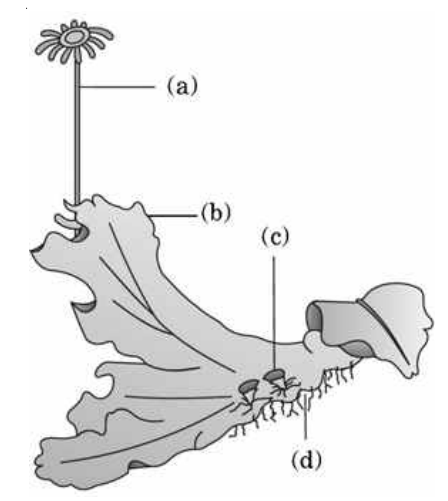 The figure shows the female plant of the liverwort $Marchantia$.
A is the stalked, umbrella-like structure with rays that bears the archegonia: the archegoniophore.
B is the flat, dorsiventral, dichotomously branched plant body bearing it: the female thallus.
C is the small cup-shaped structure on the upper surface of the thallus containing gemmae (green, multicellular asexual buds): the gemma cup.
D is the unicellular hair-like structures on the lower surface that fix the thallus to the substratum: the rhizoids. Bryophytes have no true roots.
Hence A is archegoniophore, B is female thallus, C is gemma cup and D is rhizoids.
Gametophytes
-
Male gametophyte with least number of cells is present in:In angiosperms such as Lilium the male gametophyte (pollen grain) is reduced to just 2–3 cells, the least in the plant kingdom.
Pteris and Funaria have multicellular free-living gametophytes, and the Pinus male gametophyte has more cells than that of an angiosperm.
Plant kingdom statements
-
Read the following statements (a–e) and answer the question which follows them.
(a) In liverworts, mosses and ferns gametophytes are free living
(b) Gymnosperms and some ferns are heterosporous
(c) Sexual reproduction in Fucus, Volvox and Albugo is oogamous
(d) The sporophyte in liverworts is more elaborate than that in mosses
(e) Both, Pinus and Marchantia are dioecious
How many of the above statements are correct?(a), (b) and (c) are correct.
(d) is wrong: the sporophyte of mosses is more elaborate than that of liverworts.
(e) is wrong: Pinus is monoecious.
So three statements are correct.
Gymnosperms and pteridophytes
-
Cycas and Adiantum resemble each other in havingAdiantum is a fern (pteridophyte) with flagellated, motile sperms that need water to reach the egg.
Cycas, although a gymnosperm, also has large multiciliate motile sperms.
Adiantum has no seeds or cambium, and neither has vessels.
Pteridophytes and gymnosperms
-
Examine the figures A, B, C and D. In which one of the four options are all the items A, B, C and D correct?
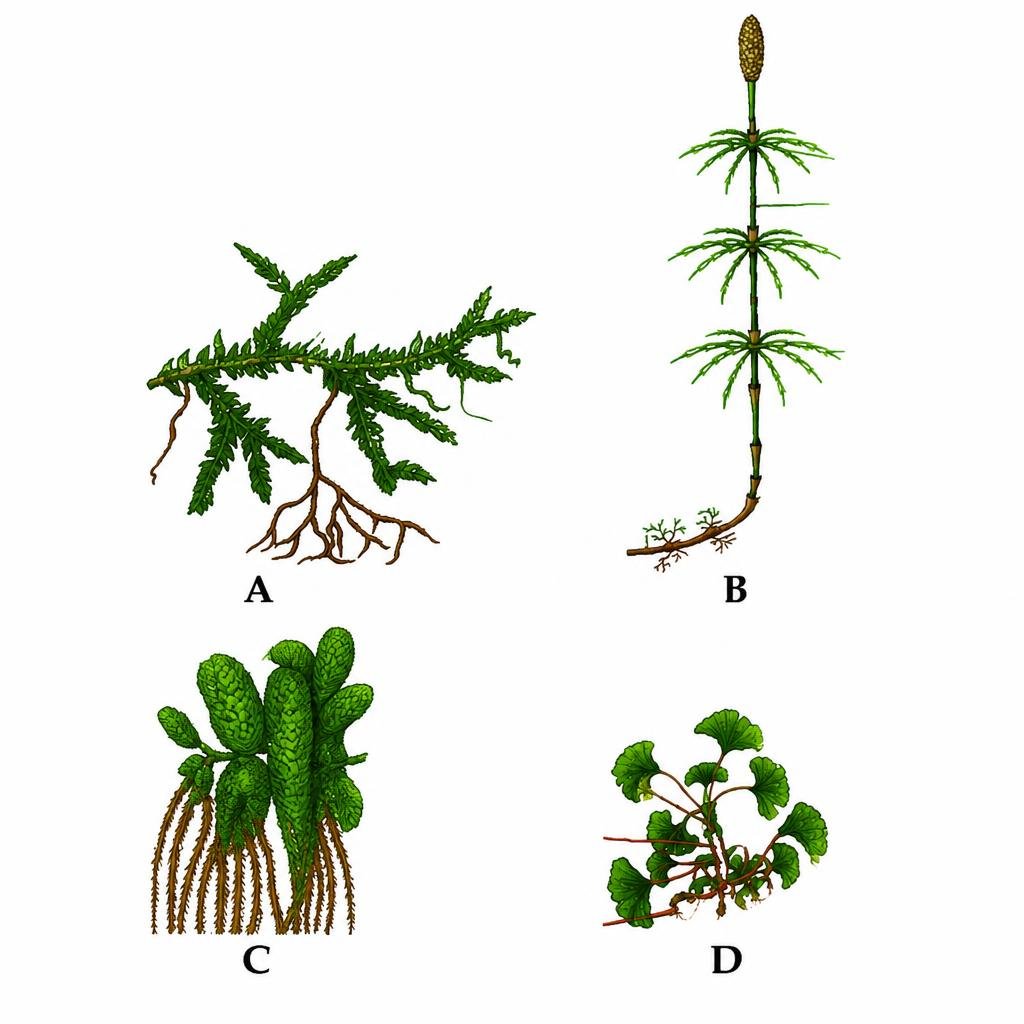 Figure A shows a creeping, branched plant with small scale-like leaves and roots arising from the stem: $Selaginella$ (a pteridophyte, the 'spike moss').
Figure B shows an erect, jointed stem with whorls of slender branches at the nodes and a terminal cone (strobilus): $Equisetum$ (horsetail).
Figure C shows a floating aquatic fern with rounded leaves above and root-like submerged leaves below: $Salvinia$.
Figure D shows a shoot with fan-shaped leaves: $Ginkgo$, a gymnosperm.
Hence A – $Selaginella$, B – $Equisetum$, C – $Salvinia$, D – $Ginkgo$.
Plant life cycles
-
Consider the following four statements whether they are correct or wrong.
(A) The sporophyte in liverworts is more elaborate than that in mosses
(B) $Salvinia$ is heterosporous
(C) The life-cycle in all seed bearing plants is diplontic
(D) In $Pinus$ male and female cones are borne on different trees
The two wrong statements together are(A) is wrong: the sporophyte in mosses is more elaborate than that in liverworts; it has a foot, seta and a capsule with an elaborate mechanism of spore dispersal.
(B) is correct: $Salvinia$ (like $Selaginella$) produces two kinds of spores, microspores and megaspores, so it is heterosporous.
(C) is correct: in all seed-bearing plants (gymnosperms and angiosperms) the dominant phase is the diploid sporophyte and the gametophyte is highly reduced, so the life cycle is diplontic.
(D) is wrong: $Pinus$ is monoecious; the male and female cones are borne on the same tree (in $Cycas$ they are on different trees).
Hence the two wrong statements are (A) and (D). -
Which one of the following has haplontic life cycle?In a haplontic life cycle the dominant, free-living phase is haploid; the zygote is the only diploid cell and it undergoes meiosis directly (zygotic meiosis).
Wheat is an angiosperm: the dominant phase is the diploid sporophyte, so its life cycle is diplontic.
$Funaria$ and $Polytrichum$ are mosses (bryophytes): they have a dominant haploid gametophyte alternating with a multicellular diploid sporophyte, i.e., a haplo-diplontic life cycle.
$Ustilago$ (smut fungus) is a fungus; its vegetative phase is not diploid, and the diploid stage is restricted to the fusion nucleus, which undergoes meiosis. Its life cycle is therefore taken as haplontic.
Hence the organism with a haplontic life cycle is $Ustilago$.
Alternation of generations
-
Compared with the gametophytes of the bryophytes, the gametophytes of vascular plants tend to beIn bryophytes the gametophyte is the dominant, long-lived, green and independent phase of the life cycle, and it bears conspicuous multicellular antheridia and archegonia.
In vascular plants the sporophyte is the dominant phase and the gametophyte is progressively reduced.
In pteridophytes it is a small, short-lived prothallus; in gymnosperms and angiosperms it is reduced to a few cells (pollen grain and embryo sac) dependent on the sporophyte.
The sex organs are also reduced: archegonia are small in pteridophytes and gymnosperms and are absent in angiosperms, and antheridia are absent in seed plants.
Hence the gametophytes of vascular plants are smaller and have smaller sex organs.
Gametes in Different Plant Groups
-
Flagellated male gametes are present in all the three of which one of the following sets?The male gametes of bryophytes are biflagellate antherozoids; Riccia is a liverwort.
The male gametes of pteridophytes are multiflagellate (except Selaginella, which has biflagellate gametes); Dryopteris is a fern.
The male gametes of gymnosperms are generally non-motile, except those of Cycas (and Ginkgo), which are large and multiciliate.
So Riccia, Dryopteris and Cycas all have flagellated male gametes.
Zygnema and Spirogyra reproduce by conjugation and have non-flagellated gametes.
Hydrilla and Calotropis are angiosperms, whose male gametes are non-motile and are carried by the pollen tube.
So every other set contains at least one member without flagellated male gametes, and the correct set is Riccia, Dryopteris and Cycas.
Gymnosperms and Angiosperms
-
Conifers differ from grasses in the -Conifers are gymnosperms and grasses are angiosperms (monocots).
In gymnosperms the endosperm is the female gametophyte itself; it is haploid (n) and is formed before fertilisation.
In angiosperms the endosperm is formed after fertilisation, as a result of triple fusion, and it is triploid (3n).
So conifers differ from grasses in the formation of endosperm before fertilisation.
Both groups produce seeds from ovules.
Both have xylem tracheids (conifers have only tracheids; grasses have vessels as well).
Both form pollen tubes to carry the male gametes (siphonogamy).
So the difference lies in the formation of endosperm before fertilization.
Gymnosperms: Cycas
-
Top-shaped multiciliate male gametes, and the mature seed which bears only one embryo with two cotyledons, are characteristic features of -In most seed plants the male gametes are non-motile and are carried to the egg by the pollen tube.
Cycads (for example Cycas) are exceptional: their male gametes are very large, top-shaped and bear a spiral band of numerous cilia (multiciliate), so they are motile.
Although the ovule may contain more than one archegonium, the mature seed of Cycas usually bears only one embryo, with two cotyledons.
Conifers (such as Pinus) have non-motile male gametes and their embryos usually have several cotyledons.
Angiosperms have non-motile male gametes.
So these are the characteristic features of cycads.
Classification of Plants: Spermatophyta
-
Which one pair of examples will correctly represent the grouping Spermatophyta according to one of the schemes of classifying plants : -Spermatophyta (seed plants) includes two groups: gymnosperms (naked seeds) and angiosperms (seeds enclosed in fruits).
A pair that correctly represents the whole grouping should include one member of each group.
Ginkgo is a gymnosperm and Pisum (pea) is an angiosperm, so this pair represents both subdivisions of Spermatophyta.
Acacia and sugarcane are both angiosperms; Pinus and Cycas are both gymnosperms; Rhizopus is a fungus and does not produce seeds.
So the pair that correctly represents Spermatophyta is Ginkgo and Pisum.
Bryophytes: Moss Sporophyte
-
Chlorenchyma is found in : -Chlorenchyma is a tissue: parenchyma cells containing chloroplasts, which carry out photosynthesis.
Chlorella is a unicellular alga, so it cannot have a tissue; its cytoplasm just contains a chloroplast.
Aspergillus is a fungus; its mycelium has no chloroplasts (the green colour is due to spores). The pollen tube of Pinus also lacks chloroplasts.
The capsule of the moss sporophyte has photosynthetic tissue (chlorenchyma) in its wall, below the epidermis, around the air spaces. This allows the sporophyte to make part of its own food.
So chlorenchyma is found in the spore capsule of a moss.
Gymnosperms: Living Fossils
-
Which one of the following is categorised under living fossils : -
More than one option is correct.
A living fossil is a living species that closely resembles ancient species known from fossils and has remained nearly unchanged for millions of years, usually with few surviving relatives.
Cycas is a primitive gymnosperm whose group (cycads) flourished in the Mesozoic era; it is called a living fossil.
Metasequoia (dawn redwood) was known only from fossils until living trees were discovered in China in the 1940s; it is also a living fossil.
Pinus is a common, widespread modern conifer, and Selaginella, though an old group, is not usually called a living fossil.
Note: the answer key of the source accepts both Cycas and Metasequoia, so both are marked correct here.
That is every question in Plant Kingdom for this filter.
Want a score?
Answers here are not saved. Practise as a test to be marked and see your progress.
Practise as a test