Looking for classes? Ksquare Career Institute, Bengaluru →

Biology
Excretory Products and their Elimination
60 questions from 34 papers, each with its answer.
- 60 questions
- 34 papers
- 1.7% of Biology
Function of the Tubules
-
Which of the following diagrams is correct with regard to the proximal (P) and distal (D) tubule of the Nephron.
PCT reabsorbs electrolytes, water, and $HCO_3^-$ while secreting $H^+$ and $NH_3$; DCT facultatively reabsorbs $NaCl$, water, and $HCO_3^-$ while secreting $K^+$ and $H^+$.
According to the NCERT nephron transport diagram: Proximal Convoluted Tubule (PCT) reabsorbs $HCO_3^-$, $NaCl$, and $H_2O$ and selectively secretes $H^+$ and $NH_3$. Distal Convoluted Tubule (DCT) reabsorbs $NaCl$, $H_2O$, and $HCO_3^-$ and selectively secretes $K^+$ and $H^+$ into the lumen to maintain ionic and acid-base balance.
Permeability of Loop of Henle and PCT Histology
-
Given below are two statements: Statements I: In the nephron the descending limb of loop of Henle is impermeable to water and permeable to electrolytes. Statement II: The proximal convoluted tubule is lined by simple columnar brush border epithelium and increases the surface area for reabsorption. In the light of the above statements, choose the correct answer from the options given below:Statement I is false: the descending limb of the loop of Henle is permeable to water but almost impermeable to electrolytes. Statement II is false: the PCT is lined by simple cuboidal brush border epithelium (not columnar), which increases the surface area for reabsorption. So both statements are false.
Juxtamedullary Nephrons
-
Choose the correct statement given below regarding juxta medullary nephron.In juxtamedullary nephrons, the loop of Henle is very long and runs deep into the medulla – correct. Juxtamedullary nephrons are fewer in number than cortical nephrons, they are not located in the columns of Bertini, and their renal corpuscles lie in the inner cortical region (not in the medulla).
Human Excretory System – Structure of Nephron
-
Nephrons are of two types: Cortical & Juxta medullary, based on their relative position in cortex and medulla.Reason: Juxta medullary nephrons have short loop of Henle whereas, cortical nephrons have longer loop of Henle.
Cortical nephrons have a short loop of Henle; juxtamedullary nephrons have a long one.
In majority of nephrons, the loop of Henle is too short and extends only very little into the medulla. Such nephrons are called cortical nephrons. In some of the nephrons, the loop of Henle is very long and runs deep into the medulla. These nephrons are called juxta medullary nephrons.
Regulation of Kidney Function
-
Select the correct statements. (a) Angiotensin II activates the cortex of adrenal gland to release aldosterone. (b) Aldosterone leads to increase in blood pressure. (c) ANF acts as a check on renin-angiotensin mechanism. (d) ADH causes vasodilation. (e) Vasopressin is released from adenohypophysis. Choose the most appropriate answer from the options given below:(a), (b) and (c) are correct. ADH (vasopressin) is released by the hypothalamus through the neurohypophysis, not the adenohypophysis, and it causes vasoconstriction, not vasodilation.
-
Which of the following would help in prevention of diuresis?The adrenal cortex secretes mineralocorticoids like aldosterone, which increase the reabsorption of $Na^+$ and water from the renal tubules. This prevents diuresis. (ANF causes vasodilation, decreased renin reduces reabsorption, and undersecretion of ADH causes more water loss.)
-
Which of the following does not favour the formation of large quantities of dilute urine?Renin from the juxtaglomerular apparatus converts angiotensinogen to angiotensin I, which is converted to angiotensin II.
This increases reabsorption of $Na^+$ and water, raising blood pressure and producing concentrated urine — not dilute urine. -
A fall in glomerular filtration rate (GFR) activatesThe kidney regulates its own filtration rate through the juxtaglomerular apparatus (JGA).
A fall in GFR (or in glomerular blood flow or pressure) directly activates the juxtaglomerular (JG) cells to release renin.
Renin converts angiotensinogen in the blood into angiotensin I, which is further converted into angiotensin II.
Angiotensin II is a powerful vasoconstrictor that raises glomerular blood pressure and thereby GFR; it also stimulates the adrenal cortex to release aldosterone.
So aldosterone release is a later, indirect step, and vasopressin release is triggered by osmoreceptors responding to changes in body fluid volume and concentration.
Hence a fall in GFR activates the juxtaglomerular cells to release renin. -
Which one of the following statements is correct with respect to kidney function regulation?Osmoreceptors in the body respond to changes in blood volume, body fluid volume and ionic concentration.
When a person drinks a lot of water, the body fluid volume increases and its osmolarity falls; this switches off the osmoreceptors and suppresses ADH release. Less water is reabsorbed and dilute urine is passed. This statement is correct.
In summer, heavy loss of water by evaporation activates the osmoreceptors and stimulates (not suppresses) ADH release, so that water is conserved.
Exposure to cold reduces sweating and decreases ADH release, which is why more urine is passed in cold weather.
Angiotensin II is formed when the JG cells release renin in response to a fall (not an increase) in glomerular blood flow or pressure.
Hence the correct statement is that ADH release is suppressed when someone drinks a lot of water. -
Angiotensinogen is a protein produced and secreted by -Angiotensinogen is a plasma protein produced and secreted into the blood by the liver cells.
When the glomerular blood flow or blood pressure falls, the juxtaglomerular (JG) cells of the kidney release the enzyme renin.
Renin converts angiotensinogen in the blood into angiotensin I.
Angiotensin I is converted into angiotensin II by the angiotensin converting enzyme, mainly in the lungs.
Angiotensin II is a powerful vasoconstrictor; it raises the glomerular blood pressure and stimulates the adrenal cortex to release aldosterone.
So the JG cells secrete renin, not angiotensinogen, and the macula densa cells only sense the composition of the filtrate.
Angiotensinogen is produced and secreted by the liver cells.
Mechanism of Concentration of the Filtrate
-
Which of the following factors is responsible for the formation of concentrated urine?
Renin-angiotensin mechanism
-
Arrange the following events occurring in Renin-Angiotensin mechanism in the correct order: I. Increase in blood pressure and Glomerular filtration rate. II. Reabsorption of $Na^+$ and water from distal parts of tubule due to Aldosterone. III. Fall in Glomerular filtration rate. IV. Vasoconstriction by Angiotensin II and release of Aldosterone. V. Renin converts Angiotensinogen into Angiotensin I, followed by Angiotensin II. Choose the correct answer from the options given below:
Juxtaglomerular apparatus
-
The JGA (Juxta Glomerular Apparatus) is a special sensitive region formed by cellular modifications in _______ related to the same nephron.
Hormonal regulation of urine formation
-
Diuresis is prevented by:Vasopressin (ADH), released from the neurohypophysis (posterior pituitary), increases water reabsorption from the later parts of the renal tubules, thereby concentrating urine and preventing excessive loss of water (diuresis).
Counter current mechanism and urine concentration
-
Given below are two statements: Statement I: Concentrated urine is formed due to counter current mechanism in nephron. Statement II: Counter current mechanism helps to maintain osmotic gradient in the medullary interstitium. In the light of the above statements, choose the most appropriate answer from the options given below.The counter current flow of filtrate through the loop of Henle and blood through the vasa recta helps maintain an increasing osmolarity towards the inner medullary interstitium, and this counter current mechanism is what enables the formation of concentrated urine. Both statements are correct.
Counter current mechanism in the nephron
-
The increase in osmolarity from outer to inner medullary interstitium is maintained due to: (i) Close proximity between Henle's loop and vasa recta (ii) Counter current mechanism (iii) Selective secretion of $HCO_3^-$ and hydrogen ions in PCT (iv) Higher blood pressure in glomerular capillariesThe increasing osmolarity of the medullary interstitium (from outer to inner medulla) is maintained by the close anatomical proximity between the loop of Henle and the vasa recta (i), operating together via the counter current mechanism (ii). Statements (iii) and (iv) are unrelated to this specific mechanism.
Renin-angiotensin system and blood pressure regulation
-
Select the correct statement:A fall in glomerular filtration rate (GFR) activates the juxtaglomerular (JG) cells to release renin, which triggers the renin-angiotensin-aldosterone pathway to restore GFR and blood pressure.
Loop of Henle - counter current mechanism
-
Ascending limb of loop of Henle is impermeable to water and allows transport of electrolytes actively or passively.Reason: Dilution of filtrate takes place due to efflux of electrolytes in the medullary fluid.The ascending limb of the loop of Henle is indeed impermeable to water and actively/passively transports electrolytes out into the medullary interstitium. This efflux of electrolytes from the ascending limb (without accompanying water) causes dilution of the filtrate as it moves up — the Reason correctly explains why dilution of the filtrate occurs.
Nitrogenous waste excretion in cockroach
-
The Cockroach is:Cockroaches (like most terrestrial insects) are uricotelic, excreting nitrogenous waste primarily in the form of uric acid, which helps conserve water.
Renin-Angiotensin-Aldosterone mechanism
-
Arrange the events of Renin - Angiotensin mechanism in correct sequence. (A) Activation of JG cells and release of renin. (B) Angiotensin II activates release of aldosterone. (C) Fall in glomerular blood pressure. (D) Reabsorption of $Na^+$ and water from distal convoluted tubule. (E) Angiotensinogen is converted to Angiotensin I and then to Angiotensin II.Correct sequence: Fall in glomerular blood pressure (C) → Activation of JG cells and release of renin (A) → Angiotensinogen is converted to Angiotensin I and then to Angiotensin II (E) → Angiotensin II activates release of aldosterone (B) → Reabsorption of $Na^+$ and water from the distal convoluted tubule (D). Order: C, A, E, B, D.
Functions of the tubules
-
Match the following parts of a nephron with their function. Select the correct option.
Pick the matching item from Column II for each row.
Column I
- A. Descending limb of Henle's loop
- B. Proximal convoluted tubule
- C. Ascending limb of Henle's loop
- D. Distal convoluted tubule
Column II
- I. Reabsorption of salts only
- II. Reabsorption of water only
- III. Conditional reabsorption of sodium ion and water
- IV. Reabsorption of ions, water and organic nutrients
Correct answer: A → II, B → IV, C → I, D → III
Function of the tubules - Henle's loop
-
Which of the following statements about the reabsorption process in Henle's loop are correct? (a) The descending limb of Henle's loop is permeable to water but almost impermeable to electrolytes. (b) Urine gets concentrated in Henle's loop. (c) Reabsorption of $Na^+$ and water takes place in Henle's loop. (d) Active or passive transport of electrolytes occurs in the ascending limb of Henle's loop. Choose the correct answer from the options given below:Reference: NCERT Class XI, page 209.
Disorders of the excretory system
-
A person is undergoing prolonged fasting. His urine will be found to contain abnormal quantities of -During prolonged fasting the carbohydrate stores (glycogen) of the body are soon used up.
The body then breaks down large amounts of stored fat for energy.
The oxidation of fatty acids produces a large amount of acetyl CoA, which cannot all be oxidised in the Krebs cycle because oxaloacetate is in short supply.
The excess acetyl CoA is converted in the liver into ketone bodies (acetoacetic acid, $\beta$-hydroxybutyric acid and acetone).
Their level in the blood rises (ketosis), and they are excreted in the urine (ketonuria).
Glucose does not appear in the urine, because the blood glucose is low.
So the urine will contain abnormal quantities of ketones.
Human excretory system – functions of parts
-
Match the items given in Column I (Function) with those in Column II (Part of Excretory system) and select the correct option given below:
Pick the matching item from Column II for each row.
Column I
- a. Ultrafiltration
- b. Concentration of urine
- c. Transport of urine
- d. Storage of urine
Column II
- i. Henle's loop
- ii. Ureter
- iii. Urinary bladder
- iv. Malpighian corpuscle
- v. Proximal convoluted tubule
Correct answer: a → iv, b → i, c → ii, d → iii
Filtration in Malpighian corpuscle, concentration in Henle's loop, transport by ureter, storage in bladder.
Ultrafiltration refers to filtration of very fine particles having molecular weight less than 68,000 daltons through the Malpighian corpuscle. Concentration of urine refers to water absorption from glomerular filtrate as a result of hyperosmolarity in the medulla created by the counter-current mechanism in Henle's loop. Urine is carried from the kidney to the bladder through the ureter. The urinary bladder is concerned with storage of urine. Correct match: a-iv, b-i, c-ii, d-iii.
Regulation of kidney function – ANF and RAAS
-
A decrease in blood pressure/volume will not cause the release of
ANF is released when blood pressure rises.
A decrease in blood pressure/volume stimulates the release of renin, aldosterone and ADH, while an increase in blood pressure/volume stimulates the release of atrial natriuretic factor (ANF). ANF causes vasodilation and inhibits the RAAS (renin–angiotensin–aldosterone system), decreasing blood volume/pressure.
Urea formation in the liver
-
In the mammals, which blood vessel would normally carry largest amount of urea?
Urea made in the liver leaves through the hepatic vein.
Proteins and amino acids are metabolised in the liver; the $-NH_2$ of amino acids is converted into urea, which is collected into the hepatic vein and later filtered in the kidney.
Tubular reabsorption
-
The part of nephron involved in active reabsorption of sodium is:
Functions of tubules
-
Removal of proximal convoluted tubule from the nephron will result inThe proximal convoluted tubule carries out obligatory reabsorption of most of the water in the filtrate.
Without it, much more water would be excreted, giving more dilute urine.
Excretion in insects
-
The body cells in cockroach discharge their nitrogenous waste in the haemolymph mainly in the form of:
Tubular secretion
-
Human urine is usually acidic because:
Human excretory system
-
Figure shows human urinary system with structures labelled A to D. Select option which correctly identifies them and gives their characteristics and/or functions.
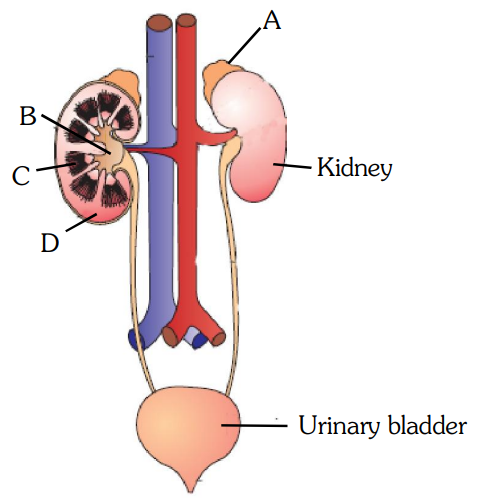 A is the adrenal gland, located at the anterior part of the kidney. It secretes catecholamines, which stimulate the breakdown of glycogen.
The cortex contains parts of nephrons, the pelvis connects to collecting ducts, and the medulla holds only the loops of Henle and collecting ducts. -
Which one of the following is not a part of a renal pyramid?The kidney has an outer cortex and an inner medulla; the medulla is divided into conical masses called renal (medullary) pyramids.
The Malpighian corpuscle, the proximal convoluted tubule and the distal convoluted tubule of each nephron lie in the cortex.
The loops of Henle dip into the medulla, and the collecting ducts run through the medullary pyramids to open at the papillae.
The capillaries running along the loops (peritubular capillaries and vasa recta) also extend into the medulla.
Hence the convoluted tubules are not a part of a renal pyramid.
Nitrogenous wastes
-
Which one of the following options gives the correct categorisation of six animals according to the type of nitrogenous wastes (A – Ammonotelic, B – Ureotelic, C – Uricotelic) they give out?Ammonotelic animals excrete ammonia, which is highly toxic and needs a large amount of water for its removal: many bony fishes, aquatic amphibians and aquatic insects.
Ureotelic animals excrete urea: mammals (humans), many terrestrial amphibians (adult frog) and marine fishes.
Uricotelic animals excrete uric acid as a pellet or paste with minimum loss of water: reptiles (lizards), birds (pigeon), land snails and insects (cockroach).
Checking the six animals: aquatic amphibia are ammonotelic; frog and humans are ureotelic; pigeon, lizards and cockroach are uricotelic.
Hence the correct categorisation is Ammonotelic – aquatic amphibia; Ureotelic – frog, humans; Uricotelic – pigeon, lizards, cockroach.
Urine formation
-
Which one of the following correctly explains the function of a specific part of a human nephron?Podocytes are the epithelial cells of the inner wall of Bowman's capsule; they are arranged in an intricate manner so as to leave minute spaces called filtration slits or slit pores, through which the blood is filtered. This statement is correct.
The afferent arteriole carries blood into the glomerulus; blood leaves the glomerulus through the efferent arteriole.
Most of the reabsorption (nearly all essential nutrients and 70–80% of electrolytes and water) takes place in the proximal convoluted tubule; reabsorption in Henle's loop is minimum.
The distal convoluted tubule reabsorbs $Na^+$ and water and secretes $K^+$, $H^+$ and $NH_3$; it does not reabsorb $K^+$.
Hence the correct explanation is that of the podocytes. -
Which one of the following statements in regard to the excretion by the human kidneys is correct?The kidneys form about 180 litres of glomerular filtrate per day, but only about 1.5 litres of urine is released.
This shows that nearly 99 per cent of the filtrate is reabsorbed by the renal tubules. This statement is correct.
The ascending limb of Henle's loop is impermeable to water but allows the transport of electrolytes (actively or passively).
The descending limb is permeable to water but almost impermeable to electrolytes.
The distal convoluted tubule is capable of reabsorbing $HCO_3^-$ and of selectively secreting $H^+$, $K^+$ and $NH_3$ to maintain the pH and sodium–potassium balance of blood.
Hence the correct statement is that nearly 99 percent of the glomerular filtrate is reabsorbed.
Excretory organs of animals
-
In which one of the following organisms are its excretory organs correctly stated?The excretory organs of the earthworm are segmentally arranged coiled tubules called nephridia, of three types: septal nephridia (on both sides of the intersegmental septa from segment 15 to the last), integumentary nephridia (attached to the lining of the body wall from segment 3 to the last) and pharyngeal nephridia (three paired tufts in segments 4, 5 and 6). This statement is correct.
In humans the kidneys are the main excretory organs; sweat glands, lungs and liver also help, and sebaceous glands eliminate some waxes and sterols, but tear glands are not excretory.
In the cockroach excretion is by Malpighian tubules (with fat body, nephrocytes and urecose glands); the enteric (hepatic) caeca secrete digestive juice.
In the frog the kidneys are excretory; the skin and buccal epithelium are respiratory surfaces.
Hence the excretory organs are correctly stated for the earthworm.
Formation of Urea
-
A person who is on a long hunger strike and is surviving only on water, will haveUrea is the main nitrogenous waste of humans. It is formed in the liver by the ornithine cycle from the ammonia produced by the deamination of amino acids.
The main source of these amino acids is the protein taken in the diet; excess amino acids cannot be stored and are broken down.
A person on a long hunger strike takes no protein at all, so very few amino acids are available for deamination.
The body first uses its stored glycogen and fat for energy, and tissue proteins are spared as far as possible.
As a result much less urea is formed in the liver and less urea is excreted in the urine.
Blood glucose does not rise during starvation; it tends to fall. Amino acids are normally absent from urine, and sodium excretion decreases because there is no intake of salt.
So the person will have less urea in his urine.
Modes of Excretion
-
Earthworms are -The nature of the nitrogenous waste excreted by an animal depends on the availability of water.
Ammonia is highly toxic and needs a large amount of water for its removal, so it is excreted when water is plentiful.
Earthworms live in moist soil. When plenty of water is available, they excrete mainly ammonia, i.e. they are ammonotelic.
When water is scarce, in drier conditions, they change over to excreting mainly urea, i.e. they become ureotelic, since urea is less toxic and needs less water.
They are not uricotelic under either condition.
So earthworms are ammonotelic when plenty of water is available.
Glomerular Filtration
-
The net pressure gradient that causes the fluid to filter out of the glomeruli into the capsule is -Filtration in the glomerulus depends on the balance of three pressures.
Glomerular hydrostatic (blood) pressure, which pushes fluid out of the capillaries into the Bowman's capsule: about 75 mm Hg.
Colloidal osmotic pressure of the plasma proteins, which opposes filtration: about 30 mm Hg.
Hydrostatic pressure of the filtrate in the Bowman's capsule (capsular pressure), which also opposes filtration: about 25 mm Hg.
Net filtration pressure $= 75 - (30 + 25)$
$= 20$ mm Hg
So the net pressure gradient that causes filtration is 20 mm Hg.
Osmoregulation in Protozoans
-
When a fresh water protozoan possessing a contractile vacuole, is placed in a glass containing marine water, the vacuole will-A freshwater protozoan such as Amoeba or Paramecium lives in a hypotonic medium. Water continuously enters its body by osmosis.
The contractile vacuole collects this excess water and pumps it out at intervals (osmoregulation).
Marine water is hypertonic (or nearly isotonic) to the protoplasm. In it, water no longer enters the cell; instead the cell tends to lose water.
With no excess water to remove, the contractile vacuole is no longer needed. It stops functioning and disappears (marine protozoans generally lack contractile vacuoles).
So the vacuole will disappear.
Mechanism of Concentration of Filtrate
-
If Henle's loop were absent from mammalian nephron, which of the following is to be expected : -The loop of Henle, together with the vasa recta, sets up the counter-current mechanism that builds an increasing osmotic gradient in the medullary interstitium (from about 300 mOsm/L in the cortex to about 1200 mOsm/L in the inner medulla).
This gradient allows water to be reabsorbed from the collecting duct, which produces a concentrated (hypertonic) urine. Mammals can thus conserve water.
Without the loop of Henle, no medullary gradient would form. Water could not be withdrawn from the collecting duct, so a large volume of dilute urine would be formed. Filtration would still occur, so urine would still be produced.
So if Henle's loop were absent, the urine would be more dilute.
That is every question in Excretory Products and their Elimination for this filter.
Want a score?
Answers here are not saved. Practise as a test to be marked and see your progress.
Practise as a test