Looking for classes? Ksquare Career Institute, Bengaluru →

Biology
Evolution
143 questions from 37 papers, each with its answer.
- 143 questions
- 37 papers
- 4.06% of Biology
Convergent Evolution - Analogous Structures
-
The flippers of the Penguins and Dolphins are the example of theFlippers of penguins (birds) and dolphins (mammals) perform similar functions but are anatomically different in origin – they are analogous structures. Analogous structures are a result of convergent evolution: different structures evolving for the same function and hence having similarities.
Hardy-Weinberg Equilibrium and Factors Disturbing It
-
Which one of the following factors will not affect the Hardy-Weinberg equilibrium?Five factors affect Hardy-Weinberg equilibrium: gene migration (gene flow), genetic drift, mutation, genetic recombination and natural selection. A constant gene pool means no change in allele frequencies, so it does not affect (disturb) the Hardy-Weinberg equilibrium.
Sequence of Human Evolution
-
Given below are some stages of human evolution. Arrange them in correct sequence. (Past to Recent) A. $Homo\ habilis$ B. $Homo\ sapiens$ C. $Homo\ neanderthalensis$ D. $Homo\ erectus$ Choose the correct sequence of human evolution from the options given below:The correct sequence of human evolution from past to recent is: $Homo\ habilis \rightarrow Homo\ erectus \rightarrow Homo\ neanderthalensis \rightarrow Homo\ sapiens$ i.e. A-D-C-B.
Geological Eras and Dominant Life Forms
-
Match List-I with List-II regarding geological eras and their dominant fauna.
Pick the matching item from Column II for each row.
Column I
- A. Mesozoic Era
- B. Proterozoic Era
- C. Cenozoic Era
- D. Paleozoic Era
Column II
- I. Lower invertebrates
- II. Fish & Amphibia
- III. Birds & Reptiles
- IV. Mammals
Correct answer: A → III, B → I, C → IV, D → II
Mesozoic Era – birds and reptiles Proterozoic Era – lower invertebrates Cenozoic Era – mammals Paleozoic Era – fish and amphibia Correct match: A-III, B-I, C-IV, D-II.
Adaptive Radiation
-
Select the correct group/set of Australian Marsupials exhibiting adaptive radiation.
Numbat, spotted cuscus and flying phalanger are Australian marsupials that arose by adaptive radiation.
The process of evolution of different species in a given geographical area starting from a point and literally radiating to other areas of geography (habitats) is called adaptive radiation. Australian marsupials exhibit this phenomenon and gave varieties of marsupials, e.g., Numbat, Spotted cuscus, Flying phalanger, etc. -
The phenomenon of evolution of different species in a given geographical area starting from a point and spreading to other habitats is calledAdaptive radiation is the process by which multiple species evolve from a common ancestor within a given geographical area, spreading and adapting to different habitats/niches, as seen with Darwin's finches on the Galapagos Islands.
Mechanism of Evolution – Natural Selection
-
Natural selection where more individuals acquired specific character value other than the mean character value, leads to:
-
In a species, the weight of newborn ranges from 2 to 5 kg. 97% of the newborn with an average weight between 3 to 3.3 kg survive whereas 99% of the infants born with weights from 2 to 2.5 kg or 4.5 to 5 kg die. Which type of selection process is taking place?
Evidences for Evolution – Homology and Analogy
-
Which of the following statements is not true?
Evidences and Mechanism of Evolution
-
Match the following:
Pick the matching item from Column II for each row.
Column I
- A. Adaptive radiation
- B. Convergent evolution
- C. Divergent evolution
- D. Evolution by anthropogenic action
Column II
- I. Selection of resistant varieties due to excessive use of herbicides and pesticides
- II. Bones of forelimbs in Man and Whale
- III. Wings of Butterfly and Bird
- IV. Darwin Finches
Correct answer: A → IV, B → III, C → II, D → I
Mechanism of Evolution – Anthropogenic Action
-
Which of the following refer to correct example(s) of organisms which have evolved due to changes in environment brought about by anthropogenic action? (a) Darwin's Finches of Galapagos islands. (b) Herbicide resistant weeds. (c) Drug resistant eukaryotes. (d) Man-created breeds of domesticated animals like dogs.Herbicide-resistant weeds, drug-resistant eukaryotes and man-created breeds of domesticated animals like dogs are examples of evolution due to anthropogenic action. Darwin's finches of the Galapagos are an example of natural selection, adaptive radiation and founder's effect, not anthropogenic action. So (b), (c) and (d).
Evidences for Evolution – Embryological Evidence
-
Embryological support for evolution was disapproved by:Embryological support for evolution (proposed by Ernst Haeckel) was disapproved by Karl Ernst von Baer. He noted that embryos never pass through the adult stages of other animals.
Origin of Life
-
Following are the two statements regarding the origin of life I. The earliest organisms that appeared on the earth were non-green and presumably anaerobes. II. The first autotrophic organisms were the chemoautotrophs that never released oxygen. Of the above statements which one of the following options is correct?
Early life was anaerobic; the first autotrophs were chemoautotrophs.
Chemoautotrophs were the earliest autotrophic microorganisms on the earth; they did not carry out photolysis, so they did not release oxygen. Hence both statements are correct. -
Which of the following is the correct sequence of events in the origin of life? I. Formation of protobionts II. Synthesis of organic monomers III. Synthesis of organic polymers IV. Formation of DNA-based genetic systems
-
Which one of the following is incorrect about the characteristics of protobionts (coacervates and microspheres) as envisaged in the abiogenic origin of life?Protobionts are aggregates of abiotically produced organic molecules surrounded by a membrane-like boundary. Coacervates (Oparin) and microspheres (Sidney Fox) are their models.
Their boundary partially isolated them from the surroundings.
They could separate combinations of molecules from the surroundings and concentrate them inside.
They could maintain an internal environment different from the outside, and showed simple metabolism-like reactions.
However, they lacked nucleic acids, i.e. a hereditary mechanism for exact replication. They could only grow and break into smaller pieces, which is not true reproduction.
The first non-cellular forms of life that could replicate arose later, when self-replicating molecules such as RNA appeared.
So the incorrect statement is that they were able to reproduce. -
First life on earth was : -According to the Oparin–Haldane theory, the first living forms arose in the primitive ocean, which was rich in organic molecules formed by chemical evolution.
These first organisms could not make their own food. They obtained energy by breaking down the organic molecules already present, anaerobically. So they were chemoheterotrophs.
Autotrophs (including photoautotrophic cyanobacteria) evolved later, when the organic food in the sea became scarce.
So the first life on earth was chemoheterotrophs.
Hardy-Weinberg Principle
-
A gene locus has two alleles A, a. If the frequency of dominant allele A is 0.4 then what will be the frequency of homozygous dominant, heterozygous and homozygous recessive individuals in the population?
-
In a population of 1000 individuals 360 belong to genotype AA, 480 to Aa and the remaining 160 to aa. Based on this data, the frequency of allele A in the population is:Total alleles = 2 × 1000 = 2000
Number of A alleles = (2 × 360) + 480 = 1200
Frequency of A $= \frac{1200}{2000} = 0.6$
Mechanism of Evolution – Mutation Theory
-
Variations caused by mutation, as proposed by Hugo de Vries, are:
Origin and Evolution of Man
-
Match the hominids with their correct brain size:
Pick the matching item from Column II for each row.
Column I
- A. Homo habilis
- B. Homo neanderthalensis
- C. Homo erectus
- D. Homo sapiens
Column II
- I. 900 cc
- II. 1350 cc
- III. 650-800 cc
- IV. 1400 cc
Correct answer: A → III, B → IV, C → I, D → II
-
Which of the following statements is correct about the origin and evolution of men?
-
Among the human ancestors the brain size was more than 1000 cc inThe cranial capacity increased steadily during human evolution.
Ramapithecus was an early ape-like form with a small brain.
Homo habilis had a brain capacity between 650 and 800 cc.
Homo erectus had a brain capacity of around 900 cc.
The Neanderthal man (Homo neanderthalensis), with a brain size of about 1400 cc (range roughly 1300-1600 cc), lived in east and central Asia between 1,00,000 and 40,000 years back.
So among those listed, the brain size was more than 1000 cc in Homo neanderthalensis. -
There are two opposing views about origin of modern man. According to one view Homo erectus in Asia were the ancestors of modern man. A study of variation of DNA however suggested African origin of modern man. What kind of observation of DNA variation could suggest this -Genetic variation (mutations) in a population accumulates with time.
The population that has existed for the longest time in a region will therefore show the greatest DNA variation.
Populations that migrated out later carry only a part of this variation (founder effect), so they show less variation.
Studies of mitochondrial DNA and other DNA sequences show the greatest genetic variation in African populations, and less in Asian and European populations.
This suggests that modern man (Homo sapiens) arose in Africa and later migrated to other continents (the 'Out of Africa' hypothesis).
So the observation that suggests an African origin is greater variation in Africa than in Asia.
Note: the answer key of the source gives 'greater variation in Asia than in Africa', which would point to an Asian origin; it is changed here because it contradicts the conclusion stated in the question. -
What kind of evidence suggested that man is more closely related with chimpanzee than with other hominoid apes ?The close relationship between humans and chimpanzees was confirmed by comparing DNA sequences.
Studies of DNA from autosomes, sex chromosomes (X and Y) and mitochondria all showed that human and chimpanzee DNA are about 98–99 percent identical, more similar than human DNA is to that of the gorilla or orangutan.
Because the evidence came from all three sources of DNA, it is far more reliable than evidence from only one kind of DNA or from chromosome morphology or fossils alone.
So the evidence came from DNA extracted from sex chromosomes, autosomes and mitochondria. -
Which of the following is correct order of the evolutionary history of man : -Peking man (Homo erectus pekinensis) lived about 500,000 years ago.
Heidelberg man (Homo heidelbergensis) followed, about 400,000–300,000 years ago.
Neanderthal man (Homo neanderthalensis) lived about 100,000–40,000 years ago.
Cro-Magnon man, an early form of modern Homo sapiens, lived about 30,000 years ago.
So the correct order is Peking man, Heidelberg man, Neanderthal man, Cro-Magnon man. -
Character which is closely related to human evolution :Disappearance of the tail, binocular vision and flat nails are features shared by all apes (and many primates), so they are not specific to human evolution.
During human evolution, with the use of fire and cooked food and the enlargement of the brain, the jaws and teeth became smaller and the face flatter, while the skull grew larger.
So reduction in the size of the jaws is closely related to human evolution.
Human evolution sequence
-
Evolution of human appears parallel to the progressive development of brain and language skills. As such, the evolution of individual species in the sequence of their appearance is:
Convergent vs divergent evolution (analogous vs homologous organs)
-
Which of the following is $not$ an example of convergent evolution?
Chronology of evolution of life forms
-
Match List I with List II with respect to chronology of evolution of life forms.
Pick the matching item from Column II for each row.
Column I
- i. About 65 mya
- ii. About 500 mya
- iii. About 350 mya
- iv. About 320 mya
Column II
- a. Jawless fish probably evolved
- b. The dinosaurs suddenly disappeared from the earth
- c. Seaweeds and few plants probably existed
- d. Invertebrates were formed and became active
Correct answer: i → b, ii → d, iii → a, iv → c
Population genetics terminology
-
Match List-I with List-II and choose the correct answer from the options given below:
Pick the matching item from Column II for each row.
Column I
- A. Gene pool
- B. Genetic drift
- C. Gene flow
- D. Gene frequency
Column II
- I. Stable within a generation
- II. Change in gene frequency by chance
- III. Transfer of genes into or out of population
- IV. Total number of genes and their alleles
Correct answer: A → IV, B → II, C → III, D → I
Gene pool is the total number of genes and their alleles in a population (A-IV); Genetic drift is a change in gene frequency by chance (B-II); Gene flow is the transfer of genes into or out of a population (C-III); Gene frequency is stable within a generation (D-I).
Adaptive radiation (Darwin's finches)
-
Which evolutionary phenomenon is depicted by the sketch given in figure?
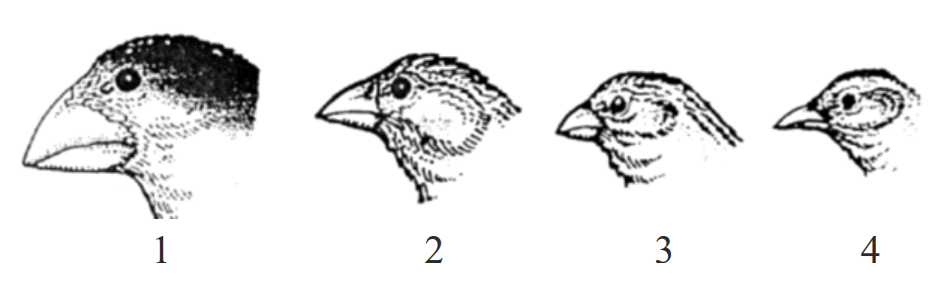 The sketch, showing a series of related species with differently adapted beaks arising from a common ancestor (as with Darwin's finches), depicts adaptive radiation — the evolution of different species from a common ancestor, each adapted to a different niche/habitat.
Convergent evolution - analogous marsupial and placental mammals
-
Match List-I with List-II with respect to convergent evolution and choose the correct answer from the options given below:
Pick the matching item from Column II for each row.
Column I
- A. Lemur
- B. Bobcat
- C. Anteater
- D. Flying squirrels
Column II
- I. Flying phalanger
- II. Numbat
- III. Spotted cuscus
- IV. Tasmanian tiger cat
Correct answer: A → III, B → IV, C → II, D → I
Lemur (placental) is analogous to the Spotted cuscus (marsupial) (A-III); Bobcat is analogous to the Tasmanian tiger cat (B-IV); Anteater is analogous to the Numbat (C-II); Flying squirrels are analogous to the Flying phalanger (D-I).
Evidence for evolution - living fossils, connecting links, vestigial organs, atavism
-
Match List-I with List-II and choose the correct answer from the options given below:
Pick the matching item from Column II for each row.
Column I
- A. Living Fossil
- B. Connecting Link
- C. Vestigial Organ
- D. Atavism
Column II
- I. Elongated canine teeth
- II. Vermiform appendix
- III. Echidna
- IV. Latimeria
Correct answer: A → IV, B → III, C → II, D → I
Living Fossil is exemplified by Latimeria (A-IV); Connecting Link is exemplified by Echidna (B-III); Vestigial Organ is exemplified by the Vermiform appendix (C-II); Atavism is exemplified by elongated canine teeth (D-I).
Geological time scale - Paleozoic era
-
What is the correct order (old to recent) of periods in Paleozoic era?The correct chronological order (old to recent) of these periods in the Paleozoic era is: Silurian, Devonian, Carboniferous, Permian.
Evidence for evolution - embryology
-
Embryological support for evolution was proposed byErnst Heckel proposed embryological evidence for evolution through his 'biogenetic law' (ontogeny recapitulates phylogeny), suggesting that embryonic development of an organism reflects its evolutionary history.
Origin of life - timeline
-
After about how many years of formation of earth, life appeared on this planet?Life is believed to have first appeared on Earth approximately 500 million years after the formation of the planet (Earth is about 4.5 billion years old, with the first life forms appearing roughly 500 million years later).
Human evolution - fossil hominids
-
A Hominid fossil discovered in Java in 1891, now extinct, having cranial capacity of about 900 cc wasHomo erectus (specifically the Java Man fossil) was discovered in Java in 1891, with a cranial capacity of about 900 cc.
Human evolution - Neanderthal man characteristics
-
Identify the fossil of man who showed the following characteristics. (A) Brain capacity of 1400 cc (B) Used hides to protect their body (C) Buried their dead bodies. In the light of above statements, choose the correct answer from the options given below:Neanderthal man had a brain capacity of about 1400 cc, used hides to protect their body from cold, and are known to have buried their dead — all characteristic features described in early anthropological studies.
Convergent evolution
-
What is common to whale, seal and shark?Whale and seal are mammals, while the shark is a cartilaginous fish; they are not closely related.
All three live in the sea and have developed similar adaptations for swimming, such as a streamlined body and limbs modified into flippers or fins.
Unrelated organisms acquiring similar features because of a similar habitat is called convergent evolution, and the similar structures are analogous organs.
So convergent evolution is common to the whale, the seal and the shark.
Homoiothermy is found in the whale and the seal (mammals) but not in the shark, which is cold-blooded.
Thick subcutaneous fat (blubber) is a feature of the marine mammals and not of the shark.
So the answer is convergent evolution.
Evidences for evolution
-
Which of the following is not evidence for evolution?Reference: NCERT Class XII, pages 113–115.
Evidences of evolution
-
Which one of the following are analogous structures:Gills of prawn and lungs of man both carry out respiration but differ in origin and structure, so they are analogous.
The other pairs are homologous structures. -
Which one of the following options gives one correct example each of convergent evolution and divergent evolution?Convergent evolution gives analogous structures: different origin, similar function. Eyes of octopus and mammals are an example (so are wings of butterflies and birds).
Divergent evolution gives homologous structures: same origin, different functions. Bones of the forelimbs of vertebrates are an example (so are thorns of Bougainvillea and tendrils of Cucurbita).
So the correct pairing is eyes of octopus and mammals (convergent) and bones of forelimbs of vertebrates (divergent). -
Which one of the following pairs of items correctly belongs to the category of organs mentioned against it?Nephridia are the excretory organs of the earthworm, and Malpighian tubules are the excretory organs of the cockroach. Both remove nitrogenous wastes, so this pair correctly belongs to the category of excretory organs.
Wings of a honeybee and wings of a crow have different origins and structures but perform the same function of flight, so they are analogous organs, not homologous.
Thorn of Bougainvillea and tendrils of Cucurbita have the same origin (both are modified axillary buds) but different functions, so they are homologous organs, not analogous.
The nictitating membrane (plica semilunaris) is a vestigial organ in the human eye, but the blind spot is not vestigial; it is the functional point where the optic nerve leaves the retina.
So the correctly matched pair is nephridia of earthworm and Malpighian tubules of cockroach - Excretory organs.
Darwinism
-
According to Darwin, the organic evolution is due to:Darwin's theory of natural selection rests on the struggle for existence, in which species compete for limited resources and the better adapted survive.
Evidences and theories of evolution
-
Given below are four statements (A–D) each with one or two blanks. Select the option which correctly fills up the blanks in two statements.
Statements:
(A) Wings of butterfly and birds look alike and are the results of ___(i)___ evolution.
(B) Miller showed that $CH_4$, $H_2$, $NH_3$ and ___(i)___, when exposed to electric discharge in a flask resulted in formation of ___(ii)___.
(C) Vermiform appendix is a ___(i)___ organ and an ___(ii)___ evidence of evolution.
(D) According to Darwin evolution took place due to ___(i)___ and ___(ii)___ of the fittest.(A): wings of butterflies and birds are analogous organs; they are not anatomically similar but perform the same function. Analogous structures are the result of convergent evolution.
(B): Miller passed an electric discharge through $CH_4$, $H_2$, $NH_3$ and water vapour at 800 °C and observed the formation of amino acids. Oxygen was not used (the early atmosphere was reducing) and nucleosides were not the product.
(C): the vermiform appendix is a vestigial organ and an anatomical (morphological) evidence of evolution; 'rudimentary' is not the accepted term.
(D): according to Darwin, evolution took place by small, heritable variations and the survival of the fittest (natural selection). Mutations were proposed by de Vries.
Checking the options, the only one in which both statements are filled correctly is (D) – small variations, survival, together with (A) – convergent.
Small Populations and Inbreeding
-
What is true about the isolated small tribal populations?An isolated small tribal population has a small gene pool, and marriages take place only within the tribe.
Such continued marriage among close relatives is inbreeding, which increases homozygosity.
Harmful recessive genes come together in the homozygous state, causing inbreeding depression: lowered fertility, lowered vigour and a higher frequency of hereditary disorders.
As a result there is a decline in the population, because boys marry girls only from their own tribe.
Strong muscles developed by wrestlers during their life time are acquired characters and are not inherited.
A small isolated population does not have a large gene pool, and hereditary diseases such as colour-blindness actually become more common in it.
Natural Selection: Industrial Melanism
-
Industrial melanism as observed in peppered moth proves thatBefore industrialisation in England, the light-coloured form of the peppered moth (Biston betularia) was common, and the dark melanic form was rare.
During the Industrial Revolution, soot from coal-burning factories killed the lichens and darkened the tree trunks. The melanic moths were now camouflaged and escaped predation by birds, while the light moths were picked out; the frequency of the melanic form rose to over 90 percent in polluted areas.
The important point is that the dark form was not created by pollution. It was already present in the population, arising again and again by a random mutation.
Pollution only changed the direction of natural selection, so that the already existing melanic variant was favoured.
So the melanic form does have a selective advantage in industrial areas, the light form has an advantage in non-polluted areas, and melanism is not a pollution-generated feature; those three statements are wrong.
Industrial melanism thus proves that the true black melanic forms arise by a recurring random mutation.
Darwinism and Mutation Theory
-
Select the correct statement from the following?According to Darwin, fitness refers ultimately and only to reproductive fitness. To survive in a particular environment an organism needs to adapt to it; those that are better adapted survive, leave more progeny and are selected by nature.
So fitness is the end result of the ability to adapt and get selected by nature. This statement is correct.
Whales and camels also have seven cervical vertebrae, as almost all mammals do; the exceptions are the sloths and the manatee.
Mutations (de Vries) are random and directionless, not directional.
Darwinian variations are small and directional.
So the last two statements have the two descriptions interchanged, and the correct statement is the one about fitness. -
Darwin in his 'Natural Selection Theory' did not believe in any role of which one of the following in organic evolution : -Darwin's theory is based on overproduction, struggle for existence (including competition and natural enemies such as parasites and predators), variations, survival of the fittest and natural selection.
Darwin believed that evolution takes place through the gradual accumulation of small, continuous variations over many generations.
He did not give any role to large, sudden, discontinuous variations (sports). These were later emphasised by Hugo de Vries in his mutation theory, who called them mutations.
So Darwin did not believe in any role of discontinuous variations.
Origin of Life: Miller's Experiment
-
Which one of the following amino-acids was not found to be synthesized in Miller's experiment ?In 1953 S.L. Miller created conditions similar to those of the primitive earth in the laboratory: he passed an electric discharge at about $800^\circ C$ through a closed flask containing $CH_4$, $H_2$, $NH_3$ and water vapour.
After about a week he found that organic compounds, including amino acids, had been formed.
The amino acids identified in his experiment were glycine, alanine and aspartic acid.
Glutamic acid was not found among the amino acids synthesised in the original experiment.
The experiment supported the idea of chemical evolution proposed by Oparin and Haldane.
So the amino acid not found to be synthesised is glutamic acid.
Palaeontological Evidences
-
Which one of the following is not a living fossil -A living fossil is a living organism that has remained almost unchanged over millions of years and closely resembles its fossil ancestors.
The king crab (Limulus) is a living fossil among arthropods.
Sphenodon (the tuatara of New Zealand) is a living fossil among reptiles.
Peripatus is a living animal that connects annelids and arthropods and is also regarded as a living fossil.
Archaeopteryx is an extinct animal known only from fossils found in the Jurassic rocks of Bavaria, Germany.
It is a fossil connecting link (missing link) between reptiles and birds, not a living fossil.
So the one that is not a living fossil is Archaeopteryx.
Geological Time Scale
-
Jurassic period of the Mesozoic era is characterized by -The Mesozoic era, the age of reptiles, is divided into the Triassic, Jurassic and Cretaceous periods.
In the Jurassic period the dinosaurs were dominant, which is why it is called the age of dinosaurs.
Gymnosperms, especially cycads and conifers, were the dominant plants.
The first birds appeared in this period; Archaeopteryx is known from Jurassic rocks.
The radiation of reptiles and the origin of mammal-like reptiles belong to the Permian and Triassic periods, and the first dinosaurs appeared in the Triassic.
The extinction of the dinosaurs and the rise of angiosperms belong to the Cretaceous period.
So the Jurassic period is characterised by gymnosperms being the dominant plants and the appearance of the first birds.
Natural Selection: Balanced Polymorphism
-
Sickle cell anemia has not been eliminated from the African population because -Sickle cell anaemia is caused by a recessive allele $Hb^S$; individuals homozygous for it ($Hb^SHb^S$) suffer from the severe disease.
Heterozygous individuals ($Hb^AHb^S$) are carriers; they are almost normal.
The malarial parasite Plasmodium cannot multiply well in the red blood cells of the carriers, because the infected cells sickle and are destroyed.
So in the malaria-affected regions of Africa the heterozygotes survive better than both the normal homozygotes (who die of malaria) and the sickle cell homozygotes (who die of anaemia).
Because of this advantage of the heterozygotes, natural selection maintains the sickle cell allele in the population; this is called balanced polymorphism.
So sickle cell anaemia has not been eliminated because it provides immunity (resistance) against malaria.
Evidences of Evolution: Dating of Fossils
-
Age of fossils in the past was generally determined by radio-carbon method and other methods involving radioactive elements found in the rocks. More precise methods, which were used recently and led to the revision of the evolutionary periods for different groups of organisms includes -Radiometric dating (carbon-14, potassium-argon, uranium-lead) measures the decay of radioactive isotopes in fossils or rocks.
Electron spin resonance (ESR) dating measures the number of trapped electrons that build up in materials such as tooth enamel and shells due to natural radiation over time. It can date fossils that are too old for radiocarbon dating and is more precise for such material.
Fossil DNA (ancient DNA) can be extracted and compared with DNA of living organisms. The differences, combined with the molecular clock idea, give independent estimates of when groups separated.
These methods have led to revision of the time periods of evolution of several groups, including humans.
So the more precise recent methods are electron spin resonance (ESR) and fossil DNA.
Natural Selection and Adaptation
-
The most likely reason for the development of resistance against pesticides in insects damaging a crop is :-In a large insect population, some individuals already carry random mutations that make them resistant to a pesticide. These mutations arise by chance, not because the pesticide is present.
When the pesticide is sprayed, the susceptible insects die, while the resistant ones survive and reproduce. This is natural selection.
Over a few generations, the resistant individuals make up most of the population.
The idea that the pesticide directly causes useful changes (directed mutations or acquired heritable changes) is Lamarckian and is not accepted. Recombination only reshuffles existing alleles.
So the most likely reason is random mutations (followed by selection).
Darwinism: Theory of Natural Selection
-
Which one of the following sequences was proposed by Darwin and Wallace for organic evolution : -The main points of the Darwin–Wallace theory of natural selection follow a logical sequence:
1. Overproduction: organisms produce far more offspring than can survive (geometric increase).
2. Variations: individuals of a population differ from one another, and many variations are heritable.
3. Constancy of population size: in spite of overproduction, population sizes remain roughly constant because resources are limited, which leads to a struggle for existence.
4. Natural selection: individuals with favourable variations survive and reproduce more (survival of the fittest), and over generations new species arise.
So the sequence is overproduction, variations, constancy of population size, natural selection.
Hardy-Weinberg Principle: Genetic Drift
-
Random genetic drift in a population probably results from : -Genetic drift is the random change in allele frequencies from one generation to the next due to chance alone (sampling error).
Its effect is significant only in small populations, where only a few individuals breed. In a small, isolated population the members interbreed among themselves, and by chance some alleles may become very common or may be lost.
Examples are the founder effect and the bottleneck effect.
In a large population, chance fluctuations average out, so drift is negligible. High variability or a constant low mutation rate do not cause drift.
So random genetic drift probably results from interbreeding within this (small) population. -
Frequency of an allele in an isolated population may change due to : -In an isolated population there is no gene flow (no migration in or out).
In a small isolated population, allele frequencies can change by chance alone from one generation to the next. This random change is called genetic drift (e.g. founder effect).
Mutation and natural selection can also change allele frequencies, but the change characteristic of small isolated populations is drift.
So, as per the answer key, allele frequency in an isolated population may change due to genetic drift.
Origin and Evolution of Man: Molecular Evidence
-
In recent years, DNA sequences (nucleotide sequence) of mt-DNA and Y chromosomes were considered for the study of human evolution, because : -Mitochondrial DNA is inherited only from the mother (maternal inheritance), and most of the Y chromosome is inherited only from the father to sons. So both are uniparental in origin.
They do not undergo recombination (mtDNA has no partner, and most of the Y chromosome does not cross over with the X).
So the sequences pass unchanged from generation to generation except for mutations, which accumulate at a roughly steady rate. Comparing them among populations lets scientists trace maternal and paternal lineages back in time (e.g. the 'Mitochondrial Eve' and 'Y-chromosome Adam' studies).
So they are used because they are uniparental in origin and do not take part in recombination.
Hardy-Weinberg Principle: Factors Affecting Equilibrium
-
In a random mating population in equilibrium, which of the following brings about a change in gene frequency in a non-directional manner : -Factors that disturb Hardy–Weinberg equilibrium are mutation, gene flow (migration), genetic drift, natural selection and non-random mating.
Selection changes allele frequencies in a definite direction, favouring the better adapted allele. Recurrent mutation and migration also push frequencies towards particular values.
Random genetic drift is the change in allele frequency purely by chance, especially in small populations. The frequency of an allele may go up in one generation and down in the next; its direction cannot be predicted.
So random drift brings about a change in gene frequency in a non-directional manner.
Speciation: Polyploidy
-
Reason of fast speciation in present day crop plants is -Polyploidy is the presence of more than two sets of chromosomes in a cell.
A polyploid plant usually cannot produce fertile offspring when crossed with its parent species, so it is reproductively isolated at once. A new species can arise in a single generation.
Many crop plants are polyploids, e.g. wheat (hexaploid, 6n), cotton, potato, banana and sugarcane. Polyploidy also gives larger plants, fruits and seeds.
So the reason for fast speciation in present day crop plants is polyploidy.
That is every question in Evolution for this filter.
Want a score?
Answers here are not saved. Practise as a test to be marked and see your progress.
Practise as a test