Looking for classes? Ksquare Career Institute, Bengaluru →

Biology
Photosynthesis in Higher Plants
91 questions from 36 papers, each with its answer.
- 91 questions
- 36 papers
- 2.58% of Biology
Requirements of the Dark (Calvin Cycle) Reaction
-
Which of the following are required for the dark reaction of photosynthesis? A. Light B. Chlorophyll C. $CO_2$ D. ATP E. NADPH Choose the correct answer from the options given below:The dark reaction (Calvin cycle) does not directly need light or chlorophyll. It requires $CO_2$ (to be fixed), and ATP and NADPH (produced in the light reaction) for the reduction of $CO_2$ to carbohydrates. So C, D and E only are required.
ATP and NADPH Requirement in Calvin Cycle
-
How many molecules of ATP and NADPH are required for every molecule of $CO_2$ fixed in the Calvin cycle?In the Calvin cycle, the fixation of one molecule of $CO_2$ requires 3 molecules of ATP and 2 molecules of NADPH. (For one glucose molecule, i.e. 6 $CO_2$ fixed, 18 ATP and 12 NADPH are required.)
Photorespiration in C3 and C4 Plants
-
Given below are two statements: Statement I: In $C_3$ Plants, some $O_2$ binds RuBisCO, hence $CO_2$ fixation is decreased. Statement II: In $C_4$ plants, mesophyll cells show very little photorespiration while bundle sheath cells do not show photorespiration. In the light of the above statements, choose the correct answer from the options given below:Statement I is true: in $C_3$ plants, RuBisCO can also bind $O_2$ (photorespiration), so $CO_2$ fixation decreases. Statement II is false: in $C_4$ plants, mesophyll cells lack RuBisCO, and photorespiration does not occur because $CO_2$ concentration is increased at the enzyme site in the bundle sheath cells. So Statement I is true but Statement II is false.
Calvin Cycle
-
How many ATP and $NADPH_2$ are required for the synthesis of one molecule of Glucose during Calvin cycle?
One glucose needs 18 ATP and 12 NADPH.
In one Calvin cycle (for one glucose): In: six $CO_2$, 18 ATP, 12 NADPH Out: one glucose, 18 ADP, 12 $NADP$
Electron Transport – Chemiosmotic Hypothesis
-
Which of the following combinations is required for chemiosmosis?
Chemiosmosis needs a membrane, a proton pump, a proton gradient and ATP synthase.
Chemiosmosis requires a membrane, a proton pump, a proton gradient and ATP synthase. Energy is used to pump protons across a membrane, to create a gradient or a high concentration of protons within the thylakoid lumen. ATP synthase has a channel that allows diffusion of protons back across the membrane; this releases enough energy to activate ATP synthase enzyme that catalyses the formation of ATP.
C4 Pathway
-
Given below are two statements: Statement I: The primary $CO_2$ acceptor in $C_4$ plants is phosphoenolpyruvate and is found in the mesophyll cells. Statement II: Mesophyll cells of $C_4$ plants lack RuBisCO enzyme In the light of the above statements, choose the correct answer from the options given below.
-
The first stable product of $CO_2$ fixation in sorghum is:
-
Study the pathway given below:
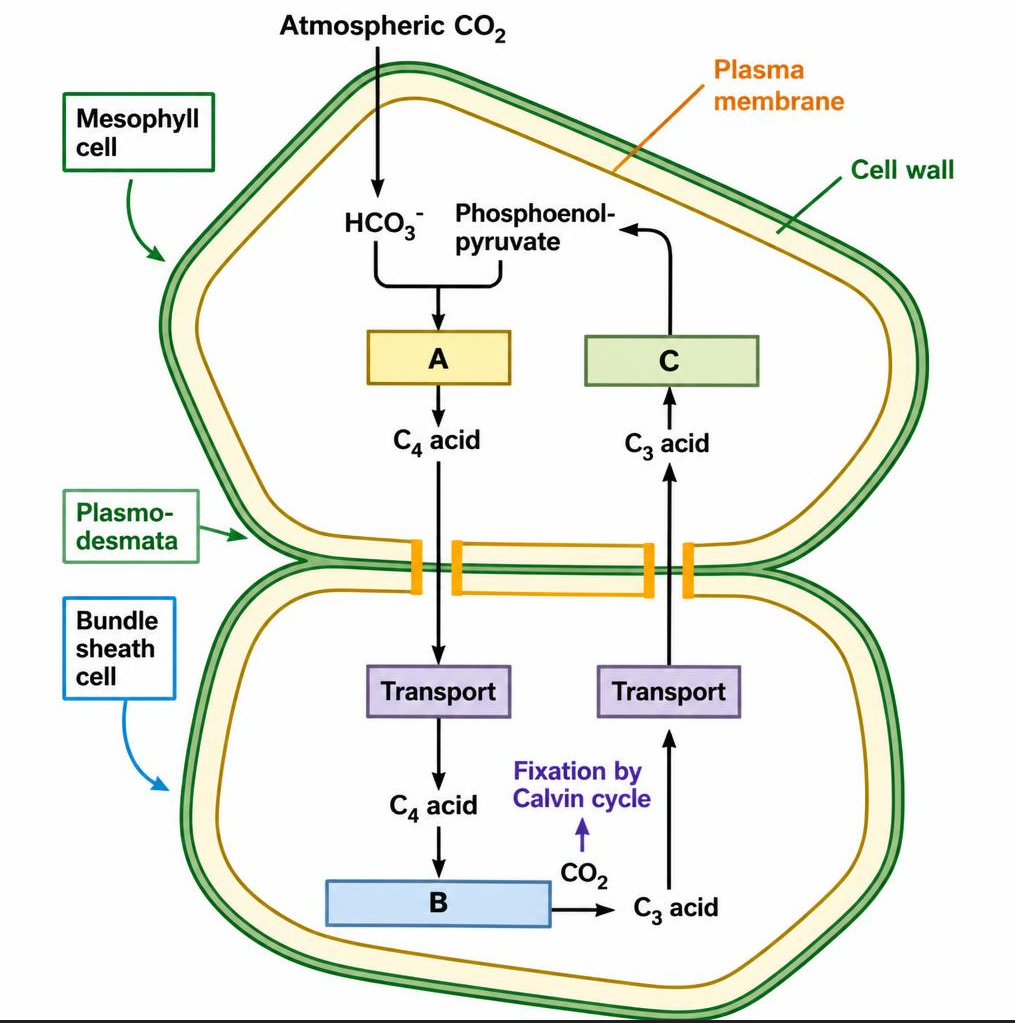
In which of the following options are correct words for all the three blanks A, B and C indicated?The figure is the Hatch and Slack ($C_4$) pathway, showing a mesophyll cell and a bundle sheath cell.
A (in the mesophyll cell): atmospheric $CO_2$, as $HCO_3^-$, combines with the 3-carbon acceptor phosphoenol pyruvate (PEP) in the presence of PEP carboxylase to form the $C_4$ acid oxaloacetic acid. This is fixation.
The $C_4$ acid (malic or aspartic acid) is transported to the bundle sheath cell.
B (in the bundle sheath cell): the $C_4$ acid is broken down to release $CO_2$ and a 3-carbon acid. This is decarboxylation; the $CO_2$ released enters the Calvin cycle.
C (back in the mesophyll cell): the $C_3$ acid is transported back and converted into PEP again. This is regeneration of the primary acceptor.
Hence A – fixation, B – decarboxylation, C – regeneration. -
As compared to a $C_3$-plant, how many additional molecules of ATP are needed for net production of one molecule of hexose sugar by $C_4$-plants -In $C_3$ plants the Calvin cycle needs 3 ATP and 2 NADPH for the fixation of one $CO_2$, so for one hexose (6 $CO_2$) it needs 18 ATP and 12 NADPH.
$C_4$ plants first fix $CO_2$ in the mesophyll cells and then release it in the bundle sheath cells for the Calvin cycle.
To regenerate phosphoenol pyruvate (PEP) from pyruvate in the mesophyll cells, the enzyme pyruvate phosphate dikinase uses 2 high energy bonds of ATP (ATP is converted to AMP) for every $CO_2$ fixed.
So 2 extra ATP are needed for each $CO_2$, i.e. $2 \times 6 = 12$ extra ATP for one hexose.
Total requirement in $C_4$ plants $= 18 + 12 = 30$ ATP per hexose.
So $C_4$ plants need twelve additional ATP molecules compared with $C_3$ plants. -
Photosynthesis in $C_4$ plants is relatively less limited by atmospheric $CO_2$ levels becauseIn $C_4$ plants, $CO_2$ is first fixed in the mesophyll cells by PEP carboxylase into a 4-carbon acid.
This acid moves into the bundle sheath cells and is decarboxylated, releasing $CO_2$ there.
This works as a $CO_2$ pump: it raises the concentration of $CO_2$ in the bundle sheath cells, where RuBisCO and the Calvin cycle are located, to a level much higher than in the atmosphere.
Because of this effective pumping, RuBisCO works at near-saturating $CO_2$ even when the atmospheric $CO_2$ is low, and photorespiration is almost eliminated.
So photosynthesis is less limited by atmospheric $CO_2$ levels; the $CO_2$ compensation point of $C_4$ plants is very low.
RuBisCO itself is the same enzyme as in $C_3$ plants, and the fixation by PEP carboxylase or the formation of 4-carbon acids is only a part of this mechanism.
So the reason is the effective pumping of $CO_2$ into the bundle sheath cells.
Chemiosmotic Hypothesis
-
Which one of the following is not true regarding the release of energy during ATP synthesis through chemiosmosis? It involves:
C4 Pathway – Kranz Anatomy
-
What is the role of large bundle sheath cells found around the vascular bundles in C4 plants?
Light Reaction – Photophosphorylation
-
Which of the following statements is incorrect?
Photorespiration
-
The oxygenation activity of RuBisCo enzyme in photorespiration leads to the formation of:In photorespiration, $O_2$ binds to RuBisCO. Instead of RuBP being converted to 2 molecules of PGA, it forms one molecule of phosphoglycerate (3-C compound) and one molecule of phosphoglycolate (2-C compound). So the oxygenation activity produces 1 molecule of a 3-C compound (along with a 2-C compound).
-
The correct sequence of cell organelles during photorespiration isPhotorespiration begins in the chloroplast, where RuBisCO binds $O_2$ and forms phosphoglycolate.
Glycolate is then metabolised in the peroxisome, and glycine is converted to serine in the mitochondria.
So the three organelles involved are the chloroplast, peroxisome and mitochondria; the only option listing these three is the answer. -
Which one of the following is wrong in relation to photorespiration : -Photorespiration occurs when RuBisCO uses $O_2$ instead of $CO_2$ (oxygenase activity), producing phosphoglycolate. It involves three organelles: chloroplasts, peroxisomes and mitochondria, and it starts in the chloroplast; true.
It depends on light (it occurs only in the daytime, along with photosynthesis); true.
It is a characteristic feature of $C_3$ plants, especially at high temperature and high $O_2$; true.
In $C_4$ plants, the $C_4$ pathway concentrates $CO_2$ around RuBisCO in the bundle sheath cells, so its oxygenase activity is suppressed and photorespiration is negligible. So it is not a characteristic of $C_4$ plants.
So the wrong statement is that photorespiration is a characteristic of $C_4$ plants.
Light Reaction – Electron Transport
-
In light reaction, plastoquinone facilitates the transfer of electrons from:After excitation, electrons pass from PS II ($P_{680}$) to the primary electron acceptor (pheophytin) and then to plastoquinone. Plastoquinone (PQ) in turn transfers electrons to the cytochrome $b_6f$ complex. So plastoquinone facilitates electron transfer from PS II to the Cyt $b_6f$ complex.
Calvin cycle (C3 pathway) - ATP and NADPH requirement
-
How many ATP and NADPH molecules are required to make one molecule of glucose through the Calvin pathway?
Light reaction of photosynthesis
-
Which of the following are required for the light reaction of Photosynthesis? A. $CO_2$ B. $O_2$ C. $H_2O$ D. Chlorophyll E. Light. Choose the correct answer from the options given below:The light reaction requires water (as electron donor, split by photolysis), chlorophyll (light-absorbing pigment) and light. $CO_2$ is required for the dark/carbon-fixation reaction, and $O_2$ is a product of the light reaction, not a requirement.
Products of the light reaction
-
Which one of the following products diffuses out of the chloroplast during photosynthesis?$O_2$, produced during the splitting of water in the light reaction, diffuses out of the chloroplast, while ATP and NADPH are used within the chloroplast to drive the dark reaction (Calvin cycle) leading to synthesis of sugars.
Calvin cycle (C3 pathway) stages
-
Observe the given figure (Calvin cycle). Identify the different stages labelled with alphabets by selecting the correct option.
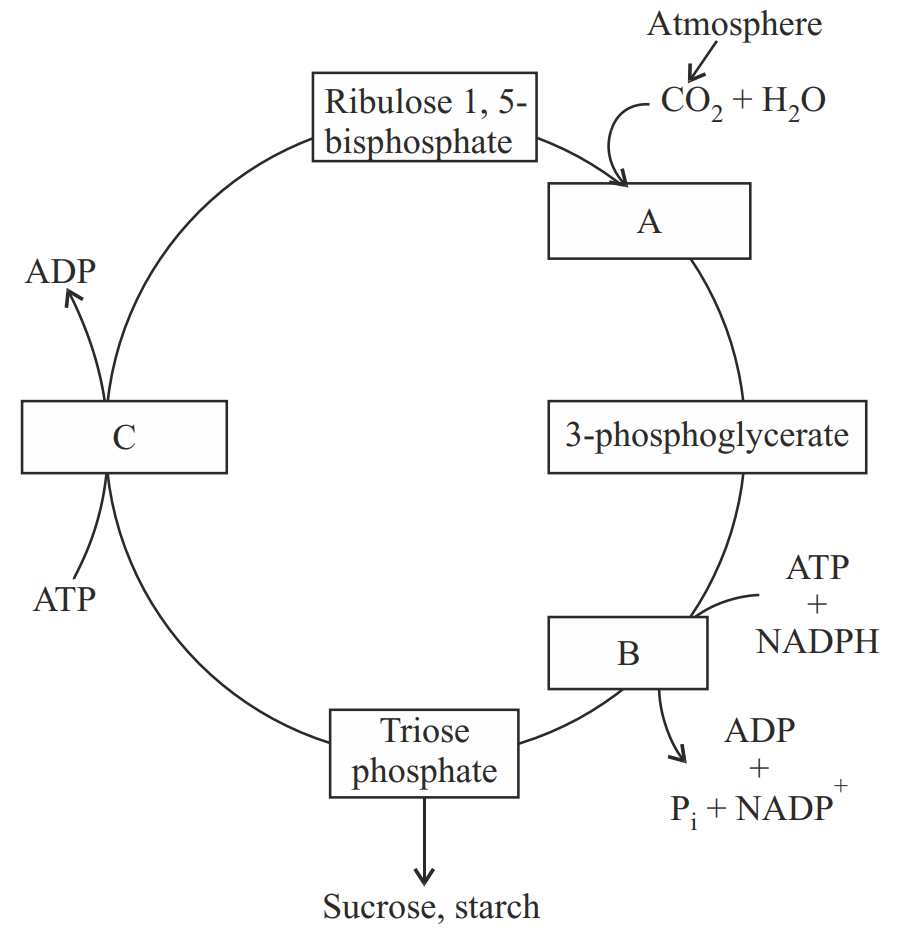 The Calvin cycle consists of three stages: Carboxylation (fixation of $CO_2$ onto RuBP to form 3-phosphoglycerate, stage A), Reduction (conversion of 3-phosphoglycerate to triose phosphate using ATP and NADPH, stage B), and Regeneration (regeneration of RuBP from triose phosphate to continue the cycle, stage C).
C4 pathway and RuBisCO
-
Which of the following statements is incorrect?In C4 plants, the site of RuBisCO activity is the bundle sheath cell, not the mesophyll cell (RuBP carboxylase/PEP carboxylase activity occurs in mesophyll cells, while RuBisCO functions in the bundle sheath cells during the Calvin cycle) — so this statement is incorrect.
Photolysis of water and electron transport
-
During non-cyclic photophosphorylation, when electrons are lost from the reaction centre at PS II, what is the source which replaces these electrons?The electrons lost from the reaction centre (P680) of PS II are replaced by electrons obtained from the splitting (photolysis) of water, which also releases $O_2$ as a byproduct.
Colours of photosynthetic pigments
-
Match List-I with List-II.
Pick the matching item from Column II for each row.
Column I
- A. Chlorophyll a
- B. Chlorophyll b
- C. Xanthophyll
- D. Carotenoid
Column II
- I. Yellow to yellow orange
- II. Yellow green
- III. Blue green
- IV. Yellow
Correct answer: A → III, B → II, C → IV, D → I
Chlorophyll a is blue green in colour (A-III); Chlorophyll b is yellow green (B-II); Xanthophyll is yellow in colour (C-IV); Carotenoid is yellow to yellow-orange (D-I).
RuBisCO and photorespiration in C4 plants
-
Given below are two statements: Statement I: RuBisCO is the most abundant enzyme in the world. Statement II: Photorespiration does not occur in C4 plants. In the light of the above statements, choose the most appropriate answer from the options given below:RuBisCO (ribulose bisphosphate carboxylase-oxygenase) is indeed considered the most abundant enzyme in the world, so Statement I is correct. In C4 plants, RuBisCO is localised in the bundle sheath cells where $CO_2$ concentration is kept high, effectively suppressing its oxygenase activity, so photorespiration does not occur (or is negligible) in C4 plants — Statement II is also correct.
Cyclic vs non-cyclic photophosphorylation
-
Which out of the following statements is incorrect?Cyclic photophosphorylation involves only Photosystem I (PS I), not both photosystems — electrons cycle back to the same PS I reaction centre without involving PS II. So the statement that it involves both PS I and PS II is incorrect.
Calvin cycle - reduction phase
-
When one $CO_2$ molecule is fixed as one molecule of triose phosphate, which of the following photochemically made, high energy chemical intermediates are used in the reduction phase?In the reduction phase, fixing one molecule of $CO_2$ (reduction of the 3-PGA formed) uses 2 ATP and 2 NADPH. The third ATP per $CO_2$ is used in the regeneration of RuBP.
Chemiosmotic hypothesis - ATP synthesis
-
Identify the correct statements regarding chemiosmotic hypothesis: (a) Splitting of the water molecule takes place on the inner side of the membrane. (b) Protons accumulate within the lumen of the thylakoids. (c) Primary acceptor of electron transfers the electrons to an electron carrier. (d) NADP reductase enzyme is located on the stroma side of the membrane. (e) Protons increase in number in stroma. Choose the correct answer from the options given below:Water splitting occurs on the inner (lumen) side of the thylakoid membrane, protons accumulate in the lumen, and NADP reductase is located on the stroma side. Statement (c) is incorrect because the primary acceptor transfers electrons to a proton carrier (PQ), not an electron carrier. Statement (e) is incorrect as proton concentration decreases in the stroma.
Early experiments on photosynthesis
-
Select the correct sequence of experiments that led to a gradual understanding of photosynthesis in green plants.Reference: NCERT Class XI, pages 134, 135.
Emerson effect – two photosystems
-
Emerson's enhancement effect and red drop have been instrumental in the discovery of
Red drop and enhancement revealed PS I and PS II.
The quantum yield dropped sharply when $Chlorella$ was illuminated with red light of wavelength more than 680 nm ('red drop'). When it was irradiated with both 680 nm and above 700 nm light, the rate of photosynthesis increased ('enhancement effect').
This showed there are two reaction centres (photosystems I and II) operating simultaneously.
Chemiosmotic hypothesis – proton gradient
-
In a chloroplast the highest number of protons are found in
Protons accumulate in the thylakoid lumen.
Photolysis (splitting of water by activated chlorophyll) takes place in the lumen of the thylakoid, producing protons there. These protons are used to reduce $NADP^+$ to NADPH in the stroma.
Light reaction
-
Read the following four statements, A, B, C and D and select the right option having both correct statements.
STATEMENTS:
(A) Z scheme of light reaction takes place in presence of PS I only.
(B) Only PS I is functional in cyclic photophosphorylation.
(C) Cyclic photophosphorylation results into synthesis of ATP and $NADPH_2$
(D) Stroma lamellae lack PS II as well as NADP.(A) is wrong: the Z scheme (non-cyclic electron flow) needs both photosystems, PS II first and then PS I, connected through the electron transport chain.
(B) is correct: when only PS I is functional, the electron is circulated within the photosystem and cyclic photophosphorylation occurs.
(C) is wrong: cyclic photophosphorylation results only in the synthesis of ATP; $NADPH + H^+$ is not formed.
(D) is correct: the stroma lamellae membranes lack PS II as well as the enzyme NADP reductase; this is where cyclic photophosphorylation takes place.
Hence the correct statements are B and D.
C4 pathway and photorespiration
-
$C_4$ plants are more efficient in photosynthesis than $C_3$ plants due toIn $C_3$ plants RuBisCO also acts as an oxygenase: when $O_2$ binds to it, RuBP is broken down in photorespiration, which fixes no $CO_2$, forms no ATP or NADPH and releases already fixed $CO_2$. This lowers productivity.
In $C_4$ plants $CO_2$ is first fixed in the mesophyll cells by PEP carboxylase into a $C_4$ acid, which is transported to the bundle sheath cells and decarboxylated there.
This raises the $CO_2$ concentration around RuBisCO in the bundle sheath, so RuBisCO works as a carboxylase and its oxygenase activity is minimised.
As a result photorespiration does not occur (is negligible) in $C_4$ plants, so their productivity and yields are better; they also tolerate higher temperatures and high light intensities.
Hence $C_4$ plants are more efficient due to a lower rate of photorespiration.
Note: the answer line in the source PDF prints (3), but its own explanation ('Photorespiration does not occur in C4 plants') and NCERT support 'lower rate of photorespiration', which is taken as the answer here. -
The $C_4$ plants are photosynthetically more efficient than $C_3$ plants because:In $C_3$ plants the enzyme RuBisCO also binds $O_2$ and carries out photorespiration, in which fixed carbon is lost as $CO_2$ without the production of ATP or sugar. This lowers the efficiency of photosynthesis.
$C_4$ plants have Kranz anatomy. In the mesophyll cells $CO_2$ is first fixed by PEP carboxylase, an enzyme that has a very high affinity for $CO_2$ and does not react with $O_2$.
The $C_4$ acid formed is transported to the bundle sheath cells and decarboxylated there, so the $CO_2$ concentration at the site of RuBisCO becomes very high.
This makes RuBisCO work as a carboxylase and minimises its oxygenase activity, so photorespiration practically does not occur.
Any $CO_2$ that is released in the bundle sheath cells is trapped and refixed by PEP carboxylase in the surrounding mesophyll cells, so no $CO_2$ escapes from the leaf.
For the same reason the $CO_2$ compensation point of $C_4$ plants is very low (not more), and the $CO_2$ efflux is prevented (not allowed).
So $C_4$ plants are more efficient because the $CO_2$ generated during photorespiration is trapped and recycled through PEP carboxylase.
Light Reaction and Electron Transport
-
Electrons from excited chlorophyll molecule of photosystem II are accepted first by:In photosystem II the reaction centre chlorophyll a (P680) absorbs red light of 680 nm; its electrons become excited and jump into an orbit farther from the nucleus.
These electrons are picked up by an electron acceptor, which passes them on to an electron transport system consisting of cytochromes.
The first stable acceptors are quinones: the electron passes through pheophytin to the bound plastoquinone QA, then to QB and the mobile plastoquinone (PQ) pool.
From plastoquinone the electrons move downhill to the cytochrome b6-f complex, then to plastocyanin and finally to photosystem I (the Z scheme).
Ferredoxin accepts electrons from photosystem I, not from photosystem II.
Cytochrome-b and cytochrome-f receive the electrons only after the quinone.
So among the given options the electrons from the excited chlorophyll of photosystem II are accepted first by quinone. -
The first acceptor of electrons from an excited chlorophyll molecule of photosystem II isIn photosystem II the reaction centre chlorophyll a (P680) absorbs light of 680 nm and its electrons become excited.
The excited electrons are picked up by an electron acceptor and passed to an electron transport system.
The electron passes through pheophytin to the quinones: the bound plastoquinone QA, then QB and the mobile plastoquinone pool. Among the given choices the first acceptor is quinone.
From plastoquinone the electrons pass to the cytochrome b6-f complex, then to plastocyanin and to photosystem I.
The iron-sulphur protein and ferredoxin are electron acceptors on the reducing side of photosystem I, not photosystem II.
Cytochromes come after the quinone in the chain.
So the first acceptor of electrons from the excited chlorophyll of photosystem II is quinone. -
In photosystem-I, the first electron acceptor is -In photosystem I the reaction centre is chlorophyll a with an absorption peak at 700 nm (P700).
When P700 absorbs light, its electron is excited and is passed to a primary electron acceptor.
This acceptor is an iron-sulphur protein (Fe-S), often written as A or FRS (ferredoxin reducing substance).
From the iron-sulphur protein the electron is passed to ferredoxin and then, through the enzyme ferredoxin-NADP reductase, to $NADP^+$, which is reduced to NADPH.
So ferredoxin comes after the iron-sulphur protein.
Plastocyanin is the electron donor to photosystem I, and the cytochrome complex lies between the two photosystems.
So in photosystem I the first electron acceptor is an iron sulphur protein.
Factors Affecting Photosynthesis: Light
-
Plants adapted to low light intensity have :-Shade plants (sciophytes) live under low light intensity, for example on the forest floor.
To trap as much of the scarce light as possible, they have more chlorophyll per reaction centre, i.e. a larger photosynthetic unit size (more antenna pigment molecules feeding each reaction centre), and larger grana with more thylakoids.
Their rate of $CO_2$ fixation is lower than that of sun plants, because light is limiting.
Extended root systems and spiny leaves are adaptations of plants of dry (xeric) habitats, not of shade.
So plants adapted to low light intensity have a larger photosynthetic unit size than sun plants.
Emerson Effect and Red Drop
-
Which pigment system is inactivated in red drop : -Emerson observed that the quantum yield of photosynthesis falls sharply when the wavelength of light is above 680 nm, even though chlorophyll still absorbs it. This is called the red drop.
Light of wavelength above 680 nm can excite PS I (P700) but not PS II (P680).
Since both photosystems are needed for non-cyclic photophosphorylation and splitting of water, photosynthesis falls when PS II is not working.
When far-red light is supplemented with shorter-wavelength red light, the rate increases more than the sum (Emerson enhancement effect).
So PS II is inactivated in the red drop.
That is every question in Photosynthesis in Higher Plants for this filter.
Want a score?
Answers here are not saved. Practise as a test to be marked and see your progress.
Practise as a test