Looking for classes? Ksquare Career Institute, Bengaluru →

Biology
Cell Cycle and Cell Division
87 questions from 33 papers, each with its answer.
- 87 questions
- 33 papers
- 2.47% of Biology
Substages of Meiotic Prophase I
-
Given below are two Statements: Statement I: Chromosomes become gradually visible under light microscope during leptotene stage. Statement II: The beginning of diplotene stage is recognized by dissolution of synaptonemal complex. In the light of the above statements, choose the correct answer from the options given below:During leptotene, chromosomes gradually condense and become visible under the light microscope – Statement I is true. The beginning of diplotene is recognised by the dissolution of the synaptonemal complex – Statement II is true. So both statements are true.
Sequence of Cell Cycle Phases
-
Following are the stages of cell division: A. Gap 2 phase B. Cytokinesis C. Synthesis phase D. Karyokinesis E. Gap 1 phase Choose the correct sequence of stages from the options given below:The cell cycle proceeds as: Gap 1 ($G_1$) phase → Synthesis (S) phase → Gap 2 ($G_2$) phase → M phase, in which karyokinesis (division of the nucleus) is followed by cytokinesis (division of the cytoplasm). So the sequence is E-C-A-D-B.
Meiosis – Stages
-
Which of the following stages of meiosis involves division of centromere?
Centromeres split and chromatids separate in anaphase.
Anaphase stage is characterised by the following key events: 1. Centromeres split and chromatids separate. 2. Chromatids move to opposite poles.
Meiosis – Prophase I Sub-stages
-
The process of appearance of recombination nodules occurs at which sub stage of prophase I in meiosis?
Recombination nodules appear in pachytene, where crossing over occurs.
The first two stages of prophase I are relatively short-lived compared to the next stage that is pachytene. During this stage the four chromatids of each bivalent chromosomes become distinct and clearly appear as tetrads. This stage is characterised by the appearance of recombination nodules, the site at which crossing over occurs between non-sister chromatids of the homologous chromosomes.
Cell Cycle – Phases
-
Match List-I with List-II
Pick the matching item from Column II for each row.
Column I
- A. M Phase
- B. $G_2$ Phase
- C. Quiescent stage
- D. $G_1$ Phase
Column II
- I. Proteins are synthesized
- II. Inactive phase
- III. Interval between mitosis and initiation of DNA replication
- IV. Equational division
Correct answer: A → IV, B → I, C → II, D → III
M phase is equational division and G1 is the interval between mitosis and DNA replication.
M phase is the most dramatic period of cell cycle, also called equational division. $G_2$ phase: Proteins are synthesized in preparation for mitosis. Quiescent stage: cells do not divide further, exit $G_1$ phase to enter an inactive state. $G_1$ phase: This phase corresponds to the interval between mitosis and initiation of DNA replication. -
Match List - 1 with List - 2.
Pick the matching item from Column II for each row.
Column I
- A. S phase
- B. $G_2$ phase
- C. Quiescent stage
- D. $G_1$ phase
Column II
- I. Proteins are synthesized
- II. Inactive phase
- III. Interval between mitosis and initiation of DNA replication
- IV. DNA replication
Correct answer: A → IV, B → I, C → II, D → III
Cell Cycle – Interphase and Quiescent Stage
-
Given below are two statements: Statement I: During $G_0$ phase of cell cycle the cell is metabolically inactive Statement II: The centrosome undergoes duplication during S phase of interphase. In the light of the above statements, choose the most appropriate answer from the option below:
Cells in G0 remain metabolically active; the centrosome duplicates in S phase.
The cells that do not divide further exit $G_1$ phase to enter an inactive stage called quiescent stage ($G_0$) of the cell cycle. Cells in this stage remain metabolically active but no longer proliferate unless called on to do so depending on the requirement of organism.
Mitosis
-
Select the incorrect statement with reference to mitosis:
-
A stage in cell division is shown in the figure. Select the answer which gives correct identification of the stage with its characteristics.
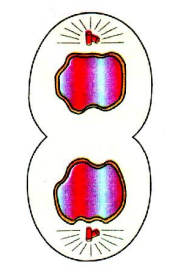 The figure shows telophase: chromosomes cluster at opposite poles, the nuclear envelope assembles around them, and the nucleolus, Golgi complex and ER reform.
-
During mitosis ER and nucleolus begin to disappear atProphase is the first stage of mitosis: chromosomal material condenses and the centrioles begin to move towards the opposite poles.
The Golgi complexes, endoplasmic reticulum, nucleolus and nuclear envelope start disappearing as prophase begins.
By the end of prophase (late prophase) they are no longer visible under the microscope, which means their disappearance must have begun earlier.
Hence the ER and nucleolus begin to disappear at early prophase.
Meiosis – Prophase I
-
The appearance of recombination nodules on homologous chromosomes during meiosis characterizes?
-
Dissolution of the synaptonemal complex occurs during:The synaptonemal complex dissolves during the diplotene stage of prophase I of meiosis; the recombined homologous chromosomes then separate except at the sites of crossover (chiasmata).
-
Match the following with respect to meiosis:
Pick the matching item from Column II for each row.
Column I
- A. Zygotene
- B. Pachytene
- C. Diplotene
- D. Diakinesis
Column II
- I. Terminalization
- II. Chiasmata
- III. Crossing over
- IV. Synapsis
Correct answer: A → IV, B → III, C → II, D → I
Meiosis
-
Which of the following stages of meiosis involves division of centromere?
-
Given below is the representation of a certain event at a particular stage of a type of cell division. Which is this stage?
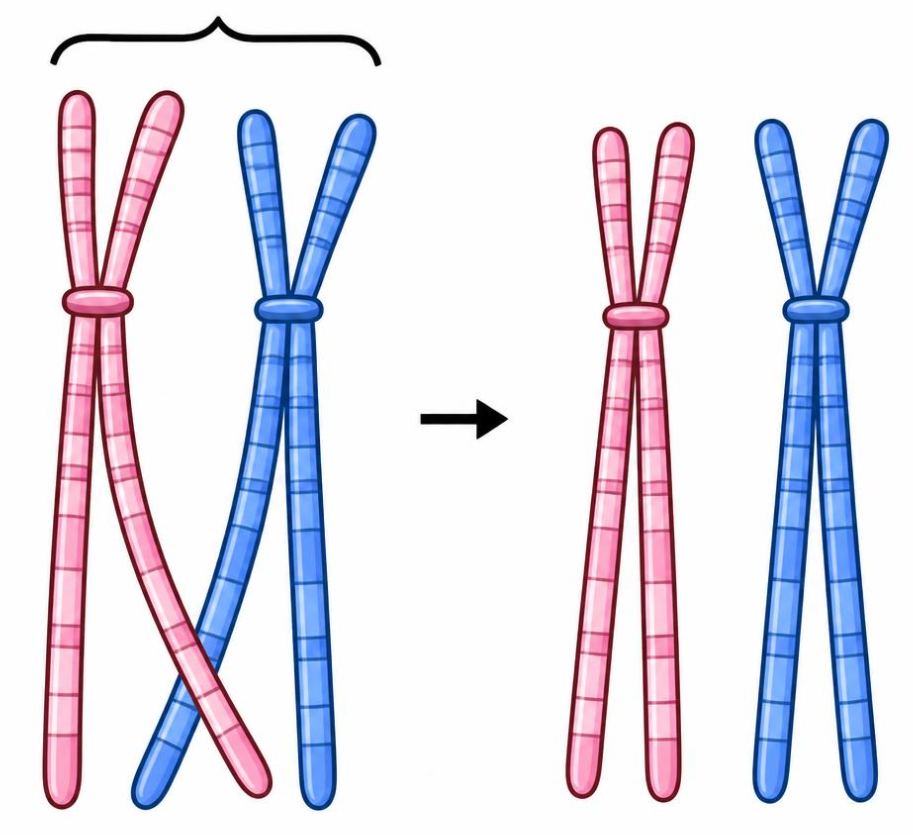 The figure shows homologous chromosomes paired together with exchange of segments between non-sister chromatids (crossing over).
Pairing of homologues and crossing over occur only in prophase I of meiosis (zygotene and pachytene).
They do not occur in mitosis or in prophase II.
Cell Cycle – Interphase
-
The fruit fly has 8 chromosomes (2n) in each cell. During interphase of Mitosis if the number of chromosomes at G1 phase is 8, what would be the number of chromosomes after S phase?
-
The centriole undergoes duplication during:
Phases of the cell cycle
-
Match List I with List II:
Pick the matching item from Column II for each row.
Column I
- i. $G_1$ phase
- ii. S phase
- iii. $G_2$ phase
- iv. M phase
Column II
- a. Actual cell division occurs
- b. Cell is metabolically active and continuously grows but does not replicate its DNA
- c. Synthesis of DNA occurs and the amount of DNA per cell doubles
- d. Proteins are synthesized while cell growth continues
Correct answer: i → b, ii → c, iii → d, iv → a
-
Match List-I with List-II and choose the correct answer from the options given below:
Pick the matching item from Column II for each row.
Column I
- A. Cells are metabolically active and proliferate
- B. DNA replication takes place
- C. Proteins are synthesised
- D. Quiescent stage with metabolically active cells
Column II
- I. G2 phase
- II. G1 phase
- III. G0 phase
- IV. S phase
Correct answer: A → II, B → IV, C → I, D → III
Cells are metabolically active and proliferate during G1 phase (A-II); DNA replication takes place during S phase (B-IV); Proteins are synthesised during G2 phase (C-I); Quiescent stage with metabolically active but non-dividing cells is G0 phase (D-III). -
In a mitotic cycle, the correct sequence of phases isThe correct sequence of the mitotic cell cycle is $G_1$ (growth) $\to$ S (DNA synthesis) $\to$ $G_2$ (preparation for division) $\to$ M (mitosis).
Meiosis - Prophase I substages
-
Recombination between homologous chromosomes is completed by the end ofCrossing over (recombination) between homologous chromosomes occurs at the pachytene stage of prophase I and is completed by its end.
-
During Meiosis I, in which stage synapsis takes place?Synapsis (pairing of homologous chromosomes to form a synaptonemal complex/bivalent) occurs during the zygotene stage of prophase I.
Types of chromosomes based on centromere position
-
Match List-I with List-II and choose the correct answer from the options given below:
Pick the matching item from Column II for each row.
Column I
- A. Metacentric chromosome
- B. Sub-metacentric chromosome
- C. Acrocentric chromosome
- D. Telocentric chromosome
Column II
- I. Chromosome has a terminal centromere
- II. Middle centromere forming two equal arms of chromosome
- III. Centromere is slightly away from the middle of chromosome resulting into two unequal arms
- IV. Centromere is situated close to its end forming one extremely short and one very long arm
Correct answer: A → II, B → III, C → IV, D → I
Metacentric chromosome has a middle centromere forming two equal arms (A-II); Sub-metacentric chromosome has a centromere slightly away from the middle, resulting in two unequal arms (B-III); Acrocentric chromosome has a centromere close to its end, forming one extremely short and one very long arm (C-IV); Telocentric chromosome has a terminal centromere (D-I).
Substages of prophase I of meiosis
-
Match List-I (Event) with List-II [Stage of Prophase-I (Meiosis-I)] and choose the correct answer from the options given below:
Pick the matching item from Column II for each row.
Column I
- A. Chiasmata formation
- B. Crossing over
- C. Synaptonemal complex formation
- D. Terminalisation of chiasmata
Column II
- I. Pachytene
- II. Diakinesis
- III. Diplotene
- IV. Zygotene
Correct answer: A → III, B → I, C → IV, D → II
Chiasmata formation occurs at diplotene (A-III); Crossing over occurs at pachytene (B-I); Synaptonemal complex formation occurs at zygotene (C-IV); Terminalisation of chiasmata occurs at diakinesis (D-II). -
Select correct sequence of substages of Prophase-I of Meiotic division: (A) Zygotene (B) Pachytene (C) Diakinesis (D) Leptotene (E) DiploteneThe correct sequence of substages of prophase I is: Leptotene (D) → Zygotene (A) → Pachytene (B) → Diplotene (E) → Diakinesis (C).
Mitosis - metaphase
-
Attachment of spindle fibers to kinetochores of chromosomes becomes evident inDuring metaphase, spindle fibres from opposite poles attach to the kinetochores of chromosomes, and chromosomes align at the metaphase plate.
Events of the cell cycle phases
-
Match the following events that occur in their respective phases of cell cycle and select the correct option:
Pick the matching item from Column II for each row.
Column I
- a. G1 phase
- b. S phase
- c. G2 phase
- d. Metaphase in M-phase
Column II
- i. Cell grows and organelle duplication
- ii. DNA replication and chromosome duplication
- iii. Cytoplasmic growth
- iv. Alignment of chromosomes
Correct answer: a → i, b → ii, c → iii, d → iv
G1 phase involves cell growth and organelle duplication (a-i); S phase involves DNA replication and chromosome duplication (b-ii); G2 phase involves cytoplasmic growth (c-iii); Metaphase in M-phase involves alignment of chromosomes (d-iv).
Meiotic prophase I - diplotene stage
-
The dissolution of synaptonemal complex occurs during:During diplotene, the synaptonemal complex dissolves and the recombined homologous chromosomes (bivalents) start separating from each other, though they remain connected at points called chiasmata.
Centromere splitting in mitosis and meiosis
-
During which stages of mitosis and meiosis, respectively does the centromere of each chromosome split?The centromere of each chromosome splits during anaphase of mitosis (separating sister chromatids), and during anaphase II of meiosis (since in meiosis I, homologous chromosomes separate without centromere splitting).
G0 phase - quiescent stage
-
Which one of the following is the quiescent stage of cell cycle?The $G_0$ (quiescent) phase is a stage where cells exit the active cell cycle and remain metabolically active but do not proliferate further, unless called back into the cycle.
Sequence of events in prophase I
-
Identify the correct sequence of events during Prophase I of meiosis: (a) Synapsis of homologous chromosomes (b) Chromosomes become gradually visible under microscope (c) Crossing over between non-sister chromatids of homologous chromosomes (d) Terminalisation of chiasmata (e) Dissolution of synaptonemal complex Choose the correct answer from the options given below:Leptotene: chromosomes become gradually visible (b). Zygotene: synapsis of homologous chromosomes (a). Pachytene: crossing over between non-sister chromatids (c). Diplotene: dissolution of the synaptonemal complex (e). Diakinesis: terminalisation of chiasmata (d).
Prophase I - zygotene
-
Bivalent or Tetrad formation is a characteristic feature observed during:During zygotene, homologous chromosomes pair (synapsis) with the formation of the synaptonemal complex; the complex formed by a pair of synapsed homologous chromosomes is called a bivalent or tetrad.
Meiosis - DNA content
-
After meiosis I, the resultant daughter cells have
Meiosis I
-
Given below are two statements: Statement I: Chromosomes are fully condensed at the end of prophase I. Statement II: Meiosis I resembles mitosis. In the light of the above statements, choose the most appropriate answer from the options given below:Reference: NCERT Class XI, page 126.
Mitosis – sequence of events
-
Which of the following options gives the correct sequence of events during mitosis?
Crossing over does not occur in mitosis.
(i) Condensation of DNA so that chromosomes become visible occurs during early to mid-prophase. (ii) Nuclear membrane disassembly begins at late prophase or the transition to metaphase. (iii) Arrangement of chromosomes at the equator (congression) occurs during metaphase. (iv) Centromere division occurs during anaphase, forming daughter chromosomes. (v) Segregation also occurs during anaphase as daughter chromosomes separate and move to opposite poles. (vi) Telophase leads to the formation of two daughter nuclei.
Mitosis – anaphase regulation
-
Anaphase promoting complex (APC) is a protein degradation machinery necessary for proper mitosis of animal cells. If APC is defective in a human cell, which of the following is expected to occur?
APC triggers sister chromatid separation.
Anaphase Promoting Complex (APC) is necessary for separation of daughter chromosomes during anaphase. If APC is defective, the chromosomes will fail to segregate during anaphase.
Cell division in prokaryotes
-
DNA replication in bacteria occurs
Bacteria replicate DNA just before binary fission.
DNA replication in bacteria occurs prior to fission. Prokaryotes do not show a well-marked S-phase.
Failure of cytokinesis – polyploidy
-
A cell at telophase stage is observed by a student in a plant brought from the field. He tells his teacher that this cell is not like other cells at telophase stage. There is no formation of cell plate and thus the cell is containing more number of chromosomes as compared to other dividing cells. This would result in
Chromosome doubling without cell division gives polyploidy.
A cell with more than two genomes is polyploid (autopolyploid or allopolyploid). A cell containing more chromosomes because no cell plate was formed shows polyploidy.
Meiosis and cell cycle
-
Select the correct option by matching Column I with Column II:
Pick the matching item from Column II for each row.
Column I
- a. Synapsis aligns homologous chromosomes
- b. Synthesis of RNA and protein
- c. Action of enzyme recombinase
- d. Centromeres do not separate but chromatids move toward opposite poles
Column II
- i. Anaphase-II
- ii. Zygotene
- iii. G2-Phase
- iv. Anaphase-I
- v. Pachytene
Correct answer: a → ii, b → iii, c → v, d → iv
(a) Synapsis aligns homologous chromosomes — Zygotene (ii)
(b) Synthesis of RNA and protein — G2 phase (iii)
(c) Action of enzyme recombinase — Pachytene (v)
(d) Centromeres do not separate but chromatids move towards opposite poles — Anaphase-I (iv)
Correct match: a-ii, b-iii, c-v, d-iv.
Cell cycle
-
A somatic cell that has just completed the S phase of its cell cycle, as compared to gamete of the same species, hasA somatic cell is diploid (2n, 2C) and a gamete is haploid (n, C).
After S phase the DNA doubles to 4C, but the chromosome number stays 2n.
So compared with a gamete, it has twice the chromosomes and four times the DNA. -
During which phase(s) of cell cycle, amount of DNA in a cell remains at 4C level if the initial amount is denoted as 2C?DNA replicates in S phase, raising the content from 2C to 4C.
It stays at 4C through $G_2$ and M phase until the chromatids separate and the cell divides. -
Given below is a schematic break-up of the phases/stages of cell cycle:
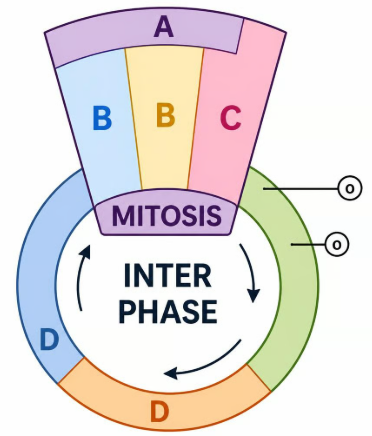
Which one of the following is the correct indication of the stage/phase in the cell cycle?The cell cycle consists of interphase ($G_1$, S and $G_2$ phases) and the M phase (mitosis: prophase, metaphase, anaphase, telophase, followed by cytokinesis).
In the diagram the long arc of interphase is divided into $G_1$, a middle phase labelled D, and $G_2$.
The phase between $G_1$ and $G_2$ is the S or synthetic phase, in which DNA replication takes place and the amount of DNA per cell doubles (2C to 4C).
So D is correctly identified as the synthetic phase.
The labels A, B and C fall within the M phase, but they are not correctly named in the other options (for example, karyokinesis is the whole process of nuclear division, not one sub-stage, and cytokinesis follows the last stage of mitosis).
Hence the correct indication is D – synthetic phase.
Prophase I
-
Arrange the following events of meiosis in correct sequence:
(a) Crossing over
(b) Synapsis
(c) Terminalisation of chiasmata
(d) Disappearance of nucleolus
Chromosome Structure: Telomeres
-
Telomere repetitive DNA sequences control the function of eukaryotic chromosomes because theyTelomeres are the specialised ends of the linear chromosomes of eukaryotes.
They consist of a highly conserved, short repetitive DNA sequence; in humans it is (TTAGGG)n, repeated many times.
They seal the ends of the chromosomes, so that the ends are not recognised as broken DNA and do not fuse with other chromosomes or get degraded by nucleases.
They also compensate for the shortening of DNA at every round of replication; the enzyme telomerase adds the repeats back.
In this way telomeres maintain the stability and integrity of the chromosomes and prevent chromosome loss.
They do not initiate transcription, they are not responsible for the pairing of homologous chromosomes, and they do not act as origins of replication (replicons).
So they control chromosome function because they prevent chromosome loss.
That is every question in Cell Cycle and Cell Division for this filter.
Want a score?
Answers here are not saved. Practise as a test to be marked and see your progress.
Practise as a test