Looking for classes? Ksquare Career Institute, Bengaluru →

Biology
Cell Cycle and Cell Division
87 questions from 33 papers, each with its answer.
- 87 questions
- 33 papers
- 2.47% of Biology
Mitosis - Anaphase
-
What is the main function of the spindle fibers during mitosis?
Spindle fibers attach to kinetochores to pull sister chromatids to opposite poles during anaphase.
Spindle fibers (microtubules) attach to kinetochores of chromosomes during metaphase and contract during anaphase to pull sister chromatids (daughter chromosomes) towards opposite spindle poles.
Mitotic Metaphase
-
Spindle fibers attach to kinetochores of chromosomes duringSpindle fibres attach to the kinetochores of chromosomes during metaphase. At this stage the chromosomes align at the metaphase plate, with spindle fibres from opposite poles attached to the kinetochores of sister chromatids, ready for separation in anaphase.
Cell Cycle – Phases of Interphase
-
Among eukaryotes, replication of DNA takes place in
DNA replication occurs in the S (synthesis) phase.
In eukaryotes, S or Synthesis phase marks the period during which DNA synthesis or replication takes place. During this phase the amount of DNA per cell doubles. -
Identify the correct statement with regard to $G_1$ phase (Gap 1) of interphase.During the $G_1$ phase, the cell is metabolically active and continuously grows but does not replicate its DNA. DNA replication takes place in S phase; nuclear division occurs during karyokinesis; reorganisation of all cell components takes place in M phase.
Cell Cycle – Phases
-
The correct sequence of phases of cell cycle is:
Mitosis
-
Which one of the following never occurs during mitotic cell division?
-
At metaphase, chromosomes are attached to the spindle fibres by theirEach metaphase chromosome consists of two sister chromatids held together at the centromere (primary constriction).
On the sides of the centromere there are small disc-shaped structures called kinetochores.
The kinetochores serve as the sites of attachment of the spindle fibres to the chromosomes, which then move to the equator of the cell.
The centromere only holds the chromatids together; satellites and secondary constrictions have no role in spindle attachment.
Hence chromosomes are attached to the spindle fibres by their kinetochores. -
Select the correct option with respect to mitosis.Metaphase: spindle fibres attach to the kinetochores and the chromosomes move to the spindle equator and get aligned along the metaphase (equatorial) plate. This statement is correct.
Anaphase: the centromeres split and the chromatids separate and move to the opposite poles; they do not remain in the centre.
Telophase: the chromosomes have already reached the poles; they decondense and the nuclear envelope reforms. The movement towards the poles starts in anaphase.
At the end of prophase the Golgi complexes, endoplasmic reticulum, nucleolus and nuclear envelope are no longer visible.
Hence the correct statement is the one about metaphase. -
Which stages of cell division do the following figures A and B represent respectively?
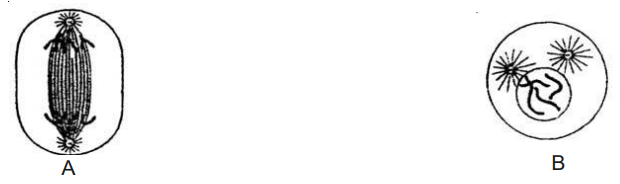 Figure A shows two groups of daughter chromosomes that have moved apart and reached the opposite poles of the cell, with the cell still undivided; this is late anaphase.
In anaphase the centromeres split and the chromatids, now daughter chromosomes, migrate to the opposite poles with their centromeres leading.
Figure B shows condensing chromosomes within the nucleus and the centrioles (asters) beginning to move apart towards opposite poles; this is prophase.
It is not metaphase, because the chromosomes are not aligned on the equatorial plate, and not telophase, because no nuclear envelopes have reformed.
Hence A is late anaphase and B is prophase. -
Best material for the study of mitosis in laboratory : -Mitosis occurs in actively dividing (meristematic) cells.
The root tip has a region of apical meristem where cells are dividing continuously, so many cells in different stages of mitosis can be seen in a squash preparation (e.g. onion root tip).
Anthers (and ovaries) are used to study meiosis; mature leaf tips have few dividing cells.
So the best material for studying mitosis in the laboratory is the root tip.
Meiosis – Prophase I
-
Which stage of meiotic prophase shows terminalisation of chiasmata as its distinctive feature?
-
In meiosis crossing over is initiated at
Crossing over occurs at pachytene.
Prophase I of meiosis has five phases: leptotene, zygotene, pachytene, diplotene and diakinesis. Crossing over takes place during pachytene.
Note: the source answer key prints (c) diplotene, but its own explanation (and the biology) gives pachytene, which is keyed here. -
Crossing over that results in genetic recombination in higher organisms occurs between :-During prophase I of meiosis (zygotene), homologous chromosomes pair to form bivalents (tetrads). Each bivalent has four chromatids.
In pachytene, crossing over takes place: segments are exchanged between non-sister chromatids of the homologous chromosomes, with the help of the enzyme recombinase. Chiasmata are the visible points of exchange.
Because the non-sister chromatids come from different parents, this exchange creates new combinations of alleles (genetic recombination).
Exchange between sister chromatids would not produce recombination, because they are identical copies.
So crossing over occurs between non-sister chromatids of a bivalent.
Meiosis
-
Regarding Meiosis, which of the statements is incorrect?
-
The enzyme recombinase is required at which stage of meiosis:Crossing over between non-sister chromatids occurs in pachytene and is mediated by the enzyme recombinase.
-
The complex formed by a pair of synapsed homologous chromosomes is called:During zygotene homologous chromosomes pair (synapsis); the complex formed by a pair of synapsed homologous chromosomes is called a bivalent or tetrad.
-
During gamete formation, the enzyme recombinase participates duringCrossing over, the exchange of genetic material between homologous chromosomes, takes place in the pachytene stage of prophase I.
It is an enzyme-mediated process, and the enzyme involved is recombinase. -
Identify the meiotic stage in which the homologous chromosomes separate while the sister chromatids remain associated at their centromeres.In metaphase I, the bivalents (pairs of homologous chromosomes) only align on the equatorial plate; nothing separates yet.
In anaphase I, the homologous chromosomes of each bivalent separate and move to opposite poles, while the two sister chromatids of each chromosome remain associated at their centromere.
In metaphase II, individual chromosomes align at the equator.
In anaphase II, the centromere of each chromosome splits and the sister chromatids separate and move to opposite poles.
Hence the stage described is anaphase I. -
Synapsis occurs betweenDuring the zygotene stage of prophase I of meiosis, the chromosomes start pairing together; this process of association is called synapsis.
The paired chromosomes are the homologous chromosomes, one from each parent.
Synapsis is accompanied by the formation of a synaptonemal complex, and the pair so formed is called a bivalent or tetrad.
The fusion of male and female gametes is syngamy, not synapsis.
Hence synapsis occurs between two homologous chromosomes.
Cell Cycle – Quiescent Stage
-
Some dividing cells exit the cell cycle and enter vegetative inactive stage. This is called quiescent stage ($G_0$). This process occurs at the end of:Some dividing cells exit the cell cycle and enter an inactive stage called the quiescent stage ($G_0$). This occurs at the end of the $G_1$ phase.
-
Cells in $G_0$ phase:
Meiosis - Prophase I substages
-
Which stage of meiosis can last for months or years in the oocytes of some vertebrates?In oocytes of some vertebrates, diplotene can last for months or years. This suspended diplotene stage is called the dictyotene state.
-
The stage during which separation of the paired homologous chromosomes begins is
Dissolution of the synaptonemal complex at diplotene begins separation of homologues.
At diplotene the synaptonemal complex disintegrates and the homologous chromosomes begin to separate. Terminalisation begins at the diplotene stage, i.e. chiasmata start to shift towards the ends.
Mitosis - metaphase
-
With respect to metaphase, which of the following statements is incorrect?Each metaphase chromosome is made up of two sister chromatids held together by the centromere, not four.
-
If you are provided with root-tips of onion in your class and are asked to count the chromosomes which of the following stages can you most conveniently look into :-In metaphase of mitosis, the chromosomes are maximally condensed (shortest and thickest), and the nuclear envelope has disappeared.
All the chromosomes line up at the equator (metaphase plate), each attached to spindle fibres at its centromere, so they are well separated and clearly visible.
This makes metaphase the best stage to study chromosome morphology and to count the chromosomes (karyotyping is also done at metaphase).
In prophase the chromosomes are still long and tangled; in anaphase they are moving apart; in telophase they decondense.
So the most convenient stage for counting chromosomes is metaphase.
Crossing over
-
In meiosis, crossing over and exchange of material between homologous chromosomes catalyzed by the enzyme:Crossing over, the exchange of genetic material between non-sister chromatids of homologous chromosomes during pachytene, is catalysed by the enzyme recombinase.
Meiosis - crossing over
-
Crossing over takes place between which chromatids and in which stage of the cell cycle?
Phases of cell cycle
-
The correct sequence of adult cell cycle phases is ________.Reference: NCERT Class XI, page 121.
-
At what stage of the cell cycle are histone proteins synthesized in a eukaryotic cell -The interphase of the cell cycle has three phases: $G_1$, S and $G_2$.
During the S (synthesis) phase, DNA replication takes place and the amount of DNA per cell doubles.
The newly replicated DNA must be packed into nucleosomes, so new histone proteins are needed at the same time.
Histone synthesis is therefore coupled with DNA replication and occurs mainly during the S phase.
During prophase and telophase the chromosomes condense and decondense, but histones are not synthesised in large amounts.
So histone proteins are synthesised during the S-phase. -
In the somatic cell cycle :-The cell cycle consists of interphase ($G_1$, S and $G_2$ phases) followed by the M phase (mitosis).
DNA replication takes place in the S (synthesis) phase. The DNA content doubles from 2C to 4C, while the chromosome number stays the same; true.
Interphase is long (about 95 percent of the cycle) and the M phase is short (in a 24 hour human cell cycle, mitosis lasts about 1 hour). So the second statement is false.
$G_2$ follows the S phase, not the mitotic phase; $G_1$ follows mitosis. So the third statement is false.
In $G_1$ the DNA content is 2C, the same as in the original cell, not double. So the fourth statement is false.
So in the somatic cell cycle, DNA replication takes place in the S phase. -
In which stage of cell cycle, DNA replication occurs :DNA replication takes place during the S (synthesis) phase of interphase, between $G_1$ and $G_2$.
The amount of DNA doubles from 2C to 4C, but the chromosome number stays the same.
So DNA replication occurs in the S phase.
Mitosis vs meiosis – synapsis
-
Which of the following is not a characteristic feature during mitosis in somatic cells?
Synapsis occurs only in meiosis.
Pairing of homologous chromosomes during zygotene of prophase I of meiosis is called synapsis, accomplished by the synaptonemal complex. The remaining options are features of somatic mitosis.
Mitosis – kinetochore
-
Spindle fibres attach on to
Spindle fibres attach at kinetochores.
During metaphase of mitosis, spindle fibres arising from the centrioles attach to the kinetochores of the chromosomes. During anaphase they contract to pull the chromosomes towards the poles.
Phases of cell cycle – S phase
-
During cell growth, DNA synthesis takes place in:
Meiosis – stages and features
-
Match the stages of meiosis in Column–I to their characteristic features in Column–II and select the correct option using the codes given below:
Pick the matching item from Column II for each row.
Column I
- a. Pachytene
- b. Metaphase-I
- c. Diakinesis
- d. Zygotene
Column II
- i. Pairing of homologous chromosomes
- ii. Terminalization of chiasmata
- iii. Crossing over takes place
- iv. Chromosomes align at equatorial plate
Correct answer: a → iii, b → iv, c → ii, d → i
Cell cycle
-
In 'S' phase of the cell cycle:S (synthesis) phase is when DNA replication takes place. The amount of DNA per cell doubles, but the chromosome number does not change.
Chromosome Structure and Mitosis
-
Centromere is required for -The centromere (primary constriction) is the region where the two sister chromatids of a chromosome are held together.
Disc-shaped structures called kinetochores are present on the sides of the centromere.
Spindle fibres attach to the kinetochores; during anaphase the centromeres split and the chromatids are pulled towards the opposite poles by the shortening of these spindle fibres.
So the centromere is required for the movement of chromosomes towards the poles.
Cytoplasmic cleavage is cytokinesis, crossing over occurs between homologous chromatids during prophase I of meiosis, and transcription occurs in genes; none of these needs the centromere.
A chromosome without a centromere (acentric fragment) is lost during cell division because it cannot move to the poles.
M Phase: Spindle Formation
-
Mitotic spindle is mainly composed of which protein :-The mitotic spindle is made of microtubules, which radiate from the centrosomes (or spindle poles in plants) and attach to the kinetochores of chromosomes.
Microtubules are hollow tubes built from the protein tubulin ($\alpha$ and $\beta$ tubulin dimers).
Actin forms microfilaments (involved in cytokinesis in animal cells), actomyosin is the contractile complex of muscle, and myoglobin is an oxygen storing protein of muscle.
So the mitotic spindle is mainly composed of tubulin.
M Phase: Metaphase
-
Spindle fibres unite with which structure of chromosomes :Kinetochores are disc-shaped protein structures at the centromere of each chromatid.
The spindle fibres (kinetochore microtubules) attach to the kinetochores and pull the chromatids to opposite poles during anaphase.
The centriole is not part of the chromosome; it organises the spindle.
So spindle fibres unite with the kinetochore.
That is every question in Cell Cycle and Cell Division for this filter.
Want a score?
Answers here are not saved. Practise as a test to be marked and see your progress.
Practise as a test