Looking for classes? Ksquare Career Institute, Bengaluru →

Biology
Biotechnology: Principles and Processes
132 questions from 36 papers, each with its answer.
- 132 questions
- 36 papers
- 3.74% of Biology
Polymerase Chain Reaction (PCR)
-
Polymerase chain reaction (PCR) amplifies DNA following the equation.
DNA amplifies exponentially as $2^n$ in PCR.
In PCR, each cycle doubles the amount of target DNA. Thus, after $n$ cycles, DNA molecules increase by a factor of $2^{n}$. -
The correct order of steps in Polymerase Chain Reaction (PCR) is
Each PCR cycle: denaturation → annealing → extension.
PCR is used for making multiple copies of a gene (or DNA) of interest in vitro. Each cycle has three steps: (i) Denaturation, (ii) Primer annealing, (iii) Extension of primer.
Bioreactors
-
Identify the part of a bio-reactor which is used as a foam braker from the given figure (A: flat bladed impeller, B: motor, C: foam breaker, D: sterile air inlet).
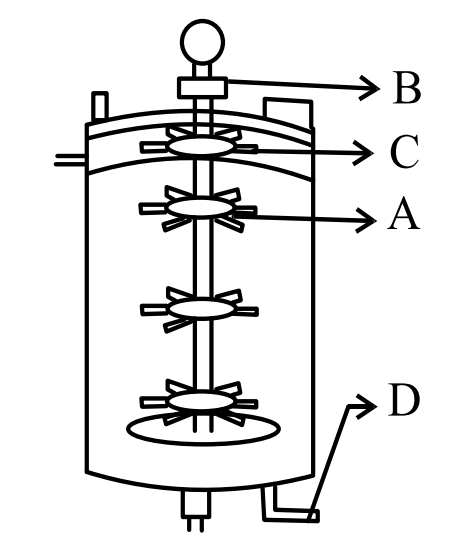
Label C indicates the foam breaker at the top of the stirrer shaft.
In a continuous stirred-tank bioreactor: B represents the drive motor, C represents the foam breaker blades near the top, A represents the flat-bladed impeller blades, and D represents the sparger/sterile air entry. Thus C is the foam breaker. -
Stirred-tank bioreactors have been designed forA stirred-tank reactor is usually cylindrical or has a curved base to facilitate the mixing of the reactor contents.
The stirrer facilitates even mixing and oxygen availability throughout the bioreactor; alternatively, air can be bubbled through the reactor (sparged stirred-tank).
The bioreactor also has an oxygen delivery system, a foam control system, a temperature control system, a pH control system and sampling ports.
Purification and addition of preservatives are parts of downstream processing, done after the bioreactor stage.
Hence stirred-tank bioreactors are designed for availability of oxygen throughout the process.
Gel Electrophoresis
-
Given below are two statements:
Statement I: The DNA fragments extracted from gel electrophoresis can be used in construction of recombinant DNA.
Statement II: Smaller size DNA fragments are observed near anode while larger fragments are found near the wells in an agarose gel.
In the light of the above statements, choose the most appropriate answer from the options given below:Both statements regarding agarose gel electrophoresis and elution are correct.
DNA fragments resolved on agarose gel are cut out and extracted (elution) to construct rDNA vectors (Statement I is correct). Negatively charged DNA migrates toward the positive anode; smaller fragments encounter lower sieving resistance and travel farthest toward the anode, while large fragments remain near the cathode wells (Statement II is correct). -
What is the criterion for DNA fragments movement on agarose gel during gel electrophoresis?
Smaller fragments migrate faster through the gel matrix.
During gel electrophoresis, DNA fragments separate (resolve) according to their size through the sieving effect provided by the agarose gel; smaller fragments move farther. -
DNA fragments generated by the restriction endonucleases in a chemical reaction can be separated by:DNA fragments are negatively charged and are separated by size using gel electrophoresis.
Tools of Recombinant DNA Technology
-
Which of the following enzyme(s) are NOT essential for gene cloning?
A. Restriction enzymes
B. DNA ligase
C. DNA mutase
D. DNA recombinase
E. DNA polymerase
Choose the correct answer from the options given below:DNA mutase and DNA recombinase are not required tools in recombinant DNA cloning vectors.
Core recombinant cloning enzymes comprise restriction endonucleases (cutting), DNA ligase (joining), and DNA polymerases (synthesis/PCR). DNA mutase and recombinase are non-essential/irrelevant. -
The linking of antibiotic resistance gene with the plasmid vector became possible with:The first recombinant DNA was constructed by Stanley Cohen and Herbert Boyer in 1972.
They cut a piece of DNA carrying an antibiotic resistance gene from a plasmid of Salmonella typhimurium using a restriction enzyme (the molecular scissors).
The cut piece of DNA was then linked with the plasmid DNA, which acted as the vector.
This linking of the antibiotic resistance gene with the plasmid vector became possible with the enzyme DNA ligase, which acts on cut DNA molecules and joins their ends by forming phosphodiester bonds.
Endonucleases cut DNA at specific sites within the molecule, exonucleases remove nucleotides from the ends, and DNA polymerase synthesises new DNA; none of these joins two DNA fragments.
So the enzyme is DNA ligase. -
Two microbes found to be very useful in genetic engineering are -Escherichia coli is the most widely used host in genetic engineering. Its plasmids, such as pBR322, are used as cloning vectors, its restriction enzyme EcoRI is used to cut DNA, and it multiplies rapidly to produce the cloned gene or its product (for example human insulin).
Agrobacterium tumefaciens is a soil bacterium that causes crown gall disease in dicot plants. It naturally transfers a piece of DNA, the T-DNA of its Ti (tumour inducing) plasmid, into the plant genome.
The Ti plasmid has been modified into a cloning vector that is no longer pathogenic but can still deliver genes of interest into plants; Agrobacterium is therefore called the natural genetic engineer of plants.
Caenorhabditis elegans is a nematode, not a microbe used as a tool in this sense.
Vibrio cholerae and Diplococcus are not standard tools of genetic engineering.
So the two very useful microbes are Escherichia coli and Agrobacterium tumefaciens. -
Which of the following enzymes are used to join bits of DNA : -DNA ligase joins two DNA fragments by forming a phosphodiester bond between the 3'-OH end of one fragment and the 5'-phosphate end of the other.
It is used in genetic engineering to join the gene of interest with the vector DNA, and in the cell to join Okazaki fragments during replication.
Primase makes RNA primers, DNA polymerase synthesises new DNA, and endonucleases cut DNA.
So ligase is used to join bits of DNA ('molecular glue').
Blue-White Screening Method
-
The blue and white selectable markers have been developed which differentiate recombinant colonies from non-recombinant colonies on the basis of their ability to produce colour in the presence of a chromogenic substrate.
Given below are two statements about this method:
Statement I: The blue coloured colonies have DNA insert in the plasmid and they are identified as recombinant colonies.
Statement II: The colonies without blue colour have DNA insert in the plasmid and are identified as recombinant colonies.
In the light of the above statements, choose the most appropriate answer from the options given below:Statement I is false; Statement II is true because insertional inactivation prevents color formation, yielding white recombinant colonies.
When foreign DNA is inserted into $\beta$-galactosidase, insertional inactivation prevents enzyme formation, leaving recombinant colonies white (uncolored). Plasmids without insert express active $\beta$-galactosidase and turn blue with chromogenic X-gal. Thus Statement I is incorrect and Statement II is correct.
Restriction Enzymes and Recognition Sequences
-
$Hind$ II always cuts DNA molecules at a particular point called recognition sequence and it consists of:$Hind$ II was the first restriction endonuclease isolated whose action depended on a specific DNA nucleotide sequence. It always cuts DNA at a particular point by recognising a specific sequence of six base pairs (GTPy↓PuAC), known as its recognition sequence. So the recognition sequence consists of 6 bp.
Ti Plasmid of Agrobacterium tumefaciens
-
The \"Ti plasmid\"" of $Agrobacterium\ tumefaciens$ stands for"The Ti plasmid of $Agrobacterium\ tumefaciens$ is the tumour inducing plasmid. Its T-DNA causes tumours in several dicot plants by transforming normal plant cells into tumour cells; it has now been modified into a cloning vector.
Tools of Recombinant DNA Technology – Gel Electrophoresis
-
Upon exposure to UV radiation, DNA stained with ethidium bromide will show
DNA stained with ethidium bromide shows bright orange bands under UV light.
In gel electrophoresis the separated DNA fragments can be visualised only after staining the DNA with a compound known as ethidium bromide followed by exposure to UV radiation. Bright orange coloured bands of DNA can be seen when stained with ethidium bromide and exposed to UV light. -
DNA strands on a gel stained with ethidium bromide when viewed under UV radiation, appear as:
-
In gel electrophoresis, separated DNA fragments can be visualized with the help of:Separated DNA fragments can be visualised only after staining the DNA with ethidium bromide followed by exposure to UV radiation – the DNA appears as bright orange bands.
Processes of Recombinant DNA Technology – Introducing DNA into Host
-
In gene gun method used to introduce alien DNA into host cells, microparticles of ______ metal are used.
Gene gun particles are coated with gold or tungsten.
A biolistic or gene gun is a technique of genetic engineering where the genes, DNA, RNA or proteins are transferred to the plant cells without the use of any vectors. The genetic material is coated with heavy metal i.e. gold or tungsten and bombarded with heavy velocity.
Isolation of the Genetic Material (DNA)
-
During the purification process for recombinant DNA technology, addition of chilled ethanol precipitates out
Chilled ethanol precipitates the genomic DNA.
Addition of chilled ethanol precipitates the genomic DNA during the isolation of DNA or genetic material. -
During the purification process for recombinant DNA technology, addition of chilled ethanol precipitates out:
-
DNA precipitation out of a mixture of biomolecules can be achieved by treatment with:
Tools of Recombinant DNA Technology – Vectors
-
Which of the following is not a cloning vector?
A probe is a labelled single-stranded DNA/RNA, not a cloning vector.
A probe is not a cloning vector rather it is a single-stranded sequence of DNA or RNA used to search for its complementary sequence in a sample genome.
Restriction Enzymes and Palindromic Sequences
-
In the following palindromic base sequences of DNA, which one can be cut easily by particular restriction enzyme?
Restriction Enzymes
-
A specific recognition sequence identified by endonucleases to make cuts at specific positions within the DNA is:
-
The specific palindromic sequence which is recognized by $EcoRI$ is:$EcoRI$ recognises the palindromic sequence: 5′-GAATTC-3′ 3′-CTTAAG-5′ and cuts between G and A on both strands, producing sticky ends.
-
Identify the wrong statement with regard to Restriction Enzymes.Restriction endonucleases function by inspecting the length of a DNA sequence; they bind to the DNA and cut the two strands of the double helix at specific (palindromic) points in the sugar–phosphate backbone. They are used in genetic engineering to form recombinant DNA molecules. DNA ligases join DNA fragments. As per the answer key in the source, statement (3) is marked as the answer.
-
Which of the following is a restriction endonuclease?
Hind II was the first restriction endonuclease isolated.
Restriction endonucleases are 'molecular scissors' which cut DNA at specific sites. $EcoRI$ and $Hind$ II are examples. -
Which one of the following represents a palindromic sequence in DNA?A palindromic sequence in DNA is a sequence of base pairs that reads the same on the two strands when the orientation of reading is kept the same (5′ → 3′ on both strands).
Take 5′ - GAATTC - 3′ with its complementary strand 3′ - CTTAAG - 5′.
Reading the upper strand 5′ → 3′ gives GAATTC; reading the lower strand 5′ → 3′ also gives GAATTC.
This is the recognition sequence of the restriction enzyme EcoRI.
In the other sequences the two strands are not even proper complements of each other and they do not read the same in the 5′ → 3′ direction.
Hence the palindromic sequence is 5′ - GAATTC - 3′ / 3′ - CTTAAG - 5′. -
Given below is a sample of a portion of DNA strand giving the base sequence on the opposite strands. What is so special shown in it?
5′ ______ GAATTC ______ 3′
3′ ______ CTTAAG ______ 5′A palindromic sequence in DNA is a sequence of base pairs that reads the same on the two strands when the orientation of reading is kept the same.
Reading the upper strand in the 5′ → 3′ direction gives GAATTC.
Reading the lower strand in the 5′ → 3′ direction also gives GAATTC.
So the given sequence is a palindrome; it is the recognition sequence of the restriction endonuclease EcoRI, which cuts between G and A on each strand to produce sticky ends.
Nothing in the sequence shows replication, a deletion or a start codon (AUG/ATG).
Hence it shows a palindromic sequence of base pairs. -
There is a restriction endonuclease called $EcoRI$. What does the $"co"$ part in it stand for?Restriction enzymes are named after the bacterium from which they are isolated.
The first letter of the name comes from the genus and the next two letters from the species of the prokaryotic cell.
EcoRI comes from $Escherichia\ coli$ RY 13: 'E' is from the genus $Escherichia$ and 'co' is from the species $coli$.
The letter 'R' is derived from the name of the strain (RY 13), and the Roman numeral 'I' shows the order in which the enzymes were isolated from that strain.
Hence 'co' stands for $coli$. -
Restriction endonucleases are enzymes whichRestriction enzymes belong to the class of enzymes called nucleases, which are of two kinds: exonucleases and endonucleases.
Exonucleases remove nucleotides from the ends of DNA.
Endonucleases make cuts at specific positions within the DNA.
Each restriction endonuclease inspects the length of the DNA, recognises a specific palindromic nucleotide sequence, binds to it and cuts each strand of the double helix at specific points in the sugar-phosphate backbone.
Hence restriction endonucleases make cuts at specific positions within the DNA molecule. -
Which one of the following palindromic base sequences in DNA can be easily cut at about the middle by some particular restriction enzyme?A palindromic sequence in DNA is a sequence of base pairs that reads the same on the two strands when the orientation of reading is kept the same (5′ → 3′ on both).
5′ GAATTC 3′ / 3′ CTTAAG 5′: the upper strand read 5′ → 3′ is GAATTC, and the lower strand read 5′ → 3′ is also GAATTC. The two strands are complementary and the sequence is a palindrome.
This is the recognition sequence of EcoRI, which cuts between G and A on each strand, a little away from the centre of the palindrome, producing sticky ends.
In the other three pairs the two strands are not even complementary to each other, so they are not palindromes.
Hence the sequence that can be cut is 5′ GAATTC 3′; 3′ CTTAAG 5′. -
Restriction endonuclease -Restriction endonucleases are enzymes, found in bacteria, that cut DNA; they are called molecular scissors.
Each restriction endonuclease recognises a specific base sequence in the DNA, usually a palindromic sequence of 4 to 8 base pairs, called its recognition sequence.
It binds to the DNA and cuts each of the two strands at specific points within this sequence, in their sugar-phosphate backbones.
For example, EcoRI recognises 5'-GAATTC-3' and cuts between G and A on both strands, producing sticky ends.
Because the cuts are made only at specific sites, the same enzyme always gives the same fragments, which is what makes recombinant DNA technology possible.
It does not cut randomly, and it neither synthesises DNA nor restricts DNA synthesis in the nucleus.
So a restriction endonuclease cuts the DNA molecule at specific sites. -
Restriction endonucleases :-Restriction endonucleases are enzymes that recognise specific palindromic base sequences in DNA and cut the DNA at or near those sites.
They are produced by bacteria as a defence mechanism against bacteriophages. When phage DNA enters, the enzyme cuts it into pieces and so restricts the growth of the virus.
The bacterium protects its own DNA by methylating its recognition sites with a methylase.
Joining (ligating) DNA molecules is done by DNA ligase; in vitro DNA synthesis is done by DNA polymerase (e.g. in PCR).
So restriction endonucleases are synthesised by bacteria as part of their defence mechanism. -
Manipulation of DNA in genetic engineering became possible due to the discovery of : -Restriction endonucleases recognise specific base sequences (palindromes) in DNA and cut the DNA at specific sites, often leaving sticky ends.
Their discovery (Arber, Smith and Nathans, Nobel Prize 1978) made it possible to cut DNA into defined fragments and to cut a vector and a foreign gene with the same enzyme so that they can be joined.
This was the key step that made recombinant DNA technology and genetic engineering possible. Ligase, which joins DNA, was also needed, but cutting at specific sites was the breakthrough.
So manipulation of DNA became possible due to the discovery of restriction endonuclease. -
Which of the following cuts the DNA from specific places : -Restriction endonucleases recognise specific (palindromic) base sequences and cut DNA within or near those sites.
EcoRI recognises 5'-GAATTC-3' and cuts between G and A on each strand, giving sticky ends.
Ligase joins DNA, exonucleases remove nucleotides from the ends of DNA (not at specific internal sites), and alkaline phosphatase removes phosphate groups.
So restriction endonuclease (EcoRI) cuts DNA at specific places.
Cloning Vectors
-
The DNA molecules to which the gene of interest is integrated for cloning is called:
-
Which vector can clone only a small fragment of DNA?A plasmid can carry only a small DNA insert (about 10 kb).
Cosmids carry about 45 kb, BACs 100–300 kb and YACs up to about 1000 kb. -
The figure below is the diagrammatic representation of the E. coli vector pBR322. Which one of the given options correctly identifies its certain component(s)?
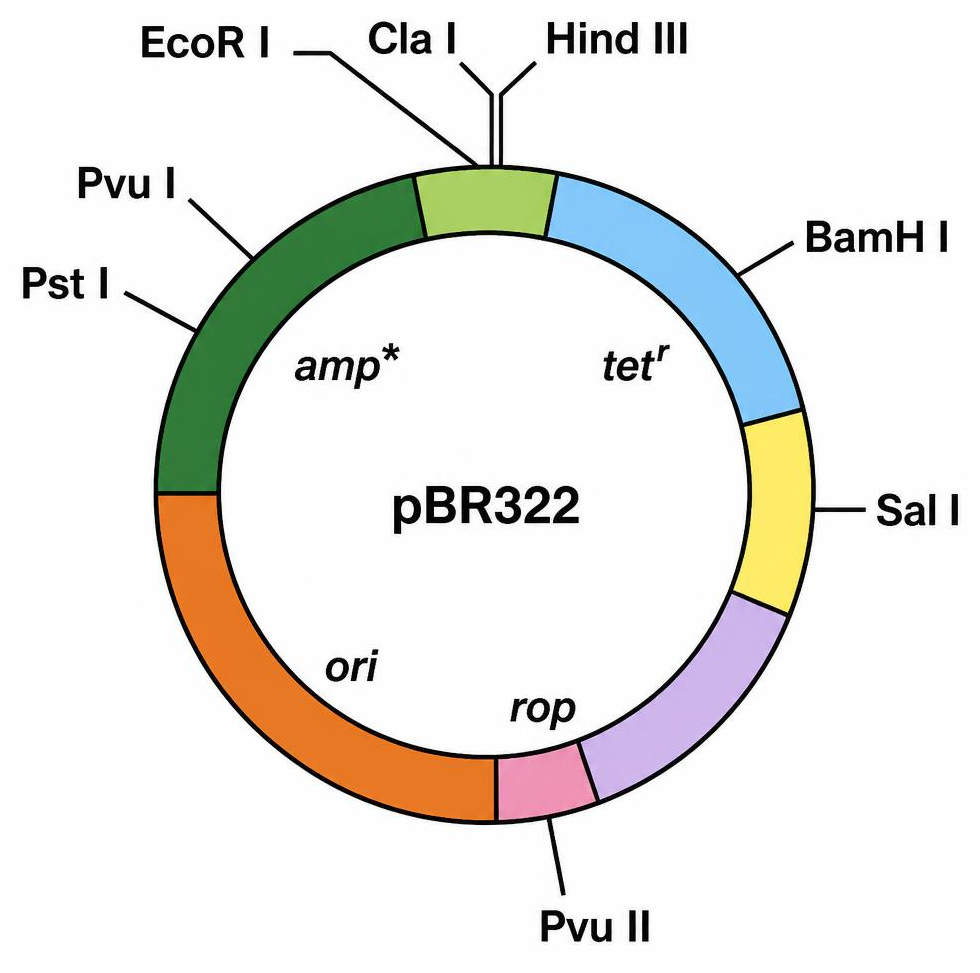 In pBR322, $amp^R$ and $tet^R$ are genes for resistance to ampicillin and tetracycline; they serve as selectable markers.
ori is the origin of replication, rop codes for proteins involved in the replication of the plasmid, and Hind III and EcoRI are restriction sites. -
In genetic engineering, the antibiotics are usedA cloning vector carries a selectable marker, which helps to identify and eliminate the non-transformants and selectively permit the growth of the transformants.
Genes coding for resistance to antibiotics such as ampicillin, tetracycline, chloramphenicol and kanamycin are the usual selectable markers (e.g., $amp^R$ and $tet^R$ in pBR322).
When the cells are plated on a medium containing the antibiotic, only the cells that have taken up the plasmid survive, so the transformants are selected.
The sequence from where replication starts is the origin of replication (ori), which is a different feature of the vector.
Hence, in genetic engineering, antibiotics are used as selectable markers.
Note: the coaching key in the source PDF marks 'To select healthy vectors'; the NCERT description (and the official answer) is that antibiotic resistance acts as a selectable marker, so that is taken as correct here. -
Which of the following are used in gene cloning?Gene cloning needs a vector, a DNA molecule that can carry the foreign gene into a host cell and replicate there.
Plasmids are small, circular, extra-chromosomal DNA molecules of bacteria that replicate independently of the chromosomal DNA; they are the most commonly used cloning vectors (e.g., pBR322).
A nucleoid is the main genetic material of a bacterium, a mesosome is an infolding of the bacterial plasma membrane, and lomasomes are membranous structures found in fungal cells; none of them is used as a vector.
Hence plasmids are used in gene cloning. -
In genetic engineering, a DNA segment (gene) of interest is transferred to the host cell through a vector. Consider the following four agents (A–D) in this regard and select the correct option about which one or more of these can be used as a vector/vectors.
(A) A bacterium
(B) Plasmid
(C) $Plasmodium$
(D) BacteriophageA vector is a DNA molecule that can carry a foreign DNA segment into a host cell and replicate there independently of the control of the chromosomal DNA.
Plasmids are autonomously replicating circular extra-chromosomal DNA molecules of bacteria; they are used as vectors.
Bacteriophages are viruses that infect bacteria and have a high copy number of their genome inside the bacterial cell; they are also used as vectors.
A bacterium is the host into which the vector carries the gene, not the vector itself.
$Plasmodium$ is the malarial parasite, a protozoan, and has nothing to do with cloning.
Hence only (B) and (D) can be used as vectors. -
Which one of the following is used as vector for cloning genes into higher organisms?Retroviruses in animals have the natural ability to transform normal cells into cancerous cells by inserting their genetic material into the host genome.
This ability has been put to use: retroviruses have been disarmed (their disease-causing genes removed) and are now used to deliver desirable genes into animal cells.
In the same way, the Ti plasmid of $Agrobacterium\ tumefaciens$ is used for plants.
Baculovirus is an insect pathogen used as a biocontrol agent, $Salmonella\ typhimurium$ is a bacterium and $Rhizopus\ nigricans$ is a fungus; they are not used as cloning vectors for higher organisms.
Hence the vector is the retrovirus. -
Which one of the following is commonly used in transfer of foreign DNA into crop plants?$Agrobacterium\ tumefaciens$ is a pathogen of several dicot plants; it naturally delivers a piece of DNA, known as T-DNA, into the plant cell, transforming normal cells into a tumour (crown gall).
Its tumour-inducing (Ti) plasmid has been modified into a cloning vector that is no longer pathogenic but can still use this mechanism to deliver genes of interest into a variety of plants.
It is therefore described as a natural genetic engineer of plants.
$Penicillium$ and $Trichoderma$ are fungi, and $Meloidogyne\ incognita$ is a root-knot nematode; none of them is a gene-transfer agent.
Hence $Agrobacterium\ tumefaciens$ is commonly used.
Processes of Recombinant DNA Technology – PCR
-
Which of the following is a correct sequence of steps in a PCR (Polymerase Chain Reaction)?
Cloning Vectors – Origin of Replication
-
The sequence that controls the copy number of the linked DNA in the vector, is termed:Ori (origin of replication) is the sequence from where replication starts; any piece of DNA linked to it can replicate in the host cells. It is also responsible for controlling the copy number of the linked DNA in the vector.
Restriction Enzymes and Other Enzymes
-
Choose the correct pair from the following:Ligases join two DNA molecules – correct pair. (Polymerases synthesise DNA; restriction endonucleases make cuts at specific positions within DNA; exonucleases remove nucleotides from the ends.)
Processes of Recombinant DNA Technology – Bioreactors
-
Which one of the following equipments is essentially required for growing microbes on a large scale, for industrial production of enzymes?
Polymerase Chain Reaction (PCR) steps
-
Identify the CORRECT sequence of steps in each cycle of Polymerase Chain Reaction:
Restriction enzymes and sticky ends
-
When a particular restriction enzyme cuts strand of DNA, overhanging stretches or sticky ends are formed.Reason: Some restriction enzymes cut the strand of DNA a little away from the centre of the palindromic site.Both statements are correct and the reason explains the assertion. Sticky ends are produced by restriction enzymes that cut the DNA strand a little away from the centre of the palindromic site, but between the same two bases on the opposite strand.
Separation of DNA fragments - gel electrophoresis
-
Separation of DNA fragments is done by a technique known asCutting of DNA by restriction endonucleases produces fragments which are separated by gel electrophoresis.
Isolation of genetic material
-
In recombinant DNA technology, lysozyme is used for disrupting bacterial cells while cellulase is for plant cells.Reason: Isolation of genetic material needs disruption of cells.Reference: NCERT Class XII, page 171.
-
The enzyme (a) is needed for isolating genetic material from plant cells and enzyme (b) for isolating genetic material from fungus. Choose the correct pair of options from the following:Genetic material is released by lysing the cell wall. Plant cell walls are digested by cellulase and fungal cell walls (chitin) by chitinase.
Methods of introducing alien DNA into host cells
-
Which of the following methods is not commonly used for introducing foreign DNA into the plant cell?Bacteriophages are used as vectors to insert foreign DNA into bacteria, not into plant cells. Agrobacterium, gene gun (biolistics) and disarmed pathogen vectors are used for plants.
Agarose gel electrophoresis
-
Refer to the following statements for agarose-gel electrophoresis: (a) Agarose is a natural polymer obtained from sea-weed. (b) The separation of DNA molecules in agarose-gel electrophoresis depends on the size of DNA. (c) The DNA migrates from negatively-charged electrode to the positively-charged electrode (d) The DNA migrates from positively-charged electrode to the negatively-charged electrode. Choose the most appropriate answer from the options given belowAgarose is a natural polymer extracted from sea weeds. DNA fragments are negatively charged and move towards the anode (positive electrode), separating according to their size.
Tools of recombinant DNA technology - enzymes
-
Match the following enzymes with their functions. Select the correct option.
Pick the matching item from Column II for each row.
Column I
- A. Restriction endonuclease
- B. Restriction exonuclease
- C. DNA ligase
- D. Taq polymerase
Column II
- I. Joins the DNA fragments
- II. Extends primers on genomic DNA template
- III. Cuts DNA at specific position
- IV. Removes nucleotides from the ends of DNA
Correct answer: A → III, B → IV, C → I, D → II
Cloning vectors - pBR322
-
The two antibiotic resistance genes on vector pBR322 are for
Cloning vectors - selectable markers
-
A selectable marker is used to:
-
A gene whose expression helps to identify transformed cell is known as
Selectable markers identify transformants.
In recombinant DNA technology, selectable markers help in identifying and eliminating non-transformants and selectively permitting the growth of transformants.
Nucleases
-
An enzyme catalysing the removal of nucleotides from ends of DNA is:
-
Which one of the following hydrolyses internal phosphodiester bonds in a polynucleotide chain -Nucleases are enzymes that hydrolyse the phosphodiester bonds of nucleic acids.
Exonucleases remove nucleotides one at a time from the ends (the 5' or the 3' end) of a polynucleotide chain.
Endonucleases make cuts at specific positions within the polynucleotide chain, i.e. they hydrolyse the internal phosphodiester bonds.
Restriction enzymes are endonucleases that cut DNA at specific recognition sequences.
Lipases hydrolyse fats and proteases hydrolyse proteins.
So the enzyme that hydrolyses internal phosphodiester bonds is endonuclease.
Polymerase chain reaction
-
During PCR, primers bind to the DNA strands in the ______ step.Reference: NCERT Class XII, page 172.
-
Which one is a true statement regarding DNA polymerase used in PCR?PCR uses a thermostable DNA polymerase (Taq polymerase) isolated from the bacterium Thermus aquaticus.
It remains active during the high-temperature denaturation step, so it need not be added again in each cycle.
Ligation is done by DNA ligase, and the enzyme is from a bacterium, not a virus.
Cloning vectors - plasmids
-
Given below are two statements: Statement I: Plasmids are autonomously replicating DNA. Statement II: Plasmids are extrachromosomal DNA. In the light of the above statements, choose the most appropriate answer from the options given below:Reference: NCERT Class XII, page 168.
-
Which of the following is not a feature of the plasmids?
Plasmids are double-stranded circular DNA.
A plasmid is extrachromosomal, double-stranded, circular DNA of bacteria. So 'single-stranded' is not a feature of plasmids. -
What is true for plasmid : -Plasmids are small, circular, extra-chromosomal DNA molecules found in bacteria (and some yeasts) that replicate independently.
They carry non-essential genes (e.g. antibiotic resistance), not genes for vital activities, and are not part of the main chromosome. They are not found in viruses.
Because they can carry foreign DNA into host cells and replicate there, plasmids such as pBR322 are widely used as vectors in gene transfer (genetic engineering).
So plasmids are widely used in gene transfer.
Features of cloning vectors
-
Match List-I with List-II.
Pick the matching item from Column II for each row.
Column I
- A. Transformation
- B. Cloning site
- C. Selection
- D. Ori
Column II
- I. Restriction enzyme
- II. Transfer DNA to host bacteria
- III. Replication
- IV. Antibiotic
Correct answer: A → II, B → I, C → IV, D → III
Reference: NCERT Class XII, pages 169, 170.
Downstream processing
-
The process of separation and purification of expressed protein before marketing is called
Separation and purification = downstream processing.
The biosynthetic stage for synthesis of product in recombinant DNA technology is called upstream processing; after it, the product is subjected to a series of processes including separation and purification, collectively referred to as downstream processing. -
Which of the following is not a component of downstream processing?
Gel electrophoresis – charge on DNA
-
DNA fragments are
Phosphate backbone makes DNA negatively charged.
DNA fragments are negatively charged because of phosphate groups.
Gel electrophoresis – visualisation
-
The DNA fragments separated on an agarose gel can be visualised after staining with
EtBr-stained DNA fluoresces orange under UV.
Ethidium bromide is used to stain DNA fragments, which appear as orange-coloured bands under UV light.
PCR – Taq polymerase
-
The $Taq$ polymerase enzyme is obtained from
Taq polymerase comes from $Thermus\ aquaticus$.
$Thermus\ aquaticus$ is a thermophile living in hot springs. 'T' and 'aq' of $Taq$ come from $Thermus\ aquaticus$. Taq DNA polymerase is used in PCR to replicate DNA.
Bioreactors – stirred-tank
-
Stirred-tank bioreactors have been designed for:
Tools of rDNA technology – DNA ligase
-
A foreign DNA and plasmid cut by the same restriction endonuclease can be joined to form a recombinant plasmid using:
Tools of rDNA technology
-
The cutting of DNA at specific locations became possible with the discovery of:
Gene transfer in plants
-
The introduction of t-DNA into plants involves:
Isolation of DNA
-
Which of the following is not correctly matched for the organism and its cell wall degrading enzyme?Algal cell walls are made of cellulose, so cellulase is used. Methylase adds methyl groups to DNA and does not degrade cell walls.
Gene transfer methods
-
For transformation, micro-particles coated with DNA to be bombarded with gene gun are made up ofIn the biolistics or gene gun method, cells are bombarded with high-velocity micro-particles of gold or tungsten coated with DNA.
This method is suitable for plant cells.
Methods of gene transfer
-
Biolistics (gene-gun) is suitable forIn biolistics (the gene-gun method), cells are bombarded with high-velocity micro-particles of gold or tungsten coated with DNA.
The particles penetrate the thick cell wall and deliver the DNA into the cell, so the method is suitable for plant cells.
It is a direct, vector-less method of introducing alien DNA into the host, i.e., of transformation.
DNA fingerprinting uses probes and electrophoresis, disarming of pathogen vectors is done by removing their disease-causing genes, and recombinant DNA is constructed using restriction enzymes and DNA ligase.
Hence biolistics is suitable for the transformation of plant cells.
Principles of biotechnology
-
Which one of the following techniques made it possible to genetically engineer living organisms?Genetic engineering means altering the chemistry of the genetic material (DNA or RNA), introducing it into a host organism and thus changing the phenotype of the host.
This became possible with recombinant DNA techniques: cutting DNA with restriction enzymes, joining it to a vector with DNA ligase and transferring it into a host, first done by Cohen and Boyer in 1972.
Heavy isotope labelling was used to prove semi-conservative replication (Meselson and Stahl).
Hybridisation is a conventional breeding method that often transfers undesirable genes along with the desired ones.
X-ray diffraction was used to work out the structure of DNA.
Hence recombinant DNA techniques made genetic engineering possible.
Separation and isolation of DNA fragments
-
Agarose extracted from sea weeds finds use inDNA fragments obtained by restriction digestion are separated by gel electrophoresis.
The most commonly used matrix is agarose, a natural polymer extracted from sea weeds.
DNA fragments, being negatively charged, move towards the anode through the agarose gel, which acts as a sieve, so they separate according to their size.
Spectrophotometry and PCR do not use agarose; tissue culture media are solidified with agar, not purified agarose.
Hence agarose finds use in gel electrophoresis. -
Gel electrophoresis is used for:Cutting of DNA by restriction endonucleases results in fragments of DNA, which are separated by a technique known as gel electrophoresis.
DNA fragments are negatively charged molecules, so they move towards the anode under an electric field through a medium or matrix.
The most commonly used matrix is agarose, a natural polymer extracted from sea weeds.
The DNA fragments separate (resolve) according to their size through the sieving effect provided by the agarose gel: the smaller the fragment, the farther it moves.
The separated bands are seen as bright orange bands after staining with ethidium bromide and exposure to UV radiation.
Cutting of DNA is done by restriction enzymes and joining by DNA ligase, not by electrophoresis.
So gel electrophoresis is used for the separation of DNA fragments according to their size.
Cloning Vectors: Ti Plasmid
-
The Ti plasmid is often used for making transgenic plants. This plasmid is found inTi (tumour-inducing) plasmid is found in the soil bacterium Agrobacterium tumefaciens, which causes crown gall in many dicot plants.
A part of this plasmid, the T-DNA, is naturally transferred into the plant genome, where it causes tumours.
Scientists remove the tumour-causing genes (disarming the plasmid) and insert the desired gene into the T-DNA. The modified Ti plasmid then acts as a vector to carry useful genes into plants, producing transgenic plants.
Yeast carries the 2 $\mu m$ plasmid, which is different; Rhizobium and Azotobacter are nitrogen-fixing bacteria.
So the Ti plasmid is found in Agrobacterium.
Agrobacterium as Vector
-
Which one of the following bacteria has found extensive use in genetic engineering work in plants : -Agrobacterium tumefaciens is a soil bacterium that causes crown gall in many dicot plants. It transfers a piece of DNA (T-DNA) from its Ti (tumour-inducing) plasmid into the plant genome.
Scientists disarm the Ti plasmid by removing its tumour-causing genes and insert useful genes into the T-DNA. The bacterium then delivers these genes into plant cells, producing transgenic plants.
So Agrobacterium is called a natural genetic engineer of plants.
Clostridium, Xanthomonas and Bacillus coagulans are not used for this purpose.
So the bacterium is Agrobacterium tumefaciens.
Plasmids as Vectors
-
In bacteria, plasmid is : -Plasmids are small, circular, double-stranded DNA molecules present in bacteria in addition to the main bacterial chromosome.
They replicate independently of the chromosome, so they are called extrachromosomal DNA.
They are functional: they carry genes for antibiotic resistance, fertility (F factor) and other properties, and they are used as vectors in genetic engineering.
So a plasmid is extra chromosomal material.
Agrobacterium as a Vector
-
The bacteria generally used for genetic engineering is :Agrobacterium tumefaciens naturally transfers a part of its Ti plasmid (T-DNA) into plant cells.
Scientists disarm the Ti plasmid and use it as a vector to introduce useful genes into plants, producing transgenic plants.
So Agrobacterium is generally used for genetic engineering (it is called a natural genetic engineer).
That is every question in Biotechnology: Principles and Processes for this filter.
Show all 132 questions Next: Biotechnology and its Applications
Want a score?
Answers here are not saved. Practise as a test to be marked and see your progress.
Practise as a test