Looking for classes? Ksquare Career Institute, Bengaluru →

Biology
Biotechnology: Principles and Processes
132 questions from 36 papers, each with its answer.
- 132 questions
- 36 papers
- 3.74% of Biology
Bioreactors
-
Continuous addition of sugars in 'fed batch' fermentation is done toIn a fed-batch culture, the substrate (sugar) is added to the bioreactor continuously or at intervals instead of being supplied all at once.
This keeps the sugar concentration low but steady, prevents substrate inhibition and prolongs the productive phase of the microbial culture.
As a result the cells keep producing their product, such as enzymes, in large amounts, which can then be recovered and purified in downstream processing.
Sewage degradation and methane production are carried out by mixed microbial populations in digesters, without controlled feeding of sugar.
The answer accepted in the key is 'purify enzymes'.
Note: several reference books give 'obtain antibiotics' for this question, since fed-batch culture is the standard method for antibiotics such as penicillin; the key of the source PDF is retained here.
Fate of Foreign DNA in a Recipient Organism
-
What is the fate of piece of DNA carrying only gene of interest which is transferred into an alien organism? A. The piece of DNA would be able to multiply itself independently in the progeny cells of the organisms. B. It may get integrated into the genome of the recipient. C. It may multiply and be inherited along with the host DNA. D. The alien piece of DNA is not an integrated part of chromosome. E. It shows ability to replicate. Choose the correct answer from the options given below:A piece of DNA carrying only the gene of interest (without an origin of replication) cannot multiply independently in the alien organism. It may get integrated into the genome of the recipient (B), and then it may multiply and be inherited along with the host DNA (C). So B and C only are correct.
pBR322 Cloning Vector - rop and ori Genes
-
The following diagram showing restriction sites in $E.\ coli$ cloning vector $pBR322$. Find the role of 'X' and 'Y' genes:
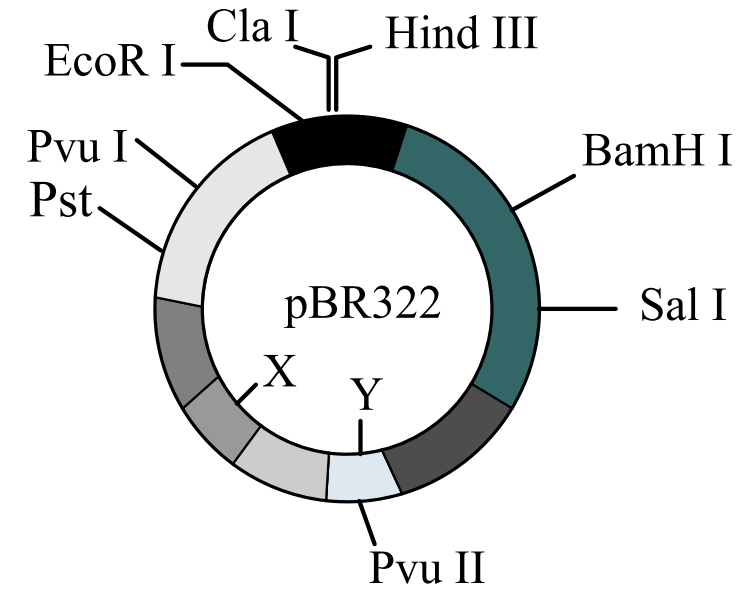 'X' represents ori (origin of replication), which is responsible for controlling the copy number of the linked DNA.
'Y' represents rop, which codes for the proteins involved in the replication of the plasmid.
Cloning Vectors – Insertional Inactivation
-
Plasmid pBR322 has PstI restriction enzyme site within gene $amp^R$ that confers ampicillin resistance. If this enzyme is used for inserting a gene for $\beta$-galactoside production and the recombinant plasmid is inserted in an E.coli strain
Plasmids
-
Maximum number of bases in plasmids discovered so far : -Plasmids vary greatly in size, from about 1 kilobase to several hundred kilobases.
Small cloning plasmids like pBR322 are about 4.4 kb, while large plasmids such as the Ti plasmid of Agrobacterium are about 200 kb, and some megaplasmids (e.g. in Rhizobium) reach about 500 kb or more.
So, as per the answer key, the maximum size of plasmids discovered (at that time) is about 500 kilo bases.
That is every question in Biotechnology: Principles and Processes for this filter.
Show all 132 questions Next: Biotechnology and its Applications
Want a score?
Answers here are not saved. Practise as a test to be marked and see your progress.
Practise as a test